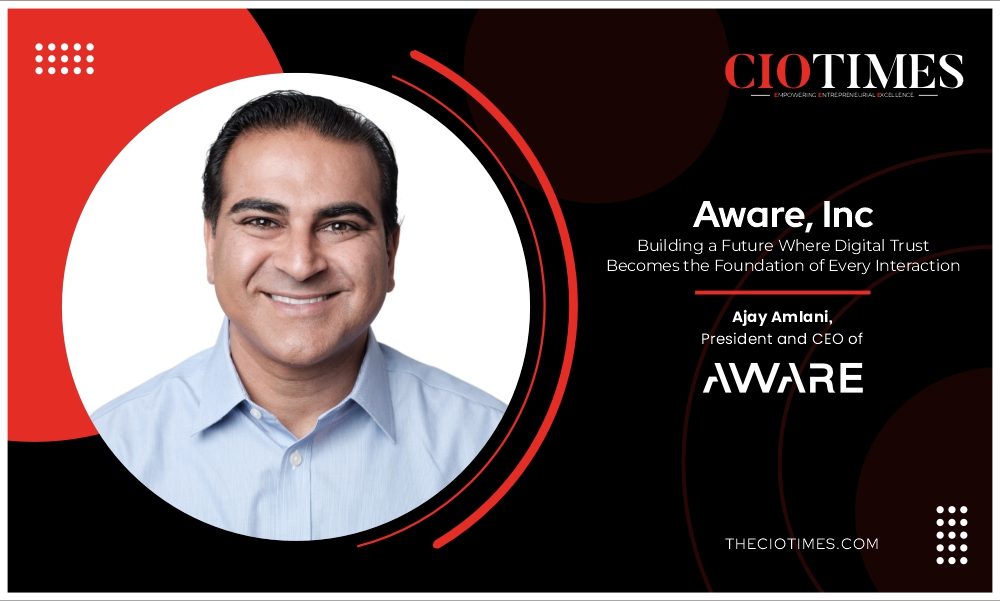
Biometric authentication systems are substantially leveraged for protecting access to sensitive information. As technology has evolved, individual human characteristics like fingerprints, facial recognition, or even iris scans are used as an alternative to conventional authentication technologies using passwords, PINs, etc. These solutions authenticate individuals using unique biological and behavioral characteristics. Leading providers like Ajay Amlani, President and CEO of Aware, Inc., deliver solutions that authenticate users through unique biological and behavioral characteristics while meeting demanding requirements for accuracy, privacy, scalability, and regulatory compliance. Organizations are voluntarily prioritizing dependable biometric solutions that balance security with convenience as identity fraud and cyber threats become increasingly sophisticated.
The Identity Architect
A distinguished leader in digital identity and biometrics, Ajay is a proven executive leader and entrepreneur with a distinguished record. He directs the strategic growth and operational excellence in secure identity solutions. He co-founded CLEAR, transforming airport security and consumer identity verification, and founded YOU Technology.
It is an AI-enabled coupon platform acquired by Kroger. His leadership portfolio includes senior roles at iProov, IDEMIA, and PayPal, complemented by public service contributions to the Department of Homeland Security and the Defense Innovation Unit. Recognized for visionary strategy, disciplined execution, and mentorship, Amlani continues to shape the future of enterprise technology and trusted identity ecosystems.
Digital Identity Pioneer
Aware, Inc. stands at the forefront of biometric intelligence, delivering enterprise-grade identity verification and fraud prevention solutions to global markets. Its flagship Awareness Platform unifies multimodal biometrics. It includes facial, fingerprint, palm, voice, and iris recognition. It includes AI-driven liveness detection to counter deepfakes, injection, and replay threats.
Designed for scalability and flexibility, the platform enables seamless orchestration of secure workflows without vendor lock‑in, empowering organizations to integrate trusted identity capabilities across diverse systems. Serving industries from aviation and border security to financial services and law enforcement, it transforms biometric data into actionable intelligence that enhances trust, compliance, and operational efficiency. With decades of expertise, the company continues to define the future of secure digital identity ecosystems worldwide.
Identity Architect
Aware has been a pioneer in biometric technology for nearly four decades. As digital identity continues to evolve, Ajay positions the company as a central architect in shaping the future of secure authentication. He underscores its legacy of advancing biometrics for some of the world’s most consequential identity programs, while emphasizing the opportunity to define the next generation of digital identity. He frames identity as the connective tissue of the digital economy, determining access to financial services, government benefits, healthcare, transportation, employment, and digital experiences. With automation and distribution accelerating, he highlights Aware’s role in enabling organizations to establish confidence that individuals are real, present, and authorized.
Sharing his vision, he adds, “I see Aware playing a central role in helping organizations establish that confidence without adding unnecessary friction. That means advancing accurate biometric matching and liveness detection, but it also means making identity systems more resilient through biometric orchestration.”
The future will not be defined by a single biometric modality or vendor, but by flexible ecosystems capable of adapting to evolving risks, regulations, and expectations. The company’s responsibility is to provide the intelligence and infrastructure that allow these ecosystems to operate securely, responsibly, and at scale.
His mission is extending beyond authentication. It is about reinforcing that biometrics reside in people, not credentials, and enabling trusted participation in society and the digital economy through advanced biometric innovation.
Trust Guardian
Artificial intelligence is reshaping identity verification. He positions Aware as a principled leader in harnessing its potential. He emphasizes that AI is a tool for strengthening, but never replacing, the rigor on which the Awareness Platform is built. Under his stewardship, the company’s R&D applies AI and machine learning to sharpen biometric accuracy. It also includes streamlining verification and countering emerging fraud, all while adhering to strict standards for data handling, model training, and validation.
Every AI application is governed by non-negotiable principles: human oversight, accountability, and transparency. High-stakes use cases undergo rigorous review and cross-functional sign-off to ensure compliance with security, privacy, and ethical standards. The result is faster, smoother verification for legitimate users, with accuracy, trust, and security firmly under human-governed control.
Ethical Identity Governance
In identity technology, innovation must advance in lockstep with privacy and compliance. He stresses that privacy and security are not opposing forces; when designed with rigor, they reinforce one another. Biometric data, being highly personal, demands deliberate governance in its collection, processing, and protection. Ajay points to principles such as data minimization, informed consent, transparency, and purpose limitation. It ensures organizations collect only what is essential, communicate usage clearly, and prevent unauthorized repurposing.
The role of technology is instrumental when it comes to safeguarding biometric templates through encryption, tokenization, access controls, and auditability.
He adds, “Biometric templates can be protected through encryption, tokenization, access controls, and other privacy-enhancing techniques.”
Orchestration capabilities are critical, providing centralized visibility and governance across workflows, eliminating fragmented systems and inconsistent policies. Ajay further asserts that responsible innovation requires ongoing engagement with customers, regulators, researchers, and communities, ensuring concerns are addressed proactively. He concludes that compliance alone is insufficient; identity systems must be secure, fair, explainable, and aligned with societal expectations.
Resilient Digital Trust
The most pressing challenge in digital trust is the dramatically reduced cost of creating convincing false identities. Generative AI now enables bad actors to produce realistic faces, voices, documents, and digital personas at unprecedented speed and scale. Organizations are no longer defending against stolen passwords alone but are facing identities, deepfake videos, injection attacks, and automated assaults capable of testing thousands of variations.
Many enterprises still rely on fragmented identity systems. Separate tools for onboarding, authentication, and fraud detection leave gaps in visibility across the lifecycle. These silos hinder risk assessment, rapid response, and consistent policy enforcement. He cautions that rising fraud often leads to added friction for all users, creating frustration and exclusion. Effective digital trust, he asserts, must enhance security while simplifying the experience for legitimate participants.
The solution lies in a layered approach combining biometric matching, advanced liveness detection, contextual risk signals, and adaptable workflows. Most critically, he frames identity as core infrastructure, not a point solution. Digital trust must be continuously evaluated, governed, and strengthened as threats evolve.
Adaptive Identity Solutions
Aware’s strength lies in serving a diverse customer base across government, financial services, healthcare, and enterprise sectors while ensuring adaptability to each industry’s unique requirements. While regulations, risk models, and user expectations differ, the common challenge remains establishing confidence in identity without unnecessary complexity. Government agencies must protect public funds, national security, and essential services; financial institutions must combat account takeover, money laundering, and synthetic identity fraud; healthcare organizations must safeguard sensitive patient data and ensure proper access. Also, enterprises must secure workforce identity, physical access, and high-value transactions. Rigid, one-size-fits-all systems cannot meet these demands, which is why adaptability defines the company’s approach.
He adds, “Our technology allows organizations to configure identity workflows according to the risk and context of a specific interaction. A low-risk event may require a seamless biometric check, while a higher-risk event may introduce stronger liveness detection, additional data sources, or human review.”
Organizations can integrate multiple biometric engines and identity technologies rather than being locked into a single configuration. Equally important is listening to customers as a driver of meaningful innovation, shaped by operational realities rather than procurement documents alone. The organization’s mission is to provide a flexible identity foundation that evolves with each company, enabling rapid response to new fraud patterns, regulatory changes, and business models without rebuilding infrastructure.
Identity Leadership
Since becoming President and CEO, Ajay’s immediate priority has been to sharpen clarity on where Aware creates the greatest value for customers and society. Uniting the company’s biometric science, trusted legacy, and experienced teams under a platform strategy that orchestrates the full identity decision process, moving beyond individual capabilities.
He adds, “We are focused on making the Awareness Platform an intelligent control plane for biometric identity. Through configurable workflows, advanced matching, liveness detection, partner technologies, and real-time decisioning, organizations can manage identity more consistently across multiple use cases.”
He identifies deepening engagement with the public sector as critical, noting government institutions face complex identity challenges yet often rely on slower-moving technology.
A Trust Advantage
Customer trust is increasingly becoming a competitive advantage. Aware ensures that trust remains central to every product, partnership, and innovation it delivers. Trust is earned through consistency, by repeatedly delivering technology that performs as expected, protecting sensitive information, and being transparent about both capabilities and limitations. This begins with accuracy and reliability.
Ajay adds, “Customers use our technology in environments where identity decisions can have serious consequences. A false acceptance may enable fraud or unauthorized access, while a false rejection may prevent a legitimate person from receiving an essential service.”
This responsibility requires rigorous testing, continuous improvement, and a deep understanding of real-world operating conditions. It also shapes Aware’s approach to partnerships. He explained that the company seeks to work with organizations that share its commitment to security, interoperability, and responsible innovation. The goal is to create an ecosystem in which each capability contributes to stronger and more transparent identity decisions for customers.
Customers should retain flexibility. It can be undermined when organizations become locked into systems that no longer meet their needs. Through biometric orchestration, Aware enables customers to optimize technologies and workflows while preserving centralized governance. Most importantly, the ultimate stakeholder is the individual whose identity is being verified.
The best identity systems should protect people without making them feel powerless or surveyed. They should offer appropriate transparency, consent, and recourse. Trust cannot be added as a feature at the end of development. It must influence how products are designed, how partnerships are selected, and how success is measured.
Harmonizing the Future Operations
The digital identity ecosystem is skyrocketing. It is exhibiting advancements in biometrics, decentralized identity, and post-quantum security. The unfolding movement from periodic identity verification to continuous, context-aware identity assurance is the most instrumental. Historically, organizations verified someone at onboarding and then relied on passwords or static credentials for every engagement after that. That model is increasingly insufficient.
Ajay ceo of the Aware states, “Identity systems will need to evaluate trust dynamically based on the person, device, transaction, environment, and level of risk.”
Biometrics will keep being at the forefront of this shift as a translation layer between a credential and the human being authorized to use it. The team at Aware also witnesses increased adoption of reusable digital credentials and decentralized identity models. These approaches can give individuals greater control over their information and reduce the need to share sensitive data repeatedly.
A major development will be the rise of autonomous AI agents. In the future, organizations will ask for authorized digital agents to represent them. The identity ecosystem will expand from Know Your Customer to include Know Your Business and Know Your Agent.
Post-quantum security will also require long-term planning. Organizations must understand where sensitive identity information is stored and how it is protected against future cryptographic risks. Across all these trends, orchestration will become increasingly important. Businesses will need a flexible layer that connects credentials, biometrics, risk signals, policies, and emerging technologies without forcing them to rebuild their systems each time the market changes.
Global Identity Vision
Ajay has a long-term vision for Aware : to serve as the trusted intelligence and orchestration layer underpinning the world’s most critical identity systems. Today’s identity market remains fragmented, with organizations deploying disparate technologies for onboarding. It also includes authentication, fraud prevention, access, and compliance. Operating in silos, these systems hinder holistic risk visibility and slow response to evolving threats.
The organization is at a stage where it can deliver a platform through which enterprises can design, deploy, monitor, and continuously refine biometric identity workflows.
He shares his vision, saying, “We want our customers to have the freedom to select the right technologies while gaining the governance, visibility, and intelligence required to operate them confidently.”
On the global scale, the societal impact of trusted identity proves instrumental. Secure identity can expand access to banking, healthcare, government services, transportation, and economic opportunity. It can shield vulnerable populations from fraud, help governments safeguard public resources, and enable organizations to deliver safer digital experiences.
An important point of discussion in the conversation was also about identity technology being deployed responsibly. The ambition is to make interactions more effective, secure, and streamlined. Aware mission is to establish a model where strong security and human‑centric design are not viewed as trade‑offs. The future of identity should instill greater confidence in organizations while providing individuals with safer, more convenient ways to participate in modern society.
Translating Innovation Through Leadership
Ajay’s career has taken him through creating successful startups, scaling technology enterprises, and serving in the U.S. government on national security and defense innovation. All of this has been a crucial part in molding his leadership philosophy. He shares his opinion that valuable innovation rests on three pillars: a mission of consequence, teams empowered to challenge assumptions, and the discipline to translate ideas into operational excellence.
Aware as a cofounder and inventor of CLEAR, he demonstrated how a bold concept could redefine an experience millions had accepted as inherently slow and frustrating. By asking whether identity technology could simultaneously strengthen aviation security and improve convenience, he learned that the most transformative innovations often advance both protection and user experience.
Founding YOU Technology reinforced the importance of understanding customer behavior and building solutions that integrate seamlessly into daily life. The company’s acquisition by Kroger underscored how a focused team and mobile‑first strategy can generate value at scale.
His tenure in government added another dimension to his perspective. As a White House Fellow and Senior Policy Advisor at the Department of Homeland Security, he worked on biometric security initiatives with direct implications for national security and public trust. He later helped establish the Department of Defense’s Defense Innovation Unit, designed to connect government missions with the speed and creativity of the commercial technology sector. These experiences shaped his conviction that leaders must serve as translators bridging technologists with policymakers, missions with markets, and long‑term vision with near‑term execution.
Guiding Values
His career was at the intersection of innovation, business growth, and public service. These have been his enduring values that shape decisions during periods of transformation and uncertainty. The principles he shared are as follows:
1. Purpose
In volatile environments, organizations often become reactive. They chase immediate opportunities without direction. A clear mission enables leaders to separate activity from meaningful progress and maintain focus on outcomes of consequence.
2. Integrity
Trust is painstaking to build yet fragile to sustain. This is peculiar in identity, security, and public service. Leaders must communicate with candor, acknowledge ambiguity, and make decisions that withstand scrutiny even when expedience may appear more appealing.
3. Empathy
Technology, he explained, affects customers, employees, citizens, and communities, each experiencing systems differently. Empathy compels leaders to ask sharper questions: Who benefits from this decision? Who might be excluded unintentionally? What burden is placed on the user?
4. Courage and intellectual humility
Innovation requires the courage to challenge entrenched practices, but equally the humility to adapt when new evidence demands a shift in perspective. The strongest teams, he observed, are not those in unanimous agreement, but those capable of debating rigorously while remaining united around the mission.
Service is a defining principle for him. Whether building a company or contributing to government, leadership must ultimately improve outcomes for others. This commitment also informs his involvement with the Women’s Coaching Alliance, which develops young women through coaching and mentorship. The periods of transformation test an organization’s values, yet they also provide the greatest opportunity to demonstrate that those values are authentic and enduring.
Empowering Future Leaders
Ajay’s advice to the next generation will be about clarity of mission. Entrepreneurship is often framed around valuations, funding rounds, or personal recognition. Those measures alone cannot sustain a team through periods of adversity. A problem of genuine consequence creates resilience and long-term commitment.
He advises leaders to voluntarily be around individuals who strengthens complement their own. The role of a leader is to assemble diverse talent, provide context, and empower decisive action. He encouraged emerging leaders to seek environments that challenge assumptions. His own career across startups, large corporations, and government demonstrated that each sector offers lessons the others can adopt. The private sector contributes speed, experimentation, and customer focus; government brings mission, scale, and a deep sense of public responsibility.
Lasting progress often emerges when these worlds collaborate. Mentorship is equally vital. No one advances alone, and leaders should seek mentors who provide unvarnished truth rather than affirmation. As careers develop, at Aware he urged leaders to deliberately create opportunities for others, particularly those who may lack access to networks or support. He also stressed the importance of remaining close to the people affected by decisions. While data is essential, leadership requires listening, empathy, and judgment. A lasting legacy is not defined solely by the companies one builds, but by the problems solved, the people developed, and the trust left behind.
Also Read :- CIO Times Magazine For More information