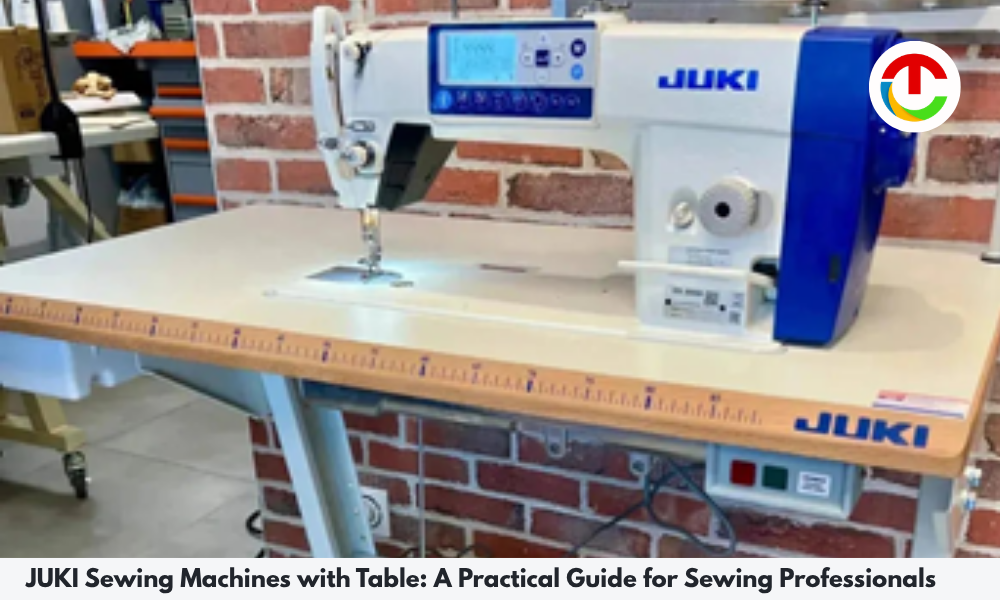
If you are looking for a reliable, ready-to-use sewing setup, JUKI sewing machines with table can be a practical choice for home workshops, tailoring businesses, upholstery work, and other sewing applications. A complete machine-and-table setup provides a stable workstation while eliminating the need to find a suitable table separately. You can explore available models and configurations in the JUKI sewing machines with table collection: https://prizzisewing.com/collections/juki-sewing-machines-with-table.
Why Choose a JUKI Sewing Machines with Table?
JUKI is known for producing both household and industrial sewing machines. Its industrial range includes lockstitch, overlock, flat-bed, post-bed, and other specialized machines, while its household range includes computerized and electric models designed for sewing, quilting, and general projects.
Choosing a machine that comes with a table offers several practical advantages:
1. Better stability:
A dedicated table helps keep the machine firmly positioned during operation.
2. More workspace:
The tabletop provides additional room for handling fabric, patterns, and sewing accessories.
3. Improved ergonomics:
A properly sized sewing table can create a more comfortable working position during extended sewing sessions.
4. Convenient setup:
Buying the machine and table together can simplify installation and workstation preparation.
5. Professional appearance:
A dedicated sewing station creates an organized workspace suitable for both personal and commercial use.
Popular Types of JUKI Machines with Tables
The right machine depends largely on the type of material and sewing you plan to handle.
1. JUKI Lockstitch Machines
Lockstitch machines are widely used for general sewing and garment production. JUKI’s industrial lineup includes models such as the DDL-8700 and DDL-9000C series.
These machines can be suitable for projects involving clothing, textiles, alterations, and production sewing. A table-mounted configuration provides a stable platform for maintaining consistent sewing speed and fabric control.
2. JUKI Heavy-Duty and Walking-Foot Machines
For thicker materials, a heavy-duty machine can be more appropriate. Models such as the JUKI DNU-1541 are designed around applications requiring greater material-handling capability. The DNU-1541 is part of JUKI’s industrial flat-bed range.
These types of machines may be considered for upholstery, canvas, leather-related work, and other demanding sewing applications, depending on the specific machine configuration, needle, thread, and material.
3. JUKI Overlock Machines
Overlock machines are designed to finish fabric edges and help prevent fraying. JUKI offers industrial overlock and safety-stitch machines in several configurations.
For businesses producing garments or working extensively with knit fabrics, an overlock machine can complement a conventional lockstitch machine.
What to Consider Before Buying?
Before choosing a JUKI sewing machine with a table, consider the following factors:
1. Material type
Determine whether you will primarily sew lightweight fabrics, medium-weight materials, or heavy fabrics. The machine’s specifications should match the materials you expect to use.
2. Sewing application
Garment construction, alterations, quilting, upholstery, leatherwork, and production sewing can require different machine types.
3. Motor configuration
Industrial machines may be supplied with different motor and control configurations. Consider whether you need a conventional setup or features such as direct drive and electronic controls.
4. Table and stand construction
The table should provide sufficient stability for the selected machine. Check that the stand, tabletop, motor, and machine head are compatible.
5. Available workspace
Measure your workspace before ordering. Industrial sewing tables generally require considerably more room than portable household machines.
6. Accessories and included components
Check what is included in the package, such as the table, stand, motor, sewing machine head, pedal, accessories, and other components. Package contents can vary between configurations.
JUKI Industrial vs. Household Sewing Machines
JUKI produces machines for very different sewing environments. Its household lineup includes computerized machines with features such as automatic thread trimming, multiple stitch patterns, and quilting functions.
Industrial JUKI machines, on the other hand, are designed for production environments and specialized sewing tasks. JUKI describes industrial machines as being built for sustained use and consistent seam quality across a variety of materials.
Therefore, a machine with a table should not be selected simply because it has a larger or more powerful appearance. The best configuration depends on your sewing requirements, material thickness, production volume, and available workspace.
Setting Up a JUKI Sewing Workstation
Once you have selected the machine, proper workstation setup is important. Place the table on a stable, level surface and make sure there is adequate space around the machine. The operator should be able to reach the controls and foot pedal comfortably without excessive stretching.
Keep frequently used accessories within easy reach, while maintaining enough open tabletop space to guide larger pieces of fabric. Good lighting is also useful, particularly when working with dark fabrics or detailed stitching.
Conclusion
A JUKI sewing machines with table can provide an organized and stable solution for serious sewing projects. From general-purpose lockstitch machines to heavy-duty and specialized industrial models, JUKI offers a broad range of machines for different applications.
When choosing a complete setup, focus on the materials you sew, the type of work you perform, required production capacity, motor configuration, and the size and quality of the table. Reviewing these factors before purchasing can help you select a workstation that fits your sewing needs and workspace.
Also Read :- How to Choose the Right Watch Size for Your Wrist