Most digital transformation problems are not really about technology. They are about the friction nobody planned for; the finance team still copying numbers between spreadsheets long after a new system was supposed to end that, or the warehouse floor that never quite knows what is in stock. Companies buy the software. The friction however, stays.
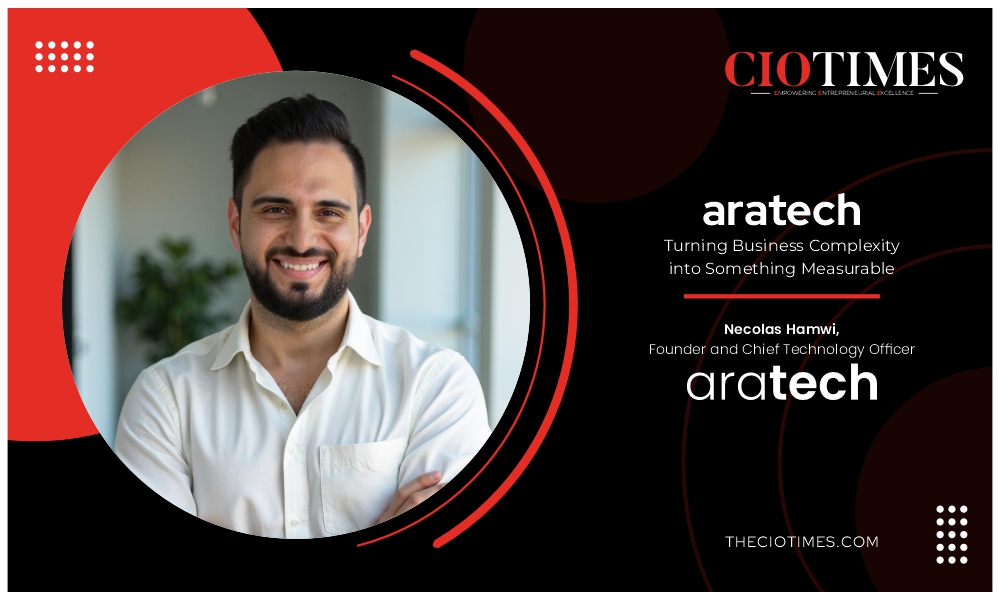
Necolas Hamwi, Founder and Chief Technology Officer of aratech, built a company around that gap. Since 2011, aratech has taken on a version of the same problem in different disguises. Necolas frames it simply: “businesses drown in complexity the moment they try to go digital.”
In the company’s earliest days, that meant a client whose website barely worked and who wanted to run a simple campaign without losing their mind over it. The stakes have grown considerably since, he says, but the story underneath has stayed the same.
The underlying problem hasn’t changed, in Necolas’s telling. What’s grown is the toolbox available to solve it. aratech started as a web and creative shop. A client needed a capability the company did not yet have, so it built one. A banking client needed ATM interfaces sturdy enough to survive a regulator’s scrutiny, which pushed the company into compliance work.
Clients kept asking aratech to unify operations that had grown into a patchwork of separate tools, and that demand eventually led the company to become an official Odoo partner. Today aratech’s services extend into AI, process automation, security auditing, and local AI servers. Necolas is quick to point out where each addition came from: “every one of those came from a real client with a real problem, not from a marketing roadmap.”
The mission, as he describes it, has not moved. Take the manual, repetitive work a business tolerates every day and turn it into something clean and measurable. Fifteen years in, aratech simply has more tools for doing it.
Redefining Digital Transformation
Ask Necolas what meaningful transformation looks like, and he skips the technology entirely. It looks like a finance team that stops working late at month-end because the numbers finally live in one place. That, to him, is the whole test.
Most digital projects fail in an unremarkable way, he argues: a company buys software, implements half of it, and ends up with a new layer of complexity stacked on the old one. Nothing gets easier. It only gets more expensive.
So aratech’s process starts before any technology is touched, mapping how work actually moves through an organization: where it enters, who approves it, what breaks on a bad day. The team automates the boring, repetitive tasks first, because that is where relief is felt immediately, then hardens the result with logging, retries, and alerts so it does not quietly fall apart months later.
When the company implements Odoo, Necolas says, it spends as much time studying how a team works as deciding which modules to activate. A dashboard that looks impressive but leaves a rogue spreadsheet running in the warehouse six months later is not, in his view, a finished job.
One Engine, Many Markets
aratech’s projects have carried it across borders, and Necolas treats that reach as an architecture problem rather than a geography problem. The core logic of a build should not care which market it is running in. Only the layer a customer actually touches should change, built to be swapped or localized without disturbing the engine underneath.
The company’s ATM interface work makes the point concretely. A bank in Riyadh and a bank in Dubai might run on the same platform, but the experience in front of a customer cannot feel identical: different languages, different reading directions, different expectations about how things should look.
aratech builds the interface as a system with right-to-left and left-to-right support, multilingual copy, and culturally appropriate icons stored as structured content rather than hardcoded strings. One engine, a different feel depending on where it lands.
The same logic carries into Odoo implementations. Chart of accounts, tax rules, and compliance requirements shift from one country to the next, but the underlying business logic, inventory, CRM, projects, stays consistent.
aratech configures per market instead of rebuilding per market. Being globally scalable does not mean one size fits all, Necolas is careful to add. It means a system flexible enough to respect a local requirement without forking the codebase into a maintenance nightmare.
Breaking Down the Handoff
Necolas came up through front-end development and UX before growing into backend engineering, automation, and AI, and he credits that path with a habit he has never shaken: seeing every product through the eyes of the person using it. He puts it bluntly: “A technically flawless app nobody uses is a failure. A gorgeous design that can’t scale is a liability. A marketing campaign that funnels people into a broken checkout is just lighting money on fire.”
That belief is why aratech keeps technology, UX, marketing, and business strategy under one roof, rather than splitting them across specialist firms. In Necolas’s experience, value leaks out at the handoff: a design shop delivers something beautiful, a development shop builds something close but not quite right, a marketing team runs campaigns against a page nobody optimized.
By the time the pieces are stitched together, months are gone, and so is the original idea. When the same people who understand a client’s business also design the interface and build the backend, that gap disappears, turning a project into what he calls a growth engine instead of just another deliverable.
Two Kinds of Risk
aratech’s client list spans fast-moving startups and established names like Aldar and Aramco, and Necolas draws a sharp line between how the company builds for each. The difference, he says, comes down to what each side is actually risking.
A high-growth startup needs speed and the room to change its mind. It is testing the market and cannot afford to wait six months for perfection, so aratech builds for velocity: rapid prototyping, clean minimum viable products, modular pieces that can be refactored later without guilt. Some shortcuts get revisited down the line, a tradeoff Necolas accepts because the alternative is launching too late to matter.
An established brand is risking something else entirely: reputation, compliance, uptime. Nobody moves fast and breaks things while building an ATM interface for a bank or integrating with an enterprise resource planning system.
As Necolas describes it, “The work is more deliberate. More testing, more documentation, more governance. That’s not bureaucracy, it’s respect for what’s at stake.” He is just as clear about what stays constant across both kinds of clients: “What never changes is the obsession with the end user. A startup’s first hundred customers and a bank’s millions of customers both deserve something that just works. It’s the risk tolerance around the build that shifts, not the standard.”
Built to Be Modified
Necolas is skeptical of “future-ready” as a label companies chase without earning it. He says, “Future-ready is about how cleanly the pieces are separated, not which tools you picked.” A headless CMS only earns the label if its content is actually structured.
A cloud deployment only earns it with real observability and a recovery path. The trap, he says, is adopting a trend without solving the architecture underneath: moving to the cloud but dragging the monolith along, going headless but welding presentation logic into the content layer, coupling every service to every other one.
aratech designs against that pattern: loose coupling, clear ownership of data, infrastructure as code. Necolas offers advice clients do not always want to hear: “use boring, proven technology on the critical path, and save the shiny new stuff for the edges.” In his framing, “The architecture that’s still standing in five years is the one that was built to be modified; not the one that was built on whatever was trending the week it launched.”
The same horizon extends to competitiveness broadly. He names three capabilities that will separate the organizations that keep up from the ones that stall: clean, accessible data rather than scattered spreadsheets, automation robust enough to survive contact with production, and the discipline to bring AI into an existing stack instead of ripping it out.
On the first, he credits Odoo as the reason aratech pushes clients toward a unified platform: “one database, one source of truth, no more arguing about whose number is right.” On the third: “We’re not trying to replace the stack; we’re trying to make the stack smarter.”
Where Transformation Actually Fails
Asked what businesses overlook most when technology outpaces their ability to adopt it, Necolas doesn’t hesitate: “People. Every single time.” The technology, in his experience, is the easy part. The hard part is convincing fifty or five hundred people to change how they work on a random Tuesday.
Companies buy the platform, hire the consultants, run a training session or two, then act surprised when half the team is quietly back on spreadsheets six months later. The failure, in his view, is rarely the software. Nobody dealt with the human side: the fear of losing control, the comfort of the old process, the absence of a reason that matters to each person.
So, when aratech implements Odoo, it spends as much energy on adoption as configuration, finding the champions who will carry the change forward, making sure their first encounter with the new system feels like a win rather than a headache. It stays available through the transition, because the questions that matter rarely surface during the demo. They come up three weeks after go-live. Necolas says, “Most tech companies deliver and vanish. We try hard to be the exception.”
Across more than 100 projects and 200 campaigns, that same distinction separates a successful project from a genuine catalyst, in his view. A brief to build an e-commerce site produces exactly that: a site that works. A brief to help a client hit ten thousand online orders a month pulls in catalog structure, checkout flow, payments, marketing automation, and analytics until the project stops being a website and becomes a growth engine.
The projects that made that leap shared traits: the client let aratech challenge the brief, the team measured everything from day one, and the platform evolved as the business learned. Necolas says, “Growth isn’t a feature you ship. It’s a discipline you build into the process from the very first conversation.”
Trust Shows Up When Things Go Wrong
Delivering a project smoothly is not, in Necolas’s estimation, where trust gets built. As he puts it, “Trust shows up when things go wrong, not when they go right.” The real test comes when a server fails at midnight, a campaign underperforms, or a third-party update breaks an integration nobody saw coming. That is the moment a client learns whether they hired a vendor or a partner.
aratech offers ongoing technical support retainers for that reason, monitoring and adapting what it builds rather than treating delivery as a finish line. The other half of earning trust, Necolas says, is less comfortable: telling clients when a feature is a bad idea, even if it costs a change order, and pushing back on unrealistic timelines.
That candor loses aratech projects occasionally, but the clients who stay wanted a partner in the first place. Fifteen years in, Necolas is blunt about what separates the agencies that last from the ones that fade: “The market is full of agencies that rebrand every two years, chase every trend, and pitch the same generic solutions in shinier slide decks.” aratech’s own positioning, by contrast, is deliberately unglamorous: the team called when a project is complicated, the stakes are high, and it simply has to work. He sums it up simply: “Trust is built one honest conversation and one resolved incident at a time.”
The User’s Eyes
Necolas’s own path, from front-end development and UX into the CTO role, still shapes how he approaches every system aratech builds. He says, “The user does not care about your architecture. They care that the button works, the page loads, and the whole thing doesn’t feel like it’s fighting them.” Whether designing an Odoo implementation or an AI agent, he starts with the person on the other end and works backward to the technology.
As he puts it, “The architecture serves the experience, never the other way around.” He pushes his team the same way, insisting they think in outcomes rather than outputs. Shipping a feature is not success in his view. A client’s team actually using it, and finding their week a little shorter because of it, is.
He stays curious by staying hands-on, prototyping and testing new tools before any of it gets near a client. He wrote a book titled ‘AI Fatigue Is Real: How to Break Free from the Overwhelm, Reclaim Your Focus, and Find Peace in the Age of AI’ that talks about the gap between the hype and the reality. Necolas also built Eva, aratech’s own AI assistant, to see how far autonomous AI could be pushed inside a real business rather than just reading about it.
The discipline that keeps the company from running in circles, he says, comes from the people around him: “Toni runs projects with a rigor I couldn’t sustain alone. Ibrahim architects systems that scale in ways I wouldn’t think of. Farah and Seba build backends that hold up under real pressure.” His own job, as he sees it, is to set the direction, protect the culture, and make sure the company never stops learning. As he puts it, “But the curiosity is what keeps us moving forward, and the discipline is what keeps us from running in circles.”
Also Read :- CIO Times Magazine For More Information