Would we still want to solve this problem if AI were unavailable?
That’s the question I’d ask before a company spends money on an AI project.
In my recent work with the AI Business Enablement team of a major international wholesaler, I’ve been exploring a recurring mistake. People arrive with an AI solution already in mind, without having investigated what’s causing the business problem.
And that can become expensive.
If poor performance comes from missed maintenance, unreliable data, or a broken process, investing in a sophisticated AI system won’t necessarily fix it. The company could spend time and money developing technology while the original problem remains.
For CIOs, that raises a difficult question:
How do you decide which projects deserve investment when teams haven’t established what actually needs fixing?
I believe the answer starts with a better way to assess these proposals, one that examines the business problem first, tests whether AI is the right solution and then decides where investment makes sense.
The Problem With Starting From an AI Portfolio Review Solution
Look at the kinds of proposals that might appear on an AI investment list. One team wants an AI agent for IT support. Another suggests a sales forecasting model. A third proposes predictive maintenance.
Each idea sounds promising, but what is the business trying to improve?
One team might demonstrate impressive model accuracy. Another estimates how many hours its system could save.
Yet neither tells the CIO enough about the causes of the problem, the potential business value or whether a simpler solution would work better.
Before discussing technology, I’d want the team to explain what’s going wrong, what evidence supports that assessment and who is responsible for improving the result.
Otherwise, we’re evaluating the proposed technology without knowing whether it addresses the right problem.
The AI Problem Portfolio Method turns that principle into three practical stages:
1. Identify:
Define the business problem, establish the performance gap and investigate its causes for AI Portfolio Review,.
2. Evaluate:
Compare AI with other possible solutions and determine which intervention makes the most sense.
3. Prioritize:
Decide which projects deserve investment based on business value, feasibility and risk.
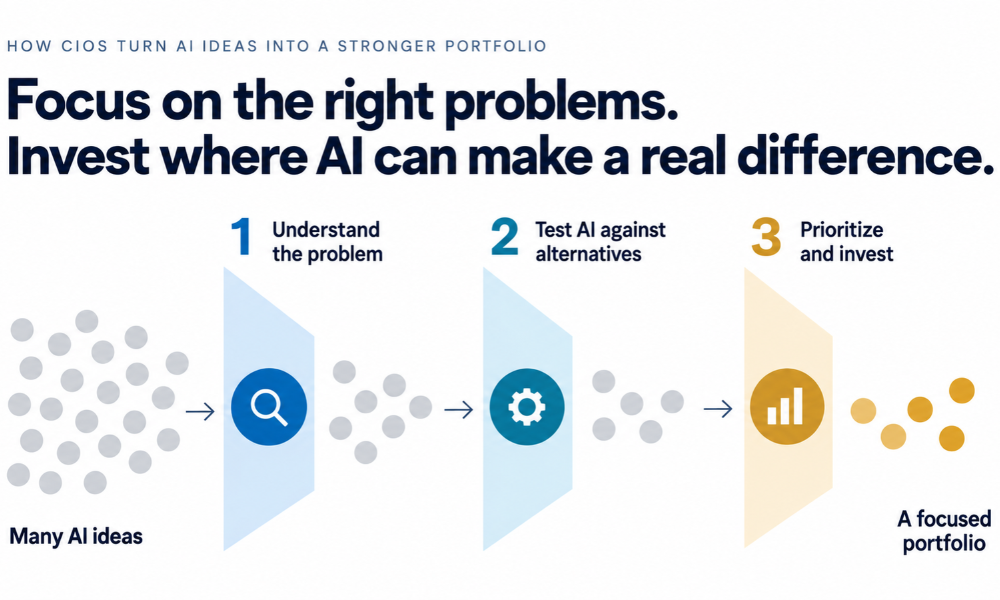
The CIO establishes how proposals are assessed, while business managers remain responsible for the results.
Stage 1: Find Out What Is Really Going Wrong
Test the predictive maintenance proposal
Take a hypothetical wholesaler proposing AI to predict refrigeration failures across hundreds of stores.
The intended outcome is less unplanned downtime. Overdue servicing, aging equipment and delayed spare parts are possible causes.
But the team has not established which, if any, explain the failures. It needs a baseline and evidence from maintenance logs, repair records and parts lead times before deciding on an AI model.
| What arrived | What the CIO needs to evaluate |
| “Build AI to predict refrigeration failures.” | “What drives avoidable downtime, what does it cost, and which intervention could reduce it?” |
Depending on the evidence, the answer could involve better maintenance execution, equipment replacement or AI-assisted prediction.
Before estimating model accuracy, the next review should ask for a breakdown of outage hours by equipment age, servicing history and repair delays.
Those records would show whether predicting failure is the missing capability.
What should a one-page problem brief show?
Every sponsor should bring the same one-page brief to review, covering six essentials.
- User and owner: Who faces the problem, makes the decision, and owns the result?
- Decision or workflow: What judgment, action, or handoff needs improvement?
- Observed friction: What goes wrong, and what evidence supports it?
- Baseline and value: Which cost, delay, quality, risk, or revenue measure could change?
- Constraints: Which policy, privacy, security, timing, or explainability limits apply?
- Success boundary: What counts as success, and what is outside scope?
Use this template when the evidence exists:
For [user or owner] making [decision], [evidenced friction] causes [measurable consequence]. Improve [outcome] within [key constraints].
If records confirm that missed servicing contributes to failures, the statement could address facilities managers scheduling inspections, missed maintenance, and avoidable outage hours.
Until then, those are hypotheses to test.
That is the value of defining the right business problem before using AI. It keeps the choice of intervention open.
Stage 2: Make AI Portfolio Review Compete With the Alternatives
Once root causes are understood, the options are easier to compare.
Missed inspections suggest stronger maintenance execution; aging assets may need replacement.
If failures remain unpredictable after those problems are addressed, predictive AI deserves a closer look.
I would use five evaluation gates before putting a proposal into the investment ranking.
- Value clarity: Is there a credible baseline, a named owner, enough affected volume, and a measurable benefit?
- AI task fit: Does the work benefit from prediction, classification, generation, or pattern detection? Would rules, analytics, automation, or process redesign be better?
- Data readiness: Are records accessible, representative, reliable, lawful to use, and timely?
- Workflow readiness: Can the output reach someone able to act, and can the process accommodate it?
- Control readiness: Are potential harms, reversibility, human oversight, monitoring, escalation and audit requirements understood?
A warning is useful only if the maintenance team can respond. False alarms waste specialist capacity, while missed failures can have serious operational consequences.
The NIST AI Risk Management Framework 1.0 offers a voluntary reference for risk governance and oversight. The same governance questions appear in CIO Times’ discussion of AI, data and risk management in regulated digital services.
Before moving on, I’d ask two stop questions:
- Would the organization still want to solve the problem if AI were unavailable?
- Can the business owner describe what action changes when the system produces an output?
A weak answer calls for further diagnosis, workflow redesign, or a bounded test rather than immediate investment.
Stage 3: Decide What Deserves Investment
Candidates that pass the gates still compete for budget and management attention. Now the CIO needs a consistent way to compare them.
Score candidates from one to five across six dimensions, support each rating with evidence, and adjust weights to strategy and risk appetite.
| Dimension | Weight | Hypothetical refrigeration score |
| Business value | 30% | 4 |
| Strategic relevance | 15% | 4 |
| Data readiness | 15% | 3 |
| Workflow and adoption readiness | 15% | 3 |
| Delivery feasibility | 10% | 3 |
| Risk manageability | 15% | 3 |
Scores are illustrative, assume the proposal has passed the gates, and represent no actual project results. A higher risk-manageability score means the risks are easier to govern.
That produces 3.45 out of 5 in this hypothetical.
A serious unresolved safety issue still blocks deployment. I would ask what evidence supports each rating and what could change it.
Without that explanation, the spreadsheet can make shaky judgment look more scientific than it is.
If reviewers disagree, keep the assumption visible until it has been tested. A written rationale helps the committee revisit its decision when new information arrives.
Every review should produce one of four decisions.
- Commit now when the opportunity is valuable and the organization is ready to deliver it responsibly.
- Run a bounded test when a controlled experiment can answer a specific open question.
- Prepare the foundations when data, workflow or governance work must come first.
- Stop when the case is weak, or another intervention is a better use of resources.
For refrigeration, the decision might be to improve records before testing prediction or to fix parts availability instead. Name the owner, the evidence that would change the decision, and the date for review.
Teach Managers to Challenge the Solution (Not Just Present It)
The CIO cannot diagnose every proposal.
Managers need practice challenging their preferred technology, particularly once a prototype has gained internal support.
I’d use real proposals in coached reviews. Each manager should submit a problem brief, defend the evidence, compare a non-AI option and identify failure modes and an implementation owner. Then ask what evidence would change their recommendation.
The hypothetical refrigeration case offers a useful test. If a model predicts a fault tomorrow, who can authorize an inspection, and will the part reach the store in time? The answer reveals whether the prediction can change an operational decision.
Measure decision quality and follow-through, rather than attendance at AI training.
A Better Question for the Next AI Portfolio Review
At the next AI portfolio review, remove the model and vendor names from the first five proposals and read what remains. If a proposal still identifies a user, a decision, evidenced friction, a baseline, constraints and an accountable owner, it deserves evaluation.
If it collapses into “use AI to improve X,” send it back.
That is the CIO’s leverage point: build a portfolio around problems the enterprise can explain, compare, govern and own before serious resources are committed.
Author Bio

Flavio Soriano is an entrepreneur, educator and former management consultant who spent five years at Arthur D. Little and McKinsey & Company. He has founded five businesses and trained more than 10,000 professionals in consulting-grade problem-solving, communication and career development. As founder of High Bridge Academy, he leads a global faculty of more than 60 former McKinsey, Bain and BCG consultants, helping professionals and teams strengthen structured thinking, executive communication, stakeholder management and the practical use of AI at work.