SOC 2 software connects to the tools your company already runs and gathers the evidence a SOC 2 auditor will ask for, then keeps checking those controls so problems show up before the audit does. In 2026, the best SOC 2 software, in the order below, is Scytale, Secureframe, Sprinto, Thoropass, Scrut Automation, Oneleet, Strike Graph, Hyperproof, Drata and Vanta.
The software gets you ready for the audit and keeps you ready afterwards. What separates the ten is who does the work it can’t, such as scoping the program, fixing what fails and answering the auditor’s questions. Some leave that with your team, and others put people next to you until the auditor signs off.
Sources and dates behind this list
Each vendor’s website and help documentation supplied the features, and G2 supplied the ratings, all checked in late October 2026. The list relies on that published information, not on hands-on testing, so confirm anything that matters to you in a demo.
What is Best SOC 2 Software ?
Under the hood, most Best SOC 2 Software do the same five jobs, measured against the AICPA’s Trust Services Criteria:
- It pulls evidence such as MFA settings, access reviews and backup logs from your systems on a schedule, so nobody has to screenshot consoles the week before fieldwork.
- It keeps testing controls after the first audit and alerts the owner when a setting drifts, such as a storage bucket that someone made public.
- It ships policy templates, tracks who has signed them and runs security awareness training.
- It gives your auditor a read-only view of the evidence and any open requests.
- On most platforms in 2026, AI agents now take on part of that work, such as checking evidence or drafting answers for security questionnaires.
Does Best SOC 2 Software include the audit?
No. A SOC 2 examination and the report that comes out of it, an attestation about how your controls work, are the work of an independent CPA firm. Some vendors bundle the audit through an affiliated firm, and others coordinate it inside the platform with an audit partner, but the attestation always comes from the auditor. Picking the software doesn’t settle who audits you, so decide that early.
Which kind of Best SOC 2 Software provider do you need?
Most companies need two providers: one to get ready and stay ready, and a CPA firm to run the audit.
| Provider type | What it does | Issues the report? | Best for |
| Self-serve compliance software | Automates evidence, monitoring and policies; your team handles scoping, fixes and auditor questions | No | Teams with someone who has run SOC 2 before |
| Software with dedicated experts | Software plus a GRC expert who scopes the program, guides fixes and reviews the work before the audit | No | Growing companies without a full-time compliance lead |
| Software with an in-house audit firm | Readiness on the platform, then the audit from the same company’s CPA practice | Yes, through its own firm | Buyers who want one contract for readiness and audit |
| Enterprise GRC platform | SOC 2 as one program inside wider risk, audit and compliance work | No | Large companies with internal audit teams |
| CPA audit firm | Tests your controls and signs the SOC 2 report | Yes | Everyone who needs the report, every year |
Best SOC 2 Software at a glance
For most growing companies, the strongest choice is a platform that comes with expert help, because the slow part of a first SOC 2 is deciding what to fix and how to prove it.
| Platform | Who does the work | Best for | G2 rating (late Oct 2026) |
| Scytale | AI GRC agents plus a dedicated GRC expert | Organizations from startups to enterprise wanting SOC 2 done alongside them | 4.8/5, 700+ reviews |
| Secureframe | Automation with expert-supported onboarding | First-time teams that want a guided setup | 4.7/5, 840 reviews |
| Sprinto | Automation-first, with guided onboarding | Cloud-native startups after a fast first report | 4.7/5, 1,685 reviews |
| Thoropass | Platform plus its own audit firm | Buyers who want readiness and audit from one vendor | 4.7/5, 586 reviews |
| Scrut Automation | Configurable automation with hands-on support | Mid-market teams building a risk-first program | 4.9/5, 1,338 reviews |
| Oneleet | Platform, human penetration tests and a vCISO | Engineering-led startups that want security testing bundled | 4.9/5, 140 reviews |
| Strike Graph | AI-assisted, risk-based program your team runs | Security teams designing controls around their own risks | 4.6/5, 197 reviews |
| Hyperproof | Your compliance team, with AI assistance | Teams running SOC 2 next to several other programs | 4.5/5, 225 reviews |
| Drata | Your security owner, with deep automation | Engineering teams that want to run the program in-house | 4.7/5, 1,399 reviews |
| Vanta | Your security owner, with a very large integration catalog | Companies with an in-house owner and a broad stack | 4.5/5, 2,885 reviews |
The 10 best SOC 2 software platforms for 2026
1. Scytale
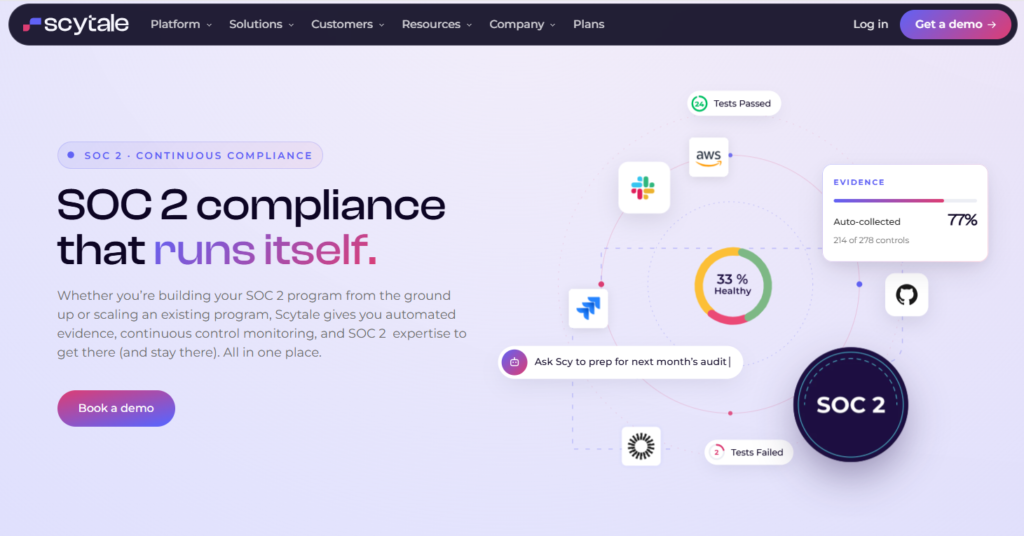
Scytale is a leading AI GRC platform that combines AI GRC agents with dedicated GRC expert support, so growing organizations, from startups to enterprises, can reach a SOC 2 report faster and stay audit-ready long after it.
- What you get: AI GRC agents that collect and validate evidence against SOC 2 controls, flag gaps, suggest fixes, update policies and pre-fill security questionnaires. Continuous monitoring detects control issues in real time, keeping you audit-ready year-round. With 150+ integrations, including custom integrations, and cross-mapping across 80+ frameworks, your SOC 2 work also supports ISO 27001, HIPAA and ISO 42001 without duplicate effort.
- Pricing: custom quote, with tiered plans that run from startups to enterprise.
- Pros: a dedicated GRC expert scopes the program, configures controls, guides the readiness assessment and reviews AI output before it reaches the auditor; a customizable Trust Center shows prospects your live SOC 2 status; streamlined audit management lets your auditor work inside the platform.
- Cons: pricing isn’t public and needs a custom quote; some advanced capabilities sit on higher-tier plans.
- Best for: growing organizations that want agentic compliance and a dedicated GRC expert working on SOC 2 alongside their own team.
On G2, Scytale averages 4.8 out of 5 from 700+ reviews, with helpfulness and ease of use leading the praise.
2. Secureframe
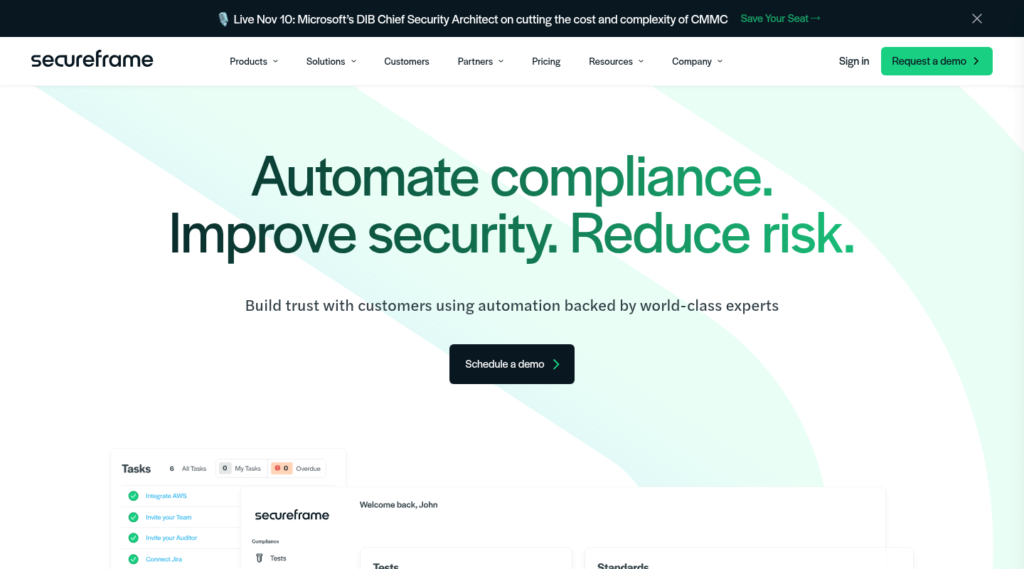
Secureframe is a compliance automation platform that pairs evidence collection and continuous checks with expert-supported onboarding across 40+ frameworks, including FedRAMP and CMMC.
- What you get: automated evidence collection from cloud and HR systems, policy templates, an auditor portal, AI evidence validation and Comply AI suggestions for fixing failed tests. Since August 2026, an MCP server lets an AI assistant read and update Secureframe data within each user’s permissions.
- Pricing: packages listed on its site without dollar figures; quotes through sales.
- Pros: a guided setup suits teams on their first SOC 2; reviewers praise how easy the platform is to run once connected.
- Cons: G2 reviewers most often report trouble connecting niche tools (184 mentions); reviewers also ask to set the timing of follow-up reminders themselves (141 mentions).
- Best for: first-time teams that want structure without hiring a compliance lead.
Secureframe holds 4.7 out of 5 on G2 across 840 reviews, with ease of use mentioned 650 times.
3. Sprinto
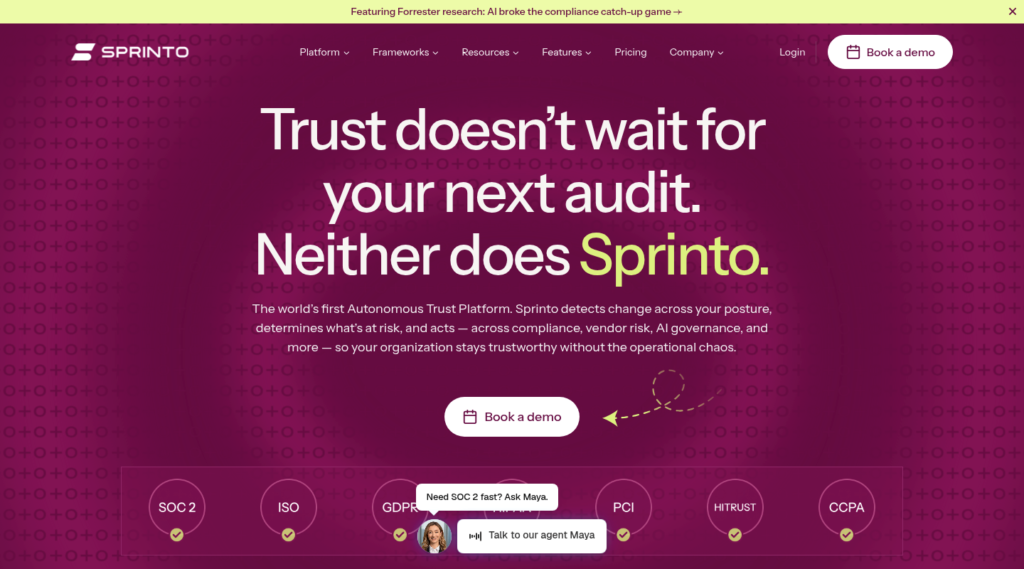
Sprinto is an automation-first compliance platform built for cloud-hosted companies, with continuous monitoring, built-in device checks and guided onboarding toward a first report.
- What you get: automated checks across the cloud and SaaS tools a startup runs, employee policy and training tracking, and device monitoring without a separate MDM tool. Sprinto MCP lets Claude, ChatGPT, Cursor, Microsoft Copilot Studio or Gemini query the program; editors and admins can also make changes, such as creating risks or closing incidents.
- Pricing: framework-based plans; the pricing page lists no dollar amounts, and each added framework costs extra.
- Pros: a fast, guided path for a company getting its first report; strong marks for responsive support.
- Cons: some integrations act up with particular tools, according to 74 G2 reviews; each extra framework adds to the bill.
- Best for: cloud-native startups that want a quick first SOC 2 and plan to stay on one or two frameworks.
Sprinto’s G2 score is 4.7 from 1,685 reviews, with ease of use the most praised trait.
4. Thoropass
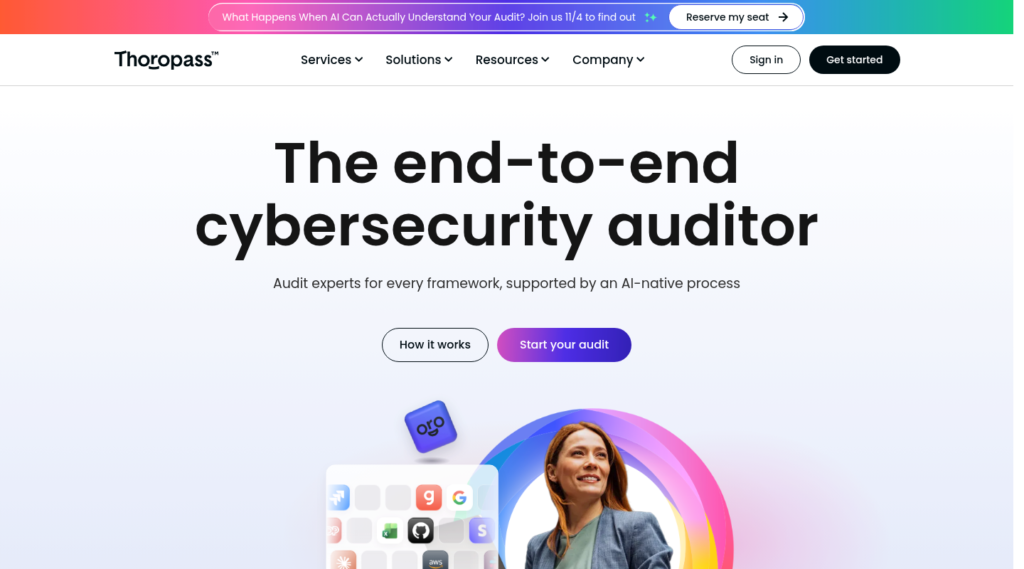
Thoropass combines compliance software with its own CPA audit practice, so the same company takes you from readiness through the SOC 2 examination.
- What you get: evidence collection and validation across 30+ frameworks, auditor collaboration inside the platform and an MCP server, launched in July 2026, that lets a customer’s AI agents work with audit scope and evidence requests.
- Pricing: quote-based, with the platform and the audit priced as one relationship.
- Pros: no separate auditor search; reviewers say the support team makes demanding audits manageable (221 mentions).
- Cons: reviewers find the interface disjointed (39 mentions) and say it’s hard to see where an audit stands (32 mentions); taking the bundled audit means you don’t pick an outside CPA firm.
- Best for: buyers who want one vendor and one contract for both readiness and the report.
G2 reviewers give Thoropass 4.7 out of 5 across 586 reviews.
5. Scrut Automation
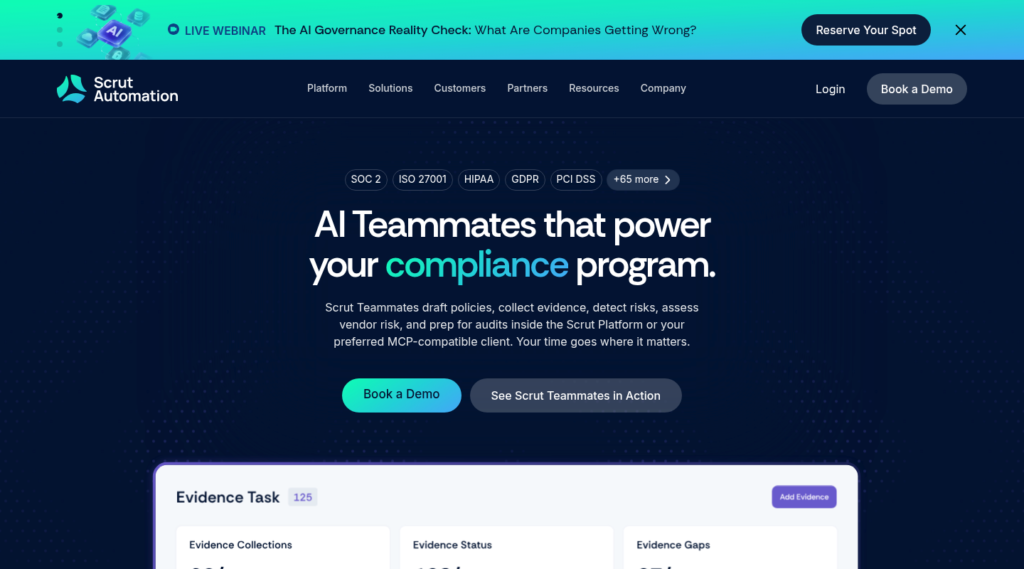
Scrut Automation is a risk-first GRC platform with prebuilt tests, policy templates and in-house compliance experts, aimed at teams that have outgrown a single framework.
- What you get: continuous tests across the connected stack, risk registers linked to controls, Scrut Teammates for agentic help with risk and compliance tasks, an audit center and Scrut MCP, which can read program data and file evidence but can’t edit or delete records.
- Pricing: quote-based.
- Pros: the joint-highest G2 rating in this group, alongside Oneleet, with reviewers singling out the support team.
- Cons: bugs that break workflows come up often in reviews, and G2’s most common complaint tag for it is “improvement needed” (69 mentions).
- Best for: mid-market teams tuning a risk-first program across several frameworks.
Scrut Automation holds 4.9 out of 5 on G2 across 1,338 reviews.
6. Oneleet
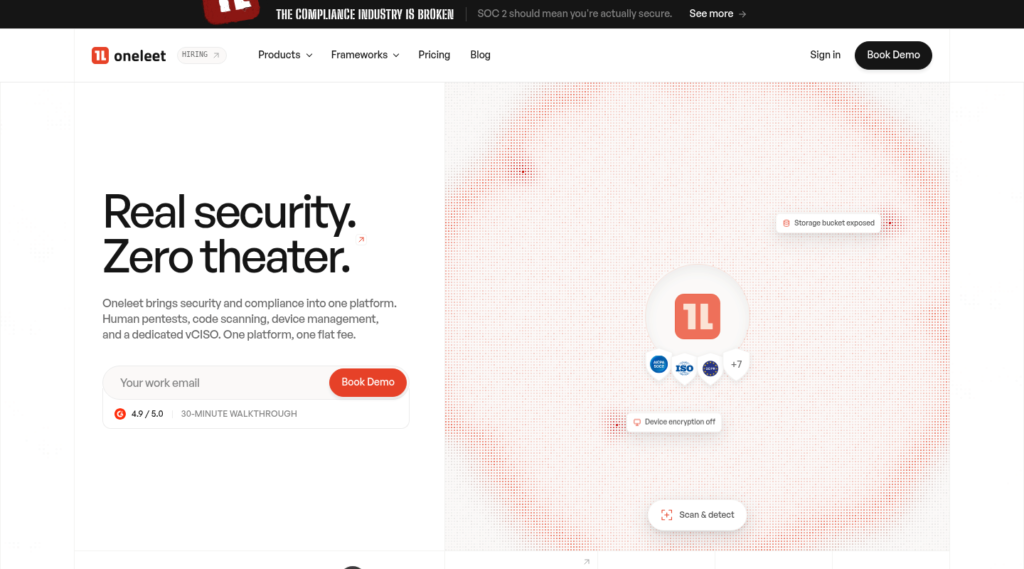
Oneleet bundles compliance automation with human penetration tests, code scanning, device management and a dedicated vCISO, sold as one platform for one flat fee.
- What you get: a requirements list built from your stack and target framework, Oneleet AI that helps fix gaps, and an expert who approves each fix before it counts. Oneleet also prepares you for the independent auditor and publishes your report on a trust center.
- Pricing: one flat fee, quoted after a scoping call.
- Pros: penetration testing and compliance from one vendor; G2 reviewers praise the security depth (302 mentions) and the expert support.
- Cons: it lists fewer frameworks than the multi-framework platforms here, with SOC 2, HIPAA, ISO 27001, PCI DSS, FedRAMP and ISO 42001 among them, which matters if more regimes are coming; reviewers report integration issues (22 mentions).
- Best for: engineering-led startups that want penetration testing alongside their first SOC 2.
Oneleet scores 4.9 out of 5 on G2 from 140 reviews.
7. Strike Graph
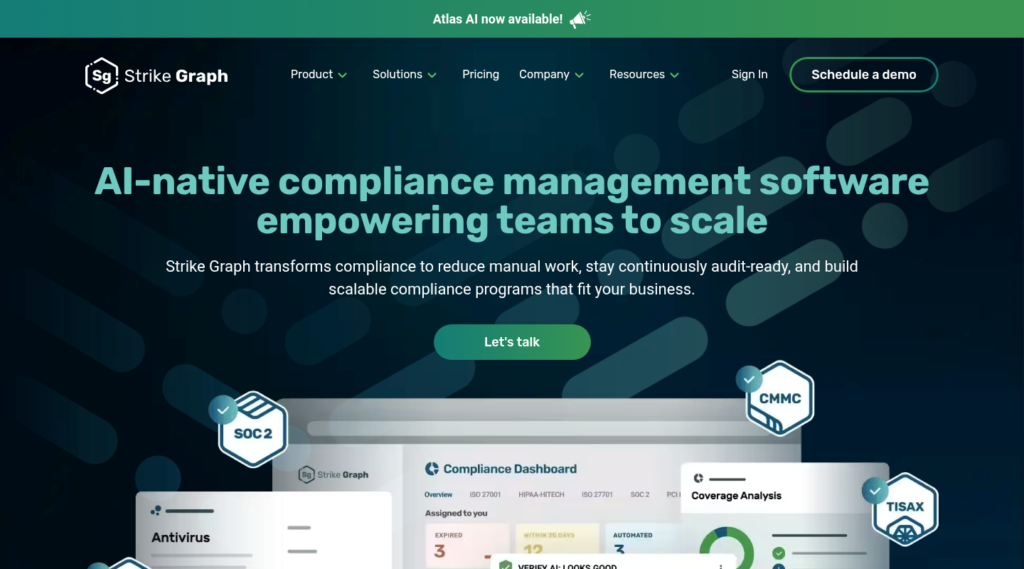
Strike Graph builds its AI-native compliance platform around controls designed to fit your own risks, with modules for vendor risk and vulnerability scans, plus trackers for POA&M (plans of action and milestones) and system security plans.
- What you get: Verify AI, which tests evidence against your controls, and a Security Assistant MCP server that gives Claude or ChatGPT read-only access to controls, evidence, risks and Verify AI results.
- Pricing: quote-based; its help center describes consumption pricing for AI features, so ask what AI use will cost.
- Pros: reviewers like its organized documentation (77 mentions on ease of use) and responsive support.
- Cons: reviewers say evidence collection takes time to learn (20 mentions) and that newcomers get little guidance (14 mentions).
- Best for: security teams that want a risk-based program with government-style POA&M records in the same tool.
Strike Graph holds 4.6 out of 5 on G2 across 197 reviews.
8. Hyperproof
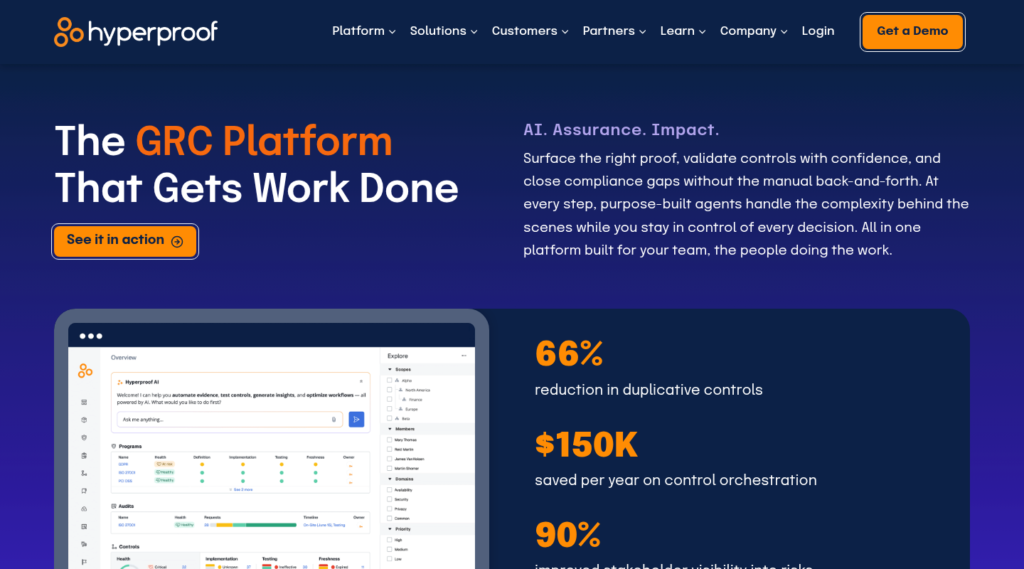
Hyperproof is a GRC platform organized around a common control set, so one control can satisfy SOC 2 and several other frameworks at once.
- What you get: cross-framework control mapping, risk registers fed by control health and vendor tracking. Hyperproof AI, launched in September 2025, suggests controls and risks, lets you search requirements in plain language and automates part of the evidence work, with a human reviewer involved.
- Pricing: quote-based.
- Pros: centralized evidence and audit collaboration suit compliance teams with many programs; customers can switch AI features off.
- Cons: setting up controls and auditor access takes some learning, per 17 G2 reviews, and 13 reviews want more flexible reporting.
- Best for: dedicated compliance teams running SOC 2 as one of several programs.
G2 lists Hyperproof at 4.5 out of 5 from 225 reviews.
9. Drata
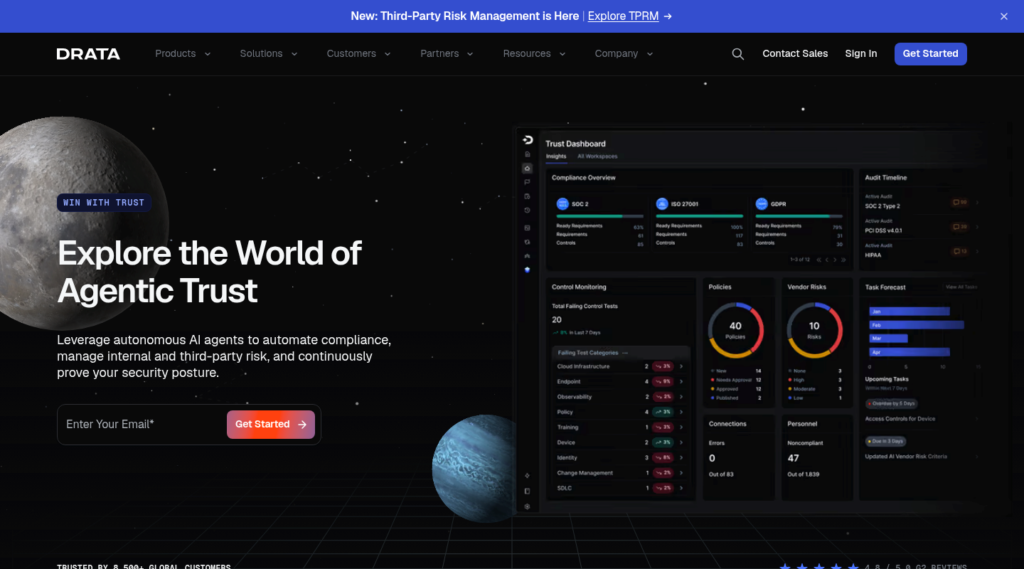
Drata is a compliance automation platform with deep integrations, continuous control monitoring and a trust center from its SafeBase acquisition, built for engineering-led teams that run the program themselves.
- What you get: automated tests that keep a pass and fail history for auditors, an audit hub, AI questionnaire help and an MCP server with read access plus 26 write actions, assigning control owners among them, all within existing permissions.
- Pricing: quote-based.
- Pros: customer support draws the most G2 praise (135 mentions); multi-framework mapping suits teams adding ISO 27001.
- Cons: the third-party integration list feels thin to 43 reviewers, and 38 describe a hard move from another tool; the model assumes someone in-house owns the fixes.
- Best for: teams where a security owner will run SOC 2 in-house and wants deep automation.
G2 reviewers give Drata 4.7 out of 5 (1,399 reviews).
10. Vanta
Few compliance brands are as familiar as Vanta, which lists one of the largest integration catalogs, automated tests that repeat every hour and an auditor partner network on its SOC 2 page.
- What you get: continuous monitoring across cloud and identity tools, a trust center and the Vanta AI Agent, plus an MCP server (public preview since June 2025) that lets Claude or Cursor check framework status and open remediation tickets.
- Pricing: quote-based, with costs rising as frameworks and add-ons stack up.
- Pros: easy to use (675 G2 mentions); a familiar brand for enterprise buyers.
- Cons: reviewers report integration issues that leave manual work (179 mentions) and pricing that small companies find hard to absorb (146 mentions); the platform flags problems and leaves the fixing to your team.
- Best for: organizations whose security owner runs compliance in-house across many tools.
Vanta holds 4.5 out of 5 on G2 across 2,885 reviews, the largest review base here.
What the AI in each Best SOC 2 Software Platforms for 2026 does
Every platform above now uses AI somewhere. The useful questions are what it does, whether an AI assistant such as Claude or ChatGPT can reach your compliance data, and who checks the result before an auditor sees it.
| Platform | AI work the vendor documents | AI assistant access (MCP) | Who checks the AI’s work |
| Scytale | Agents collect and validate evidence, surface gaps and trigger fixes, keep policies current, assess vendors | Read-only Scytale MCP for Claude, ChatGPT or any MCP client (launched Oct 2026) | A dedicated GRC expert reviews and guides |
| Secureframe | AI evidence validation, Comply AI remediation suggestions | MCP server with read and write access (Aug 2026) | Your team |
| Sprinto | Automated checks with AI assistance | Sprinto MCP; write access for editors and admins | Your team |
| Thoropass | AI evidence collection and validation | MCP server for customers’ own agents (Jul 2026) | Thoropass auditors during the audit |
| Scrut Automation | Scrut Teammates for risk and compliance tasks | Scrut MCP; reads data, files evidence only | Your team, with vendor support |
| Oneleet | Oneleet AI helps fix gaps | Not documented | A Oneleet expert approves every fix |
| Strike Graph | Verify AI tests evidence | Read-only Security Assistant MCP | Your team |
| Hyperproof | Control and risk recommendations, plain-language search, evidence automation | Not documented | Your team; a human approves AI steps |
| Drata | Agentic workflows, AI questionnaire help | MCP server with 26 write actions | Your team |
| Vanta | Vanta AI Agent, AI evidence review | MCP server (public preview since Jun 2025) | Your team |
Most of these vendors now let an AI assistant read your program, so access no longer sets them apart. The last column does. On a self-serve platform, AI output goes to whoever on your team owns compliance, and that person decides whether it holds up. Oneleet has an expert approve each fix, and Thoropass’s auditors see the evidence during the audit itself. Scytale covers the whole program: a dedicated GRC expert reviews the AI’s output from scoping through the audit.
What’s changing for SOC 2 in 2027?
The criteria behind every SOC 2 report today date from 2017, and the AICPA last refreshed their points of focus in 2022. On October 28, 2026, the AICPA published exposure drafts of proposed 2027 Trust Services Criteria and description criteria. The draft restructures the criteria, removes duplicate concepts and adds new points of focus for AI: AI governance, model monitoring, prompt manipulation, data poisoning, transparency of AI-generated outputs, training data management and the risks of automated decision-making.
Comments close January 15, 2027. If the AICPA approves the update, it applies to SOC 2 engagements that start on or after December 31, 2027, with early adoption allowed. Until then, the 2017 criteria stay in force.
Two other AICPA moves point the same way. In September 2026 it published technical guidance on how a service organization’s use of AI affects SOC 1 and SOC 2 examinations. In October 2026 it announced a joint offering with AIUC that pairs a SOC 2 report with AIUC-1 certification for AI systems and agents, with a full launch expected in early 2027.
For buyers, the practical step is to ask each vendor now how its control library will map to the 2027 criteria, and whether it will support early adoption. A platform with cross-framework mapping can add the new points of focus to controls you already run. If your company builds or deploys AI, ask how the platform will help you show governance over models and agents, since the proposed AI points of focus name both.
How much does SOC 2 cost?
A SOC 2 budget has four parts, and the software is often not the largest:
- The platform. Every vendor in this list prices by quote. Costs rise as you add frameworks and employees, so price the program you’ll run in two years.
- The audit. The CPA firm’s fee depends on whether you need a Type I or Type II report, which trust services categories are in scope beyond the required security criteria, and how complex your environment is, according to the CPA firm Schellman.
- A penetration test. Enterprise buyers often ask for a recent test, and some platforms include one while others leave it to a separate firm.
- Your team’s time. Remediation, policy sign-offs and auditor questions take hours from engineering and IT, and this is the cost expert support is meant to cut.
Get quotes from two or three CPA firms before you sign a software contract. Their numbers will show how much of the budget the audit takes and whether a bundled option saves money.
How to choose SOC 2 software?
Start with the audit and work backwards:
- Decide whether you need a Type I report now, a Type II report, or both in sequence, and when a customer expects it.
- Pick your CPA firm, or decide to use a vendor’s bundled or partner auditor.
- Count the frameworks you expect to carry in two years. ISO 27001 or an AI framework on the roadmap favors a platform with cross-framework mapping.
- Decide who will do the work. If your team has never been through a SOC 2 audit, look at platforms that include dedicated expert support.
- Check the integrations for your exact stack in a demo, including identity provider, cloud, HR system and code repository.
- Ask how the platform will handle the proposed 2027 criteria and who reviews AI-generated evidence.
Can a self-serve tool get you ready without outside help?
It can if someone on your team has scoped a SOC 2 program before and has time to own it. Self-serve platforms are good at finding problems. They don’t decide which controls fit your business, rewrite a policy to match how your team works or argue a finding with the auditor. Teams without that person tend to stall at scoping and remediation, which is where dedicated GRC experts help most.
5 mistakes to avoid when buying SOC 2 software
- Buying before choosing a report type and auditor. The audit plan decides which features you need, so settle it first.
- Pricing one framework when two are coming. Per-framework add-ons make a second framework expensive on some platforms. Ask for a two-year quote.
- Expecting the dashboard to fix controls. A failing test still needs a person to change a setting, write a policy or collect a document.
- Skipping the integration check. Integration problems are the most common complaint in G2 reviews of this category. Test your own tools in the demo.
- Ignoring who reviews the AI. AI-generated evidence that nobody checks can create findings instead of preventing them.
How long does SOC 2 take with software?
A Type I report checks whether your controls have the right design on a single date, so its timeline depends on how much you need to fix first. A Type II report tests whether those controls worked over an observation period. Scytale’s SOC 2 guidance puts that window at six to twelve months for most companies, and Schellman describes Type II examinations as extending over a period of up to a year in general.
Software shortens the parts around the audit: connecting systems, finding gaps and collecting evidence without manual exports. It doesn’t shorten the observation window, so a company that needs a Type II report in 2027 should start its window well before then.
Best SOC 2 software by company type
- Startups facing a first SOC 2 without a compliance lead: Scytale, an AI GRC platform where AI GRC agents and a dedicated GRC expert share the work; Secureframe if you want a guided self-serve setup.
- Buyers who want readiness and audit from one vendor: Thoropass.
- Engineering-led startups that want penetration testing bundled: Oneleet.
- Companies carrying several frameworks: Scytale for cross-framework mapping across 80+ frameworks with expert help; Hyperproof for an in-house compliance team.
- Teams with an in-house security owner: Drata or Vanta.
Choosing the best SOC 2 software for 2026
Choosing among the best SOC 2 software comes down to who will do the work. Teams with an experienced security owner can run Drata or Vanta and handle the rest themselves. Teams that want readiness and audit under one roof can look at Thoropass. Growing companies that want the work done with them, from scoping through the report and into the 2027 criteria, should start with Scytale. Its AI GRC platform puts AI GRC agents on the evidence and monitoring and pairs them with a dedicated GRC expert, across 80+ frameworks.
Also Read :- The 10 Best Autonomous Pentesting Tools Compared (October, 2026)