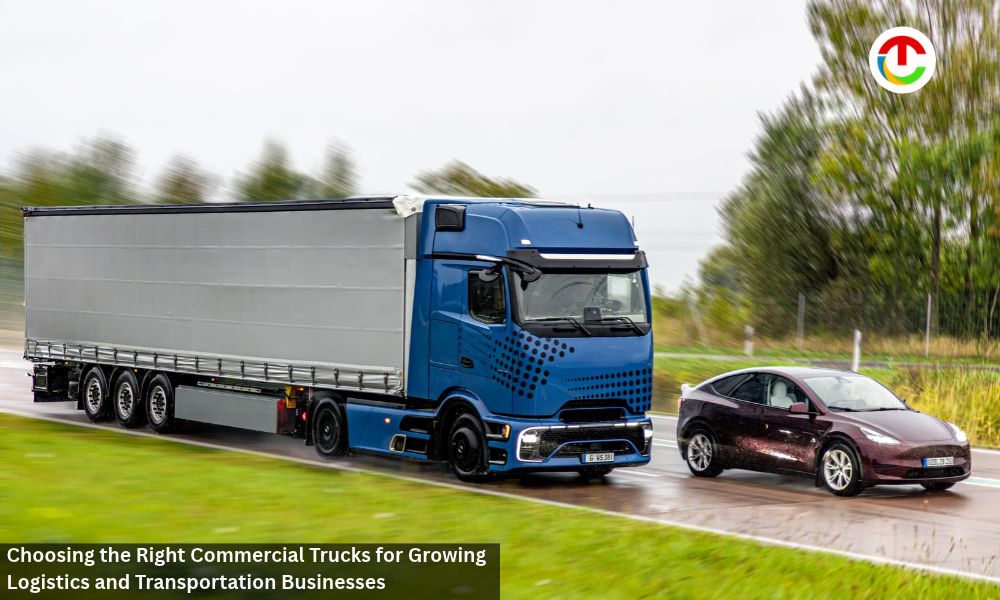
Fleet decisions define the practical ceiling on what a logistics or transportation business can deliver. The right Commercial Trucks determine which contracts you can take, how reliably you can service them, and what your cost per mile looks like over the life of the asset.
For growing operations, those decisions carry more weight than almost any other capital investment – and they don’t get easier as the fleet scales.
Matching the Commercial Trucks to the Operation
Source: Pexels
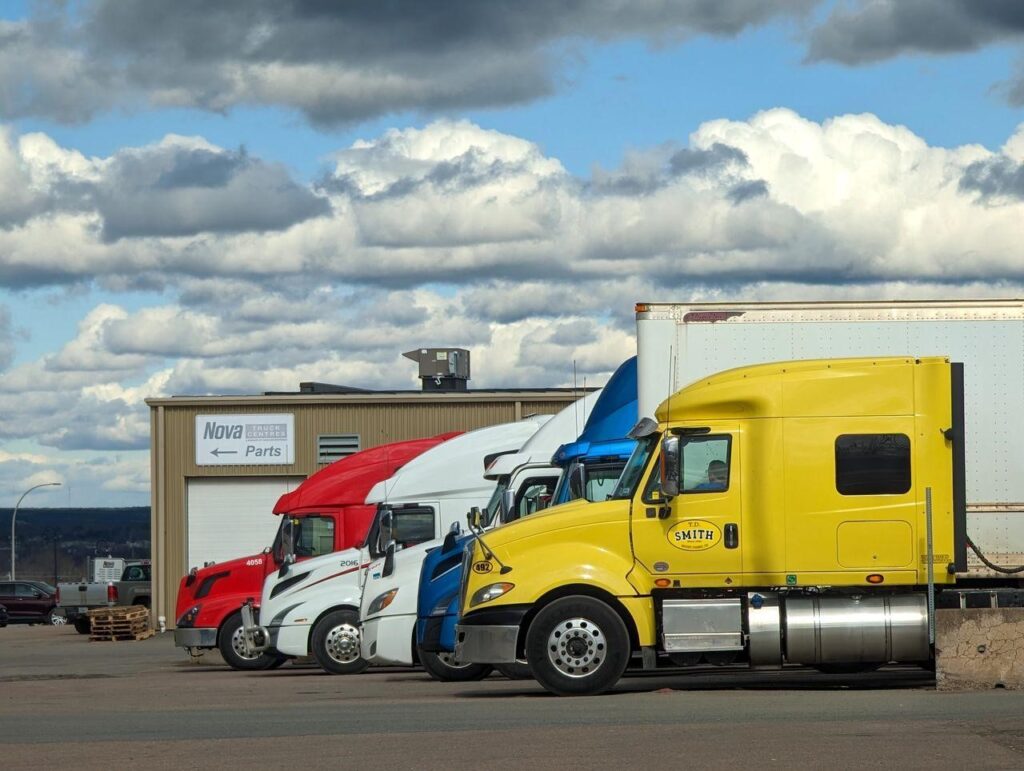
The first question isn’t which brand or which model. It’s what the truck will actually be doing. Regional haul, over-the-road long-haul, local distribution, and vocational work each have different requirements, and a truck built for one rarely performs optimally in another.
Regional and long-haul operations need aerodynamic efficiency, driver comfort for extended hours, and powertrains calibrated for highway performance.
Local distribution and final-mile work demand maneuverability, frequent stop-start capability, and configurations that simplify loading and unloading. Vocational applications – flatbed, tanker, dump, refuse – often require specific chassis specifications, axle ratings, and PTO integration that standard highway trucks don’t provide.
Operators expanding into new freight segments or geographies frequently underestimate how much the duty cycle affects total operating cost. A truck spec’d for 500-mile linehaul runs on regional routes is likely running richer than necessary. A regional spec running over-the-road will show the difference in fuel consumption and wear.
Working with a dealership that knows the full product line matters here. Kenworth Tampa through CSM Truck is an example of what a dealer relationship looks like when it goes beyond the transaction – spec consultation, fleet management support, and access to both on-highway and vocational configurations across the Kenworth lineup.
What to evaluate before committing to a Commercial Trucks specification:
1. Duty cycle and route profile –
average daily miles, typical load weight, terrain, and number of stops per shift all shape which powertrain, transmission, and axle ratio combinations make sense; a spec that looks economical on paper can cost more over three years if it’s mismatched to the application
2. Payload and weight requirements –
GVW ratings, axle configurations, and legal weight limits by route determine what a truck can carry and what it can’t; getting this wrong means either leaving freight behind or running overweight risk
Powertrain and Technology Considerations
The powertrain decision has grown more complex as the industry works through its diesel, natural gas, and electric options. For most growing operations today, diesel remains the practical choice for range, payload, and fueling infrastructure.
But the diesel engines in current commercial trucks are meaningfully different from those of a decade ago – cleaner, more fuel-efficient, and increasingly integrated with predictive telematics and driver assistance systems.
Engine selection involves matching the horsepower and torque curve to the application. Heavier loads and grades need torque at lower RPMs. Highway fuel economy improves when engines can cruise in higher gears at lower RPM – a factor that shapes both engine and axle ratio selection.
On transmission, automated manuals have largely taken over new fleet purchases. They’re more consistent on grades than a driver shifting manually, and the fuel economy difference adds up across a fleet.
Telematics integration has become a baseline expectation rather than an optional upgrade. Fleet management platforms that connect engine diagnostics,driver behavior data, fuel consumption, and maintenance scheduling give operations managers real-time visibility into what each truck in the fleet is doing and what it needs.
For growing fleets that are building out their back-office systems, buying trucks with strong telematics integration simplifies that build.
What fleet buyers evaluate when comparing models:
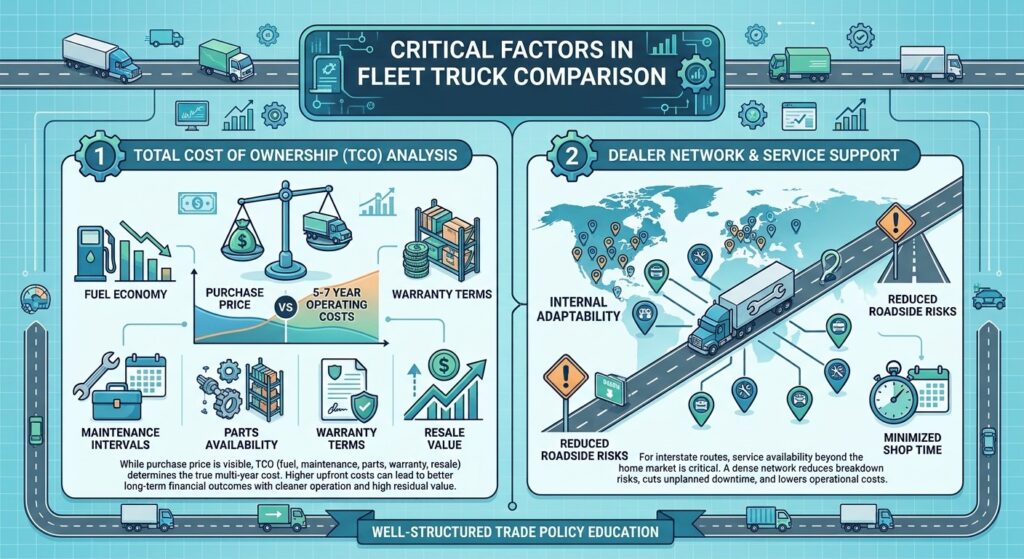
1. Total cost of ownership –
purchase price is one number, but fuel economy, maintenance intervals, parts availability, warranty terms, and resale value determine what the truck actually costs over a typical 5- to 7-year hold; a truck that costs more upfront but runs cleaner and holds residual value can be the better financial decision
2. Dealer network and service support –
for a truck that runs interstate routes, service availability outside the home market matters; a brand with a dense dealer network reduces the risk and cost of roadside breakdowns and unplanned shop time
Building a Fleet Strategy That Scales
Single-truck decisions accumulate into a fleet strategy whether you plan for it or not. Operations that make disciplined choices early – standardizing on a small number of configurations, building a service relationship with a dealer that knows their operation, tracking performance data at the asset level – tend to scale more cleanly than those that buy opportunistically.
Standardization reduces parts inventory, simplifies driver cross-training, and makes it easier to negotiate fleet pricing and favorable service agreements. It also makes the data more useful: when you’re running the same spec across twenty trucks, variation in fuel economy or repair frequency tells you something meaningful. When every truck is different, the variation is noise.
As freight demand grows and contract opportunities expand, the capacity to execute depends on equipment that runs reliably and cost-effectively.
The decisions made early in a fleet’s development – what to buy, from whom, and how to manage the assets over time – shape the operational capability and financial performance of the business for years forward.
Also Read :- The Work Truck Buying Playbook: How to Spec a Heavy-Duty Pickup Without Overpaying