
Source: Magnific
Your knee has been grinding for three years, and your surgeon back home wants you on a waiting list until spring. One Healthcare Innovation night you type “advanced stem cell therapy Mexico” into your phone. By morning, you have four clinic brochures, two video-call invitations, and a price list in dollars.
That’s how a lot of medical trips start now. Not with a travel agent. With a search bar.
The trip itself hasn’t changed much. You still fly, you still sit in a waiting room, you still recover in a strange bed. What changed is everything around it. How you find the doctor, how your records move, and who watches you after you fly home.
The Trip Used to Start With a BrochureThe Trip Used to Start With a Brochure
Twenty years ago, a patient going abroad for care had a glossy pamphlet, a phone number, and a lot of faith. Records traveled in a paper folder. If the X-rays got lost at the airport, you had to start over.
Today the first appointment often happens on a laptop. A surgeon in Guadalajara can look at your MRI before you buy a plane ticket. Your blood work and other test results get sent to the clinic online. Translation apps fill the gaps that used to cause real misunderstandings in the exam room.
Why Mexico Keeps Showing UpWhy Mexico Keeps Showing Up?
Distance is a big part of it. So is the price. For many Americans, a clinic in Tijuana is a shorter drive than the nearest specialist in their own state.
The numbers back up what border towns already know. In a CDC-supported survey of U.S. residents, Mexico accounted for 41% of medical tourism trips.
Cost and proximity can explain the volume. They don’t explain the new kind of demand. That comes from treatments people can’t easily get at home.
Before You Go: What to Weigh and What to AskBefore You Go: What to Weigh and What to Ask
The price on the clinic’s website is only part of the bill. Before you get attached to a quote, think through the whole trip.
- The total cost. Add flights, a hotel for the full recovery, meals, local transport, and a companion’s costs if someone comes with you.
- Recovery time. Some procedures mean days of rest before you can fly. Ask how long, then plan your time off work around it.
- The facility. Check whether the hospital or clinic holds a recognized accreditation, and confirm it on the accrediting body’s own website.
- Your rights if something goes wrong. Legal options differ by country. Know what recourse you’d have before you sign anything.
What Healthcare Innovation Actually ChangedWhat Healthcare Innovation Actually Changed?
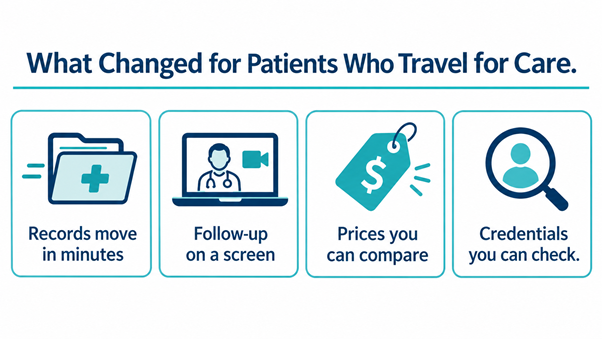
Strip away the sales copy and four things are different for the traveling patient.
First, records move. Imaging files, lab panels, and surgical notes can go from a clinic in Monterrey to a primary care doctor in Ohio in minutes. When that works, your home doctor isn’t guessing what happened.
Second, follow-up can happen on a screen. A wound check over video isn’t perfect. Still, it beats a 2,000-mile drive for a five-minute look.
Third, prices are easier to compare. Many clinics now post package rates online, so a patient can line up three quotes side by side before a single phone call. That pressure pushes clinics to be clearer about what’s included, and what isn’t.
Finally, patients can do more homework. Accreditation status, surgeon credentials, and patient reviews are a few clicks away.
The Gaps Technology Hasn’t ClosedThe Gaps Technology Hasn’t Closed
Here’s where you need to be careful. The weakest link in medical travel was never the flight. It’s the handoff.
Your surgery happens in one country. Your recovery happens in another. If an infection shows up on day nine, the surgeon who knows your case is a border away, and your local ER doctor has never seen the clinic’s notes. A portal helps only if someone uploaded the right files.
Insurance can be another issue. Many U.S. plans won’t pay for care abroad, and fewer will pay to fix a problem that started there. Read your policy before you decide to go, not after.
And language still matters. An app can translate “take twice daily.” But sometimes healthcare explanations aren’t so easy to understand, even in your native language.
What to Do Before You Book AnythingWhat to Do Before You Book Anything
You don’t need to avoid medical travel. You need to treat it like the major decision it is. Start here:
- Talk to your own doctor first. Ask whether the treatment you’re looking at has evidence for your condition. Bring the clinic’s materials with you.
- Request a video consult with the actual physician, not a coordinator. Ask the five questions above and write down the answers.
- Get the clinic to agree, in writing, to send full records to your home doctor.
- Call your insurer and ask two things: will they cover care abroad, and will they cover complications from it?
- Plan to stay near the clinic longer than they suggest. Flying too soon after a procedure is a common way small problems become big ones.
The internet and technology have changed how we function as a society. And the future of health is even more exciting.
But still, you have to be careful, do your research, for Healthcare Innovation and find a suitable clinic for your needs.
Also Read :- Healthcare AI Adoption Accelerates as Hospitals Seek to Reduce Administrative Workloads