Every layer of the modern data center arrived to solve a real problem. The x86 server delivered mainframe-like computing power at a fraction of the cost and footprint. Server virtualization came next to raise utilization and consolidate hardware, and hyperconverged infrastructure followed.
Along the way, storage got its own software, and so did networking. Backup, disaster recovery and management each arrived with their own console, license, appliances, and upgrade calendar. Each purchase made sense when it was made. Stacked together over 25 to 30 years, they produced an environment that takes a team of specialists to keep in sync.
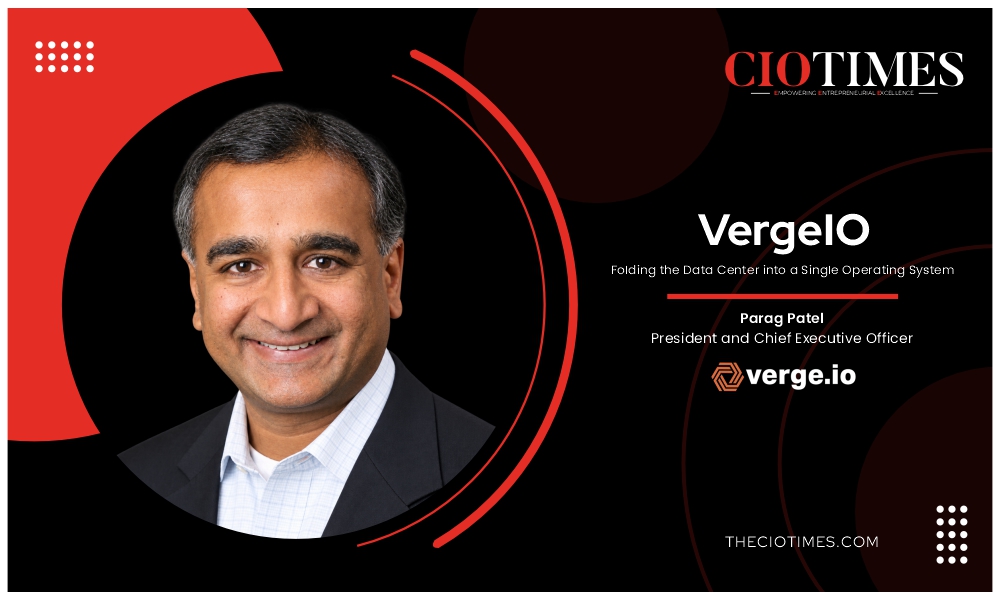
Parag Patel has watched that story up close. He spent two decades in virtualization, most of it at VMware, and in September 2026 he became President and Chief Executive Officer of VergeIO, the Ann Arbor, Michigan company (www.verge.io) behind VergeOS.
He joined VMware when it had roughly 500 people and helped build it into a global infrastructure standard. He grew the partner ecosystem from 20 partners to more than 20,000, helped build the OEM business that put VMware on servers from every major hardware vendor, started the telco virtualization business and led vSAN go-to-market from zero to more than 25,000 customers. He grew up in Katy, Texas, and holds a B.S. in Electrical Engineering from Stanford University and an MBA from the Harvard Business School.
He joined VergeIO because the data center is readying for its next major era: “We are in the midst of a breathtaking data center buildout, but the future architecture needs to marry the legacy infrastructure with AI requirements. Data Center executives are looking for ways to streamline the legacy stack so they can accommodate the emerging one.”
What those executives are dealing with, in his view, is the rising cost of everything that goes into the data center, from memory and flash to power and floor space, not to mention the increasing costs of running VMware. VergeOS was built on the premise that the complex stack the industry assembled over the past twenty years can be consolidated into a single software layer covering all the major data center functions.
Customers replace a set of separately licensed products and appliances with one operating system and run it on the servers they already own, rather than buying their way out of the problem. Parag finds this simplicity and savings compelling, but he also thinks the same move gets customers ready for AI, which needs efficient use of hardware, data that stays under the customer’s control, and an infrastructure team that is not spending its week holding five products together. As he puts it: “Establishing a new infrastructure software baseline solves all three, and it starts with what is costing them money today.”
A Question Asked Fifteen Years Ago
VergeIO founder Greg Campbell looked at the same stack fifteen years ago and asked a different question. Parag puts it like this: “What happens when compute, storage, networking, and data protection live inside the operating system itself?”
Parag calls the operating system the most strategic layer in the data center, and VergeOS uses that position to consolidate several point products with a single operating system. Most of the company’s strategy came out of that decision, starting with the code itself: “One code base means one thing to install, patch, and support.”
VergeOS runs on standard x86 servers, so the customer selects the hardware. Licensing is per server rather than tied to cores or capacity, which Parag says helps customers understand what they own. When he talks to customers about all this, he boils it down: “I describe the promise we make to customers in three words: simplicity, savings, and service.”
Storage That Lives Inside the Hypervisor
A shorter vendor list is the obvious benefit of consolidation, but Parag points to a larger one: “Fewer products matter. The larger advantage comes from every layer sharing one set of code and one view of the system.”
In a stitched-together stack, he says, storage often runs inside a controller VM on every host, and that VM competes with the applications for processor and memory. VergeFS runs as a service inside the hypervisor instead. With no storage VM and no extra hop in the I/O path, memory and processor capacity can go to the workloads.
The RAM cache reads directly, and global inline deduplication lets that cache cover more of the environment with the same memory. According to Parag, customers typically run the same workloads on fewer servers, and at today’s memory prices he counts that as a real savings.
Most enterprise storage lives in an external array or inside a storage VM on each host. VergeFS, a distributed file system, pools the drives across every server in the cluster into one global resource and presents it directly to the workloads. Data is deduplicated before it is written, across the whole environment, so in Parag’s example, “a thousand virtual machines built from the same image store that image only once.” Replication gets lighter as well, because only unique blocks travel to a disaster recovery site.
Customers can mix NVMe, SSDs and hard drives in the same cluster. Existing Fibre Channel SAN capacity can be used through dedicated LUNs presented separately to each node, although direct-attached disks are preferred. Writes go to the tier a volume sits on and the RAM cache serves the reads, so how much tier choice matters depends on each workload’s read and write pattern and its cache hit rate.
Snapshots in VergeOS are metadata operations, available at the VM, Virtual Data Center and system-wide level, with configurable retention that includes immutability. A team can use one as a working lab or as a backup without copying the underlying data.
Each snapshot stands on its own, so the production copy could be erased or corrupted while the snapshot stays viable for use or restoration, and extra capacity is consumed only when net new data is added to a snapshot copy. Virtual machines, Kubernetes persistent volumes through the CSI driver, file shares and AI data sets all draw from the same pool, which leaves the IT team with one set of tools to learn.
Because the hypervisor, the storage layer and the network layer belong to one system, a single piece of software handles a failure with the full picture in front of it. Updates roll through the cluster one node at a time while workloads keep running, provided the remaining nodes have sufficient capacity.
CIOs care about control over the estate, Parag says, and the Virtual Data Center is built for that. VergeOS packages a set of virtual machines with their storage, network, security policy and permissions into one object that can be snapshotted, replicated, assigned to a business unit, or recovered at another site on different hardware. In Parag’s view, that changes how the estate is run: “IT teams manage an application environment as a unit, which is easier to control than disparate products stitched together.”
Savings Start with Hardware Already in the Rack
The cost pressure on IT leaders right now comes from several places at once, according to Parag. Virtualization licensing costs have risen sharply for many organizations, memory and flash prices have climbed fast, and AI projects are pulling budget toward GPUs and token bills. A team that needs more capacity today, he says, faces long hardware lead times and prices that have doubled or worse.
So VergeIO starts with what the customer already owns. VergeOS runs on standard x86 servers from Dell, HPE, Cisco, Lenovo and others, and servers of different ages and brands can sit in the same resource pool. A customer moving to VergeOS often keeps its existing servers and gets several more years out of them, and Parag puts that ahead of everything else right now: “In this market, that is the fastest savings available.”
Global inline deduplication runs at the operating system level across the entire environment. Storage has six numbered tiers, with Tier 0 for metadata and Tiers 1 through 5 for workload data, from NVMe down to hard disk. Data that needs speed sits on flash, and data that needs capacity can go to less expensive media.
A RAM cache can accelerate frequently accessed blocks, though performance still depends on the workload and its storage tier. VergeOS is licensed per physical server, with no charges by socket, core, capacity or memory. Parag sums up the model in five words: “Simple and easy to understand.”
Recovery Built into the Write Path
VergeIO works closely with backup partners, and Parag notes that VergeOS is fully supported in Veeam Backup & Replication. He sees backup as protection for workloads. The infrastructure layer protects the environment as a whole, and VergeOS handles that layer under an approach the company calls Data Resiliency.
That protection begins on the write path. Every write is deduplicated, and two or three copies of the unique blocks are replicated synchronously across servers in the cluster, so workloads keep running through a failed drive or a failed server. When failures exceed local redundancy, ioGuardian lets a repair server retrieve missing blocks from a synchronized destination, potentially avoiding a full snapshot rollback. Whether that works depends on the availability of the destination and the affected blocks.
For site-level events, ioReplicate sends snapshot-based copies of entire Virtual Data Centers to a second VergeOS location, and global deduplication keeps that traffic lean. At the recovery site, the Virtual Data Center comes up with its networks and policies intact, on whatever hardware is there, in a few clicks.
Parag sees the change in practical terms: “For the business, a disruptive event becomes an operational task.” The team recovers a complete application environment as one object instead of rebuilding servers, storage mappings and firewall rules from separate products under pressure. Customers who run disaster recovery tests on VergeOS, he says, report that those tests pass on the first try.
Ransomware changes the planning. Parag says: “Dependable recovery means planning for an attacker who goes after your recovery points first.” VergeIO works on that problem at three points in the infrastructure.
ioFortify handles detection. It uses the VergeOS task engine to watch deduplication efficiency across the system, since a change in deduplication behavior can indicate encryption activity, although it requires investigation. Email alerts can prompt the team to investigate and contain the attack, and how quickly they detect and respond determines the size of the problem.
Clean recovery points come from immutable snapshots. VergeOS system snapshots can be marked immutable to prevent early deletion, even by administrators. Removing the flag starts a mandatory unlock delay of up to seven days, while snapshots still expire on schedule. A snapshot schedule aligned to the recovery point objective improves the chance of keeping a clean point from before encryption started.
Recovery itself skips the restore job. A snapshot mounts as a working copy, so the team can bring up the pre-attack snapshot in a quarantined Virtual Data Center, scan it and promote it to production. In Parag’s words: “Nobody waits for terabytes to copy back across the network.”
Add a backup platform holding independent copies offsite, and a customer has two separate layers of recovery. Parag treats this as a promise the company has to keep: “We promise fast recovery that customers have already tested, and every release is built to keep that promise.”
Migration Without Starting Over
Plenty of enterprises would like a more unified infrastructure. Parag says the hard part is getting there: “For most organizations, the hardest part of changing infrastructure is the migration itself, so we put our effort there.”
VergeOS runs on the servers customers already own, including hardware from earlier virtualization platforms, with different generations working together in one pool. With memory expensive and hard to obtain, reusing servers protects both the budget and the timeline.
ioMigrate automates the move, rehosting VMware virtual machines onto VergeOS along with their network configuration. Project timing depends on the environment, and customers can move applications in waves at a pace the business accepts.
Veeam protects VergeOS workloads, so a customer’s backup investment stays in place, and Kubernetes teams use VergeIO’s Helm charts with whatever distribution they already run. VergeIO also sells through channel partners, which means customers can make the change with the reseller and integrator they already know.
Automation for Teams of a Few
Parag says automation matters most to the customers VergeIO serves best. Midmarket IT teams are small, and the same few people run virtualization, storage, networking and backup. A substantial share of their infrastructure work can go into coordinating across products, and that shapes what automation can do for them. “Automation built on a fragmented stack spends much of its effort gluing those products together. Automation built on a single operating system acts on the whole environment directly.”
Provisioning is the clearest example. A Virtual Data Center captures compute, storage, networks and policy in one object, so a team can stand up a complete environment for a new project or a new tenant from a template in minutes. Everything available in the interface is available through the API, and the same work can run from scripts, pipelines and AI assistants.
When a performance problem appears, the team looks at one system that sees the hypervisor, the storage and the network together, and a support call goes to one vendor. VergeOS also includes ioOptimize, which uses machine learning to monitor hardware health and move virtual machines off failing or aging servers, and ioFortify turns deduplication behavior into a ransomware alarm. Parag measures the gains in hours. “If automation gives an administrator back an hour a week, that hour goes into the projects the business has been waiting upon, and those small gains compound.”
Private AI on Private Infrastructure
Parag starts with what customers are facing: “Customers are dealing with a great deal of cost and complexity on the AI side right now.” They are buying GPUs, adding new systems and receiving token bills that are hard to predict. He thinks they need two things: a simpler, less expensive data center everywhere else, which frees budget and people for AI, and a way to run AI on the same private infrastructure with the same controls.
VergeIO supports GPU passthrough. On compatible NVIDIA hardware with appropriate drivers and commercial vGPU licensing, it also supports vGPU profiles or MIG partitions, so several workloads can share an expensive card. VergeIQ takes that a step further by making AI a native resource within VergeOS, the same way storage runs through VergeFS and networking through VergeFabric.
Enterprises can run fully private, on-premises generative AI environments with the simplicity, efficiency and control they expect from their core infrastructure, inside their own data centers and with no per-token pricing. The company says organizations keep complete control over sensitive documents, proprietary code and internal datasets while using them to generate immediate insights, tailored content and actionable intelligence, all securely within their own data centersOrganizations keep complete control over sensitive documents, proprietary code and internal datasets while putting AI to work: summarizing documents, reviewing internal code, drafting scripts and documentation, and answering questions about the infrastructure itself.
Governance follows from where the data lives. AI workloads run in Virtual Data Centers with their own networks, permissions and policies, so a data science project stays isolated from production and from other teams. The snapshots, replication and ioGuardian protection that cover every other workload cover AI data sets and models too. Parag notes who is paying attention: “Data stays under the customer’s control, on the customer’s hardware, which is what regulated industries and a growing number of boards are asking for.”
The Cost That Never Shows Up as a Line Item
When VergeIO customers modernize their infrastructure, Parag says the cost they most often miss is the one nobody budgets for. “The most underestimated cost is complexity. It rarely shows up as a line item. It shows up as the renewal nobody can model, the upgrade that needs three vendors to coordinate, and the skilled engineer who is critical to making it all work.”
He has watched it happen throughout his career. Complexity builds up gradually, even around great products, and every new product, license and integration adds something the customer has to absorb until the customer is carrying the cost of fitting it all together. Then the world changes and that complexity is no longer supportable.
He took two lessons from that for VergeIO. The first is that simplicity has to be the North Star for the product, the pricing, the documentation, the deployment and the migration, and that when the company faces a decision, the first question is which option is simpler for the customer.
The second is that service decides whether customers stay through the hard days. Service was one of the first things he noticed about the company. “When I looked at VergeIO before joining, customer satisfaction stood out. Customers love the support and the attention they receive, and that is something I intend to protect.”
His advice for technology leaders judging any modern platform is to measure the whole environment before and after, because a platform that pushes work from one layer onto another shows up quickly in the numbers. Start with the servers required for the same workloads, which reflects how efficiently the platform uses memory and processors and how much hardware refresh it defers.
Count products, contracts and renewal dates to see whether complexity left the environment or simply moved to procurement. Administrator hours spent coordinating across tools will tell a team whether automation reduced labor or added another console, and the steps and people needed for a routine upgrade show whether the stack behaves as one system. He would also track how long a new administrator takes to become productive and how predictable license costs stay over three years as the environment grows. He singles out one of them: “The recovery test deserves special attention. Recover a full application environment, including its networks and security policies, and time it.”
The Next Building Block
Parag says: “The building block of the data center keeps changing, which is what I find most satisfying about this part of the industry.” It started with the mainframe. The x86 server brought that power down to an affordable box virtualization, the software-defined data center and hyperconverged infrastructure came after. In his reading, each era rewarded the company that made infrastructure simpler to run and less expensive to own, and the building block is changing again.
He believes the next generation looks like an operating system, with every core data center function living in the OS and licensed as one product. It runs on whatever standard hardware the customer chooses, includes resilience and ransomware recovery, and runs AI privately next to everything else.
The pricing fits on one page, and a small team operates it, increasingly working alongside AI assistants. Parag says VergeOS is that platform today, and the job now is to keep extending it. “I was privileged to play a role in the last three platform shifts. VergeIO gives me the opportunity to help lead the next one.”
He expects customers to shape the roadmap more than anything else, and he has a VMware story to explain why. When he brought VMWare vSAN to market, the team pulled its most vocal early adopters together the afternoon before VMworld, with product managers, engineers and chief architects in the room. “The sessions were scheduled for two hours, and by evening I was ordering pizza for dinner, since nobody wanted to leave.” That kind of feedback loop, he says, builds products people enjoy using, and he wants the same discipline at VergeIO.
The midmarket is VergeIO sweet spot, along with the partners who serve it. Every customer segment asks for different things, so Parag intends to be deliberate about what the company builds and the promises it makes, and to keep the product simple. He also sees organizations rebuilding on premises with more intention than they have in a decade.
Virtualization licensing changes started that conversation, memory and flash prices sharpened it, and private AI is extending it. In his view, each of those points toward infrastructure that gets more out of existing hardware and keeps data under the customer’s control.
Inside VergeIO, he has started with questions. “I have asked everyone at VergeIO three questions. What is our enduring promise of value? Which discipline will we be exceptional at? What can each of us do to get 1% better every week?” The answers will guide the long-term vision, and he is clear about where he wants it to lead. “Our goal is to build an enduring company that reduces the cost and complexity of enterprise infrastructure for our customers.”
Also Read :- CIO Times Magazine For More information