
A serious health condition that keeps you from working hits differently when you’re in your 50s or early 60s. Retirement isn’t close enough to fall back on, and starting over in a different field isn’t realistic when you’re managing a chronic condition.
The federal disability system has rules that account for exactly this situation – but most people don’t know they exist until they’re already partway through a claim the Disability Benefits .
The Two Programs and How They Differ
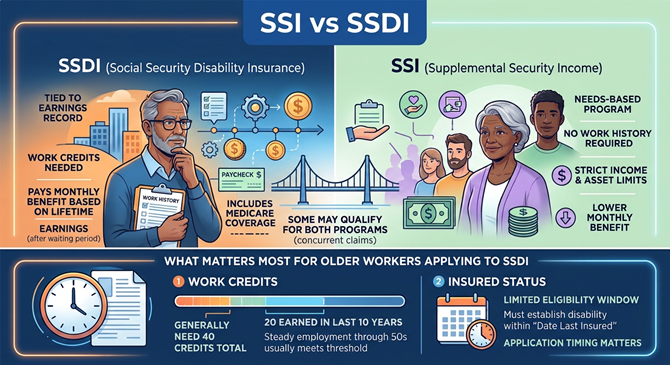
Federal disability benefits run through two separate programs, and which one applies to you depends largely on your work history. Understanding the difference between SSI vs SSDI is the first thing to get clear before you file anything.
SSDI (Social Security Disability Insurance) is tied to your earnings record. If you’ve worked and paid Social Security taxes long enough, you’ve built up what the SSA calls “work credits.” SSDI pays a monthly benefit based on your lifetime earnings and includes Medicare coverage after a waiting period. For most older workers with steady employment history, SSDI is the program that applies.
SSI (Supplemental Security Income) is needs-based. It doesn’t require a work history, but income and assets must fall below strict limits, and the monthly benefit is lower. Some claimants qualify for both programs, but that’s less common for workers with solid employment records.
What matters most for older workers applying to SSDI:
- Work credits – you generally need 40 credits total, with 20 earned in the last 10 years; most people who’ve worked steadily through their 50s will meet this threshold
- Insured status – your eligibility window doesn’t stay open indefinitely; if you stop working, you have a limited period called your “date last insured” within which a disability must be established, so timing the application matters
How Age Changes the Evaluation of Disability Benefits?
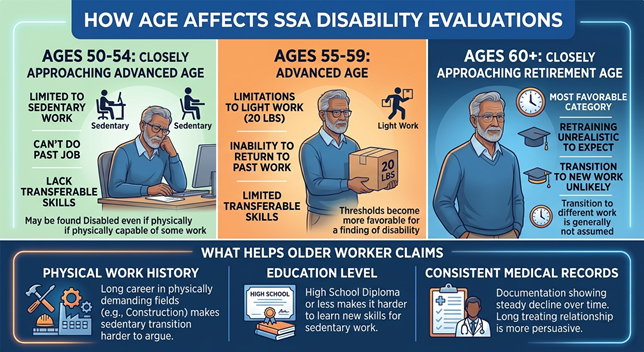
The Social Security Administration doesn’t evaluate a 55-year-old the same way it evaluates a 35-year-old, and the practical difference is significant.
The SSA uses rules called the Medical-Vocational Guidelines – commonly called the Grid – to decide whether someone who can’t do their past work can reasonably adjust to other work.
The Grid weighs your age, education, and work history together. For older workers, the thresholds become more favorable at each stage.
Workers between 50 and 54 fall into the “Closely Approaching Advanced Age” category. If you’re limited to sedentary work, can’t do your past job, and lack transferable skills, the Grid may find you disabled even if you’re physically capable of some work.
Workers between 55 and 59 are classified as “Advanced Age.” Limitations to light work – lifting up to 20 pounds occasionally – combined with inability to return to past work and limited transferable skills can support a disability finding.
Workers 60 and older fall into the most favorable category, “Closely Approaching Retirement Age.” The assumption is that transitioning to substantially different work would require retraining that isn’t realistic to expect.
What tends to help older worker claims:
- Physical work history – a long career in construction, manufacturing, healthcare, or other physically demanding fields makes the transition to a sedentary job harder to argue; the SSA takes this into account
- Education level – a high school diploma or less, combined with physical work experience, generally supports a finding that sedentary work isn’t a realistic alternative
- Consistent medical records – documentation showing a steady decline in function over time is more persuasive than records that are recent or inconsistent; the longer your treating relationship with a physician, the better
Medical Evidence of Disability Benefits and What the SSA Is Looking For
The Grid rules don’t substitute for a solid medical case. Before the Grid analysis applies at all, the SSA has to find a medically determinable impairment that prevents you from doing your past work.
The conditions that come up most often in older worker claims include degenerative disc disease, arthritis, COPD, heart disease, and diabetes – often in combination. What matters isn’t the diagnosis alone but records that document how the condition limits your functional capacity: how long you can stand or sit, how much you can lift, whether you need rest periods, and how pain affects reliability.
Your treating physician’s opinion carries real weight. A detailed statement from a doctor who has treated you over time, explaining your limitations in specific functional terms, strengthens a claim considerably more than records alone.
Timing Matters More Than Most People Realize
One decision that catches many older workers off guard is the relationship between early Social Security retirement and SSDI. Taking retirement at 62 permanently reduces your monthly payment.
If you qualify for SSDI, your benefit converts to retirement at full retirement age with no reduction – meaning SSDI claimants often end up with a higher lifetime payment than those who took early retirement out of necessity.
The application process takes time, and initial approvals aren’t guaranteed. Many legitimate claims get denied and require appeal. Starting the process early, with complete documentation and a clear understanding of how the Grid applies to your situation, puts you in a much better position than waiting until finances force the issue.
Also Read :- The Future of Brain Health: How Science Is Changing the Way We Think About Nutrition