You search whether your teenager can choose which parent to live with and find an answer: “Yes, at 14.” Then another article says the judge decides.
Which one should you believe?
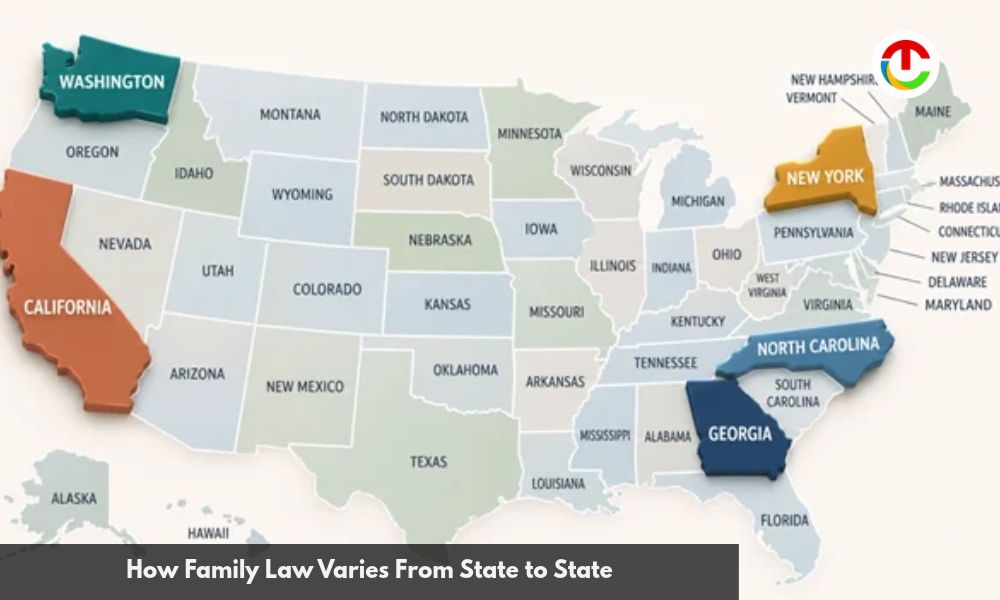
Well, the truth is, both answers could be true, depending on the state they’re referring to. The reason for that is that although federal law affects some family matters, rules about divorce, custody and support come from state Family Law.
That’s why, below, TDE Family Law & Divorce Attorneys explain six differences to help you recognize when an answer online might not apply to your family.
1. Some States Give a Teenager’s Custody Choice Greater Weight
Since we mentioned this example already, in Georgia, children aged 14 or older can select the parent they want to live with. Their choice carries a legal presumption, meaning the court should follow it unless living with that parent would be contrary to the child’s best interests.
California also considers a sufficiently mature child’s wishes. At 14, children generally have the right to speak to the court, but their chosen parent does not receive Georgia’s presumption.
So, a Georgia teenager’s Family Law preference can carry more legal weight, but that doesn’t let a child simply cancel an existing custody order or move households without the legal process.
2. Unmarried Fathers May Need Different Steps to Obtain Parenting Rights
Signing paperwork at the hospital can have different consequences depending on the state.
For instance, in Georgia, acknowledging paternity doesn’t itself give an unmarried father custody or visitation rights. He generally needs a separate legal step called legitimation before obtaining those rights. And no, a DNA test or child support payments doesn’t replace it.
In Washington, Family Law however, a valid, filed acknowledgment of parentage establishes legal parenthood and confers parental rights and duties, subject to rules allowing withdrawal or challenge.
That means a Georgia father can owe support while still needing to establish parenting rights. In Washington, acknowledgment can establish parenthood directly, although a parenting schedule may still require a court order.
3. Dividing Property Doesn’t Always Mean Splitting It Equally

Suppose you and your spouse have $400,000 in property available to divide after accounting for debts. Does each person get $200,000?
The answer is: that depends on the state.
In California, yes, that’s generally the result if the entire amount is community property. Courts ordinarily divide the community estate equally, although agreements and legal exceptions can change the outcome.
New York, on the other hand, uses a different approach: marital property is divided fairly under the circumstances, which can mean unequal shares.
The practical difference is how much room the judge has to adjust each spouse’s share. Neither state requires every asset to be split individually; one spouse might keep the house while the other receives assets of corresponding value.
4. The Divorce Waiting Period Can Start at Different Times
In North Carolina, spouses seeking an ordinary separation-based divorce must live in different homes for at least a year and a day before filing. At least one must intend the separation to be permanent.
California, for instance, Family Law doesn’t require that year of living apart before filing. Instead, the marriage generally cannot legally end until six months after the other spouse receives the divorce papers or appears in the case, whichever happens first.
In practical terms, North Carolina’s separation period comes before filing, whereas California’s waiting period runs during proceedings.
5. Cheating Can Affect Whether Alimony Is Available
Yup, you read that right: an affair can have consequences in certain states, such as North Carolina.
For example, a financially dependent spouse who engaged in qualifying sexual misconduct before or on the separation date is barred from alimony. If only the supporting spouse did so, the court must award alimony to the dependent spouse. If both did, the judge has discretion.
Contrarily, California doesn’t impose the same automatic consequences for an affair. Support depends on factors including financial need, ability to pay and marriage duration, while domestic violence has separate legal significance.
The difference matters most when gathering evidence, as in North Carolina, proving an affair can determine whether alimony is available, rather than simply explaining why the relationship ended.
6. Child Support Can Continue Beyond High School
A child’s eighteenth birthday doesn’t end support everywhere.
In New York, for instance, parents generally must support an unemancipated child by the age of 21. In Texas, ordinary support generally continues until 18 or high school graduation, whichever comes later, subject to school enrollment requirements.
Consequently, a financially dependent 19-year-old who has finished high school may still qualify for support in New York, while Texas support would generally have ended.
Disability rules and agreements can extend support, so it’s advisable to check the applicable law and order before assuming payments stop at a particular birthday.
Also Read :- Documents to Bring to Your Initial Commercial Litigation Consultation with The Law Offices of Colby Lewis