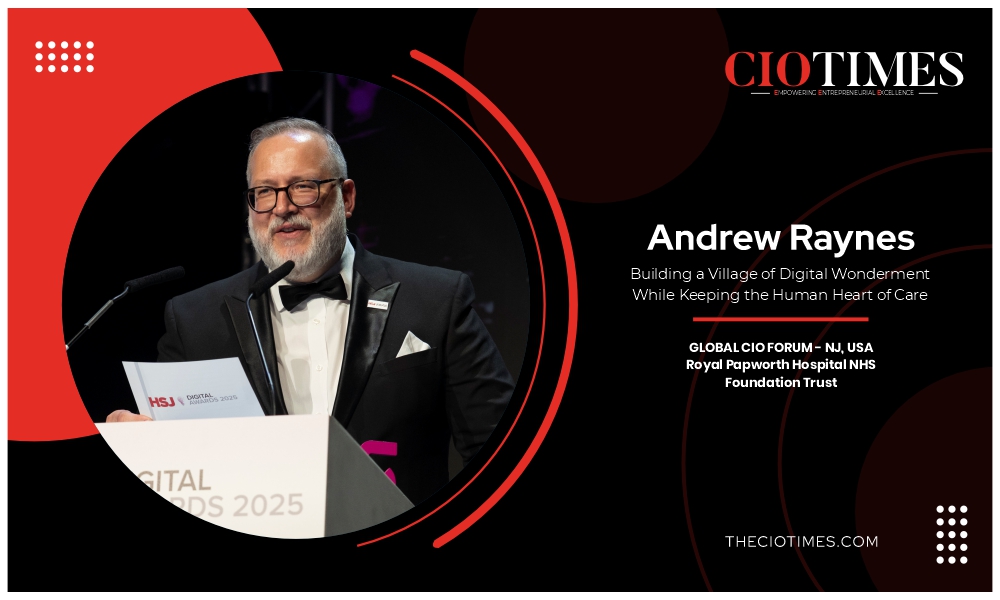
In multiple continents and industries, chief information officers are redefining leadership without being in the limelight. They patiently stand at the crossroads of innovation, research, and strategy that create tangible and real-world impact. Their role is as human as it is technical to ensure progress is uniform and never slows down. When talking about these leaders, Andrew Raynes is a name we cannot forget. Chief Information Officer at Royal Papworth Hospital NHS Foundation Trust, there’s a lot to take inspiration from his extensive two-decade career trajectory across healthcare IT, public sector transformation, education, and advisory leadership.
The Knowledge Hunger
For sure, he can be referred to as a knowledge-hungry professional, as his journey suggests. He starts the conversation by questioning whether or not a standard career journey exists for anyone. He believes that Chief Information Officers (CIOs) must gather a wealth of experience and perspective to be successful. This includes coming from diverse disciplines from infrastructure, DevOps, governance, security, training, and transformation, as well as soft skills. While exposure to private- and public-sector methods of working to more formal qualifications and professional registration (e.g., BCS Fellowship, CHCIO, Fed-IP) is crucial, it can also uphold academic experience and rigour.
He shares, “Career growth is often non-linear, requiring exploration and often moves across or outside organisations to gain necessary exposure, including business and finance. From my own personal journey, my experience started as a hospital porter looking to gain an opportunity to work in tech.”
He was accustomed to the switches between working in the health and private sectors, including overseas, the former Community NHS, Primary Care, the Strategic Health Authority, and the NHS National Programme for IT. He joined Royal Papworth Hospital NHS Foundation Trust following his prior role as IT Programme Director at Barking, Havering and Redbridge University Hospitals NHS Trust. His experience included working as a consultant training health tech students in Canada, implementing IT in a GP-led practice at HMP Thameside on the Belmarsh Prison Estate, and Liquidlogic, a children and adult social care system in a Local Authority in Leicester. More recently, commencing the roll-out of the Shared Care Record in Cambridgeshire and Peterborough ICS, AI for diagnostic imaging, and the implementation of a new surgical robot at Royal Papworth.
He feels honoured and has a great sense of privilege. He works as executive director, CIO, and SIRO at Royal Papworth Hospital NHS Foundation Trust, which is a globally recognised top 100 specialist cardiothoracic centre of excellence, on the Cambridge Biomedical Campus. A graduate of the Saïd Business School Executive Leadership Programme, he personally invested in his journey, self-funding a master’s in healthcare informatics, specialising in education, and achieving CHIME Certified Healthcare Chief Information Officer status. Today, as a Fellow of the British Computer Society and a Leading Practitioner with the Federation of Informatics Professionals, he champions the professionalisation of IT in health and care. His voice features in outlets including the New Statesman. He opened the Health Innovation Conference, while his Digital team were part of the overall hospital effort to earn CQC ‘outstanding’ recognition in 2019 and the 2021 HTN Now Award in their response to Covid.
Empathy Wins
Selecting the right work opportunity is the key, as it lays the foundation for your future, Andrew Raynes stresses. Work doesn’t turn out to be as easy as one expects it to be. It is complex, rapid, and disruptive. Sometimes he creates his own opportunities; sometimes they arrive unexpectedly; other times, he simply looks ahead, quietly anticipating what comes next. He always envisioned himself as offering social benefit and value in society via his profession. His career started by chance as he had to take up the job of a hospital porter at the age of 17 upon losing his father in a tragic car accident. He remains thankful to his family and guiding leaders who guided him towards the right path ahead.
From a porter, he went on to become a hospital switchboard operative, then as part of a team, implementing a Unix-based Patient Administration System (PAS) in the NHS in the mid-90s. He has simultaneously enjoyed many opportunities that have ignited the fire in him from EPR implementation teams, being an education and training lead for the National IT programme, and leading several high-profile projects.
He shares, “Hearing people’s stories, seeing kindness in action and adaptability, having a focus and achieving what has been set out, sometimes being able to put aside the distraction but to deliver something that really makes a difference.”
He reminds professionals to keep in mind the sustainability of technologies and make decisions that support the integration. For him, ultimately, transforming services through technology is more about change and improvement almost always involving people and processes.
Standards Aligned for optimal Integrations
Andrew Raynes is a mission-critical CIO and prefers striking a balance between innovation, cybersecurity, compliance, and patient safety. He also sees it as a challenge and has a focus on risk appetite to integrate innovation. He believes creativity should never be smothered, while also recognising the limits of pursuing innovation when it simply isn’t working, or worth reinventing. At times, innovation exists for an individual. One should be inclined to recreate the process till it adds significant value. Partnerships can prove beneficial in this space and help organisations in customised ways as needed. Ambition and innovation need to be in sync to know when to stop the integration of the same.
He says, “Set a scope, or is the innovation an open box. Do you have something that will already fix the problem, therefore optimise as opposed to rip and replace may be a better strategy? What’s more is not neglecting the tech stack, people, and whether the innovation is worth the effort in pursuing it if it doesn’t fix the issue.”
Innovation takes place in many ways, while it is also challenging to decide the level of innovation to leverage. He recalls a phrase from a respected colleague he met in Hong Kong who advised him in order to collaborate and to be a true partner; he needs to first have his own house in order. He understood the point well and started building on standards, enterprise, resilient architecture, and good integrations.
Digital Heart
For Andrew Raynes drew, the recent recognition is a “pinch-yourself” moment, a deeply humbling honour that he treats with genuine reverence rather than ego. He views these accolades not as a personal trophy but as a testament to the collective pulse of his team and the support network that carries the mission forward. His leadership is defined by a quiet but fierce love for the NHS, anchored by a philosophy that blends high-level purpose with a human touch, always ensuring that every pound spent translates into better care.
His roadmap for a digital-first NHS stays focused on:
- Mastering the fundamentals: He believes in maximising digital solutions for staff and patients alike, empowering people with data they can actually use and tools that work as fast as the clinicians do.
- Safety as a standard: Ensuring that every layer of service delivery is both safe and cybersecure.
- Connecting the dots: Making seamless care a reality by integrating systems and processes across entire regions.
- Fuelling the future: Pushing the boundaries of research and innovation through high-quality data and agile teams that excel in the “nitty-gritty” of deployment and testing.
- Designing for the planet: Prioritising digital designs that are as environmentally sustainable as they are efficient.
- Investing in people: Championing the professional growth of the Digital team, ensuring that as the technology evolves, the humans behind it do too.
Following Standardised Analogies
About sharing a digital transformation initiative that brought tangible outcomes, he thinks the key is the right technology for the right problem. He is intrigued by the skill that the records sharing capability has across systems, which enables the sharing of data and images. This is a more practical, affordable, and scalable approach for saving occupied clinicians. It has also helped in managing patients’ hours, helping to care for them. The most crucial one has been the launch of an internally built referral management system (PRIS3). The magic behind the transformation lies in a solution crafted by a development team that embraces the agility of low-code and no-code technology. While built for speed, the system is impressively scalable, now serving nine district general hospitals that all seamlessly refer into Royal Papworth.
For Andrew Raynes, the true breakthrough is how the adoption of rigorous standards, intelligent automation, and safe AI is finally dismantling the old barriers to information sharing, and the results are already beginning to surface in real-time.
Most recent is the introduction of ambient voice and building on Royal Papworth’s rollout of T-Pro’s document workflow and speech recognition as a core part of its digital transformation journey to enhance patient care. Through its partnership with T-Pro, the Trust has established a strong and scalable digital documentation foundation. Exploring AI-powered documentation through solutions such as T-Pro Scribe, which captures clinical conversations in real time and transforms them into structured, high-quality clinical documentation, helping the broader ambition to move towards more intelligent, real-time, and patient-centred documentation practices
aligned to NHS standards, ensuring that AI innovation is introduced in a controlled, transparent, and clinically safe manner.
Alongside these advancements, there is a quiet but powerful shift taking place through the thoughtful adoption of intelligent automation. Not as a replacement for people, but as an enabler of them, automation is helping to remove the repetitive, time-consuming tasks that can so often weigh down frontline teams. From working with E18 and the Digital workforce their approach to streamlining administrative processes, improving data accuracy, and ensuring information flows reliably across systems creates the space for clinicians and staff to focus on what truly matters: patient care. In a system where every minute and every pound counts, this kind of transformation is not just about efficiency, but about restoring capacity, reducing friction, and supporting a more responsive, human-centered NHS.
Aside from the progression, Andrew Raynes remains adamant that the technology is only half the story; the real heart of the operation is the people. He watched with immense pride this year as his digital team took full ownership of their professional evolution. They didn’t just meet expectations; they went above and beyond for their own growth, ultimately securing prestigious gold accreditation with the BCS.
Experiences Mould
His diverse expertise in NHS Trusts, local government, and advisory roles has a grounding effect in crafting a wider capability and a sense of outlook. A one-sided approach to all doesn’t work as context is vital. Leadership direction-setting is also crucial. Who sets the direction, is it top down, down up, or much flatter, are some questions that need to be answered. When stepping back to look at the true weight of leadership Andrew Raynes finds himself fascinated by what it takes to move the needle within a vast, complex hierarchy. He often muses on how to spark a shared ambition, a future that people can truly feel, be warm to, and see themselves in while staying deeply honest about the inequalities that still hold so many back. For him, the real art of leadership is balancing that environment so that every person feels genuinely seen and supported, rather than managed by some distant, elitist machine. He believes the heart of the answer lies in meeting people exactly where they are, walking beside them on a journey that feels incremental, achievable, and humanly sustainable.
His philosophy is rooted in the belief that while every path must honour its unique local story, it should be anchored by steady standards and the simple ability to work together. This means meeting the trailblazers at their level, but more importantly, reaching back to pull others up to that same bar by getting the quiet, essential basics right first. He is the first to admit this is no easy feat; it demands a sincere investment of heart, steady leadership, and the patience to find a sensible, human rhythm of priority. Ultimately, he calls for a more compassionate lens, one that never loses sight of the “greatest need,” even when the financial reality is at its toughest.
Be A Learned CIO
The bridge between everyday work and IT now sits in the hands of the people using it, and Andrew Raynes is focusing on making that connection feel natural while balancing the technical load with the right partners. Different corners of the organisation often hold the real wisdom about the tools they use. For instance, a CIO isn’t expected to be a niche expert in every single app; they are more of a seasoned generalist from a world of transformation.
While those specialists exist across the business, the CIO’s true gift is painting a picture of why a solid digital foundation matters for the person on the frontline. They act as a storyteller for the board, not just a member, but an independent voice sharing global success stories to help. It is all about making the value feel real so the whole organisation truly wants to come on board.
Upcoming Trends to Consider
- Cyber as standard and don’t underestimate the risk
- Bar code scanning and rigorous adoption of GS1 standards
- Interoperability and standards to support integration
- Hybrid cloud
- Modular standards-based technologies that work and fix genuine problems.
- Low-code, no-code rapid development apps,
- Sustainable AI, agentic, and robotics
Long-term Vision
Implementing a culture of innovation, collaboration, and accountability is achieved by providing the right liberty to them. They are also governed such that they feel supported in decision-making and delivery. Too many meetings can hinder work development, have control of what’s a priority and what’s not, and handle engagement oversight. Challenges are stimulated when events and managing partners are inspired through technology.
He adds, “Explore the wider organisational structures to ensure a line of sight into the board so that it’s sighted on the developments and risks.”
Steering Through Challenges
The ongoing challenges of handling multiple tasks at once, while prioritising what’s strategically important, what can be scheduled for later, and handling expectations. Doing everything together isn’t possible, so having a mechanism for streamlining the process is important.
He adds, “Set up tangible measures that you can navigate. Guardrails, which help manage the prioritisation process, are vital to survival and not biting off more than you can chew.”
He understands his technology foundation guides decisions; a Maslow-style hierarchy of digital needs clearly shows where investment must sit to sustain a resilient business.
Advice for the Future
Andrew Raynes advises to welcome new experiences with open arms, learn new things, and dive deep into unfamiliar areas.
He says, “Learn, remain humble and value your team, it’s they who make you successful.”
Digital Soul
The leadership journey for Andrew Raynes continues, fuelled by a deep-seated heart to truly move the needle in the world of health and care technology. He remains hungry to build a foundation where healthcare feels like it belongs to everyone. By being a listener first, he shapes a strategy that is as ambitious as it is balanced, bringing a genuine sense of value to the whole system. He is someone who has fought for the many, making a sustainable difference while never forgetting that it’s the taxpayer funding these efforts to help the many, not just an elite few.
He says, “In my legacy, I would like to have made a difference. In moving the hospital, my ambition is to have created a village of digital wonderment at Royal Papworth.”
Technology that is truly connected finally breathes time back into care, adding soul to our teams and delivering for them. This is all lifted by a highly qualified, eager family of staff who stay progressive and keep growing, remaining a deeply precious asset to the organisation and the wider NHS, health and care system.
Also Read:- CIO Times Magazine for More information