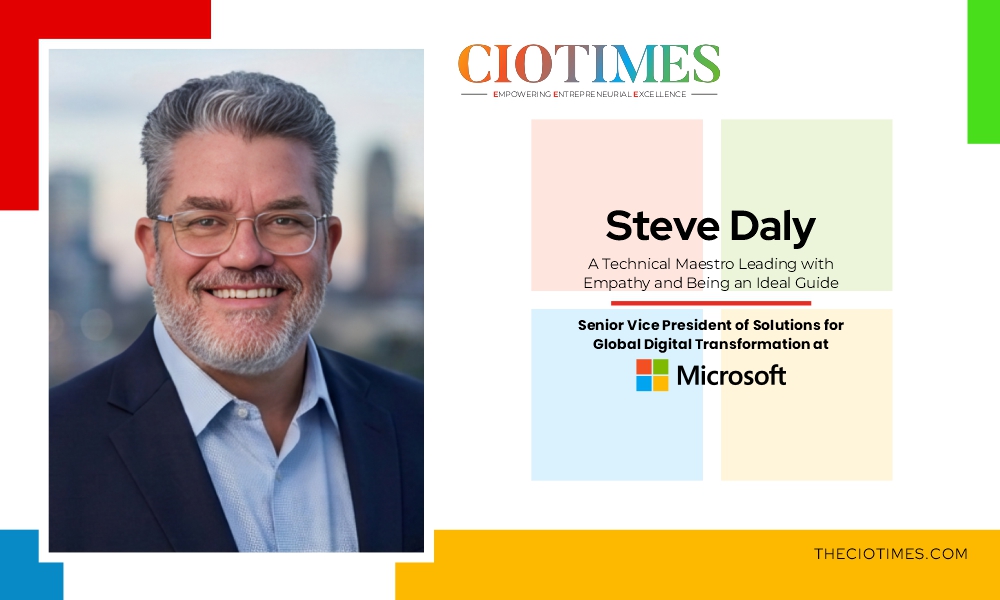
Microsoft, being the biggie it is, plays a pivotal role in helping businesses to get through today’s complex technology sector. The organization models itself as a strategic partner in transforming the powerful ecosystem it has nurtured. Microsoft 365, Azure, Dynamics 365, and more that are into solving real on-ground business challenges. Professionals who are associated with a giant organization like Microsoft are more than just technology partners. Leveraging technology from Microsoft, these professionals help reduce risk while improving collaboration and performing better in data-driven decision-making. We are elated to introduce you to a similar leader, Steve Daly, Senior Vice President of Solutions for Global Digital Transformation at New Era Technology. His 35 years of extensive experience in the technology sector have revolutionized how enterprises leverage cutting-edge technology to bring in unmatched growth and innovation.
New Era Technology is the AI, application, and infrastructure partner that simplifies, secures, and scales technology across modern work environments. New Era has solutions and service capabilities in 150+ countries and all 50 U.S. States. An Exemplary Trajectory
Being the expert he is with a comprehensive experience, he is humble as he believes in showing up each day while figuring things out during intrinsic inflection points. He shares that his first real job was at Providian, where he was working with a sharp entrepreneurial team led by a group of 4 unit presidents. First half of the week, he would be engulfed in writing code, and the other half, he would be on the phone with his parents of college age children on the other side, trying to figure out how to pay their college fees. This split taught him: the best technology solutions come from actually understanding the humans who’ll use them. Not from requirements documents. From empathy.
Upon joining Papa John’s, his skills fueled him more than he’d realize. He joined when they had stores of fewer than 500. He crafted the workflow systems that ran store development and management, which encompassed all operations. He also handled the team that launched PapaJohns.com, which was on Lotus Domino. E-commerce was integrated by the team before the playbook was even written by anyone.
Watching the systems he built to carry the weight of the company’s explosive growth and sometimes buckle under pressures he hadn’t fully anticipated was a turning point for Steve. That’s where enterprise architecture stopped being theoretical. It wasn’t about clean diagrams or polished strategy decks. It became something far more real: building systems strong enough to stretch, adapt, and keep going when the business demanded more than expected.
His path from there was anything but linear. He moved through consulting, media, startups, and government, gathering perspective with every chapter. He launched his own firm, Uptick Solutions, fueled by the same drive that shaped his early career. Later, as an Entrepreneur in Residence at UC, he found himself mentoring founders who reflected his younger self: ambitious, hopeful, and eager to leave a mark.
He adds, “Now I’m leading the global AI practice at New Era Technology, and honestly? It feels like everything before was preparation. Every technology wave—client-server, web, cloud, mobile, AI—requires the same fundamental skill: helping organizations see where things are heading before it’s obvious.”
Definite Output
As Senior Vice President of Solutions for Global Digital Transformation at New Era Technology, Steve’s job is as demanding as it is visionary. On paper, his mission sounds straightforward, but the reality is much more nuanced: he’s there to help global companies change in ways that actually move the needle. He isn’t interested in theoretical digital “fluff” or flashy slide decks; he’s focused on the kind of progress you can see in the data and feel in the daily operations.
Steve Daly’s world generally revolves around three big goals. He heads up the company’s global AI practice, guides clients through transformations that are built to last, and, most importantly, makes sure every project results in a tangible business win rather than just a nice presentation.
When it comes to AI, he lives and breathes the Microsoft ecosystem, specifically tools like Copilot Studio, Azure AI, and the Power Platform. But Steve Daly is the first to tell you that the real challenge isn’t the software. It’s helping a company move past the “AI is cool” phase and into the “AI is actually helping our bottom line” phase. That transition is often more of a human hurdle than a technical one.
Of course, transformation isn’t just about AI. It’s a complex balancing act of modernizing old applications, migrating to the cloud, and sometimes reinventing a company’s entire foundation. He works with many clients who are stuck in a tough spot: they’re running mission-critical operations on legacy systems while trying to embrace a future that demands a completely different way of thinking.
So, how does he make sure all this effort actually pays off? It comes down to a bit of healthy discipline. Steve Daly insists on defining what success looks like before a single line of code is ever written.
He adds, “I’ve developed AI envisioning workshops specifically to ground conversations in business problems, not technology wish lists.”
He sets clear metrics early and, perhaps most importantly, focuses on teaching the client’s own team how to manage the new systems. In Steve’s eyes, if a company is permanently dependent on outside consultants, it hasn’t really transformed; they’ve just traded one problem for another.
Faith Establishment
Steve Daly highlights three attributes that define a trusted Microsoft Solution Provider. Let’s see them one by one:
1. Technical depth
By in-depth technical knowledge, he means not just those who have logo certificates, but those who know everything about Microsoft. It includes: How Copilot Studio talks to Dataverse. How Azure AI services play with Power Platform. How Fabric changes everything about data strategy. This Microsoft lineup is powerful as it is deployed, but one needs people who authentically believe and know these components.
2. Business Acumen
This one bifurcates solution providers from implementers. Can you translate between technical capability and business strategy? Can you help clients see possibilities and constraints? Do you bring cross-industry pattern recognition that accelerates decisions?
He asserts, “If you can’t talk business outcomes in executive language, you’re just another vendor.”
3. Honest guidance
This one is the most crucial, he believes. The AI space right now is drowning in hype. Trusted partners tell clients what they need to hear, not what closes the deal. They recommend appropriate solutions even when expensive options would be more profitable. They acknowledge uncertainty instead of overselling.
He adds, “I’ve been in this industry long enough to see providers who nail the first two but fumble the third. Short-term, it works. Long-term, it always catches up with them.”
Solution-focused AI
He taps into the fact that there is a significant gap between a compelling AI demo and a production system that gives genuine results. Closing these AI initiatives is what his job actually is.
He envisions AI while posing these questions: What business problem is the team actually solving? Not “where can it use AI?” but “what’s the outcome it needs, and is AI the right tool?” Answers are both positive and negative.
When the hint comes as AI being the right answer, the team scrutinizes opportunities against reality, which includes data readiness, organizational capability, and integration complexity. Organizations that overlook this step often see bold pilots fade when real-world challenges surface.
The Microsoft ecosystem gives its team something invaluable: a trusted foundation. It allows them to move fast without cutting corners on security, compliance, or enterprise-grade requirements. Tools like Copilot Studio and Azure AI aren’t experimental add-ons; they’re built for real business environments, with the kind of governance many custom-built systems struggle to replicate. Over time, the team has developed particular expertise in crafting tailored RAG solutions that connect AI to a company’s own institutional knowledge. That’s often where the real differentiation happens, not in the tool itself, but in how intelligently it’s applied.
But technology alone isn’t enough. For him, measurement is non-negotiable. Before anything is built, clear baselines are established. After deployment, outcomes are tracked rigorously. AI that can’t demonstrate meaningful business impact won’t survive the next budgeting cycle, no matter how impressive it looks in a demo.
Tech Helps in Better Positioning
Steve’s team at New Era Technology meets the clients where they’re stuck and do not go with the analyst’s reports. The clientele of his team is already hustling with three situations he highlights:
- keeping legacy systems alive because they still run critical operations
- adopting cloud capabilities that require fundamentally different operational models
- figuring out AI before competitors do. These aren’t separate initiatives.
Their AI practice wasn’t built in a boardroom; it was shaped in the field, alongside clients navigating real complexity. The frameworks they use today were tested in live environments, refined through trial, pressure, and results. Deep expertise in Microsoft Copilot, Power BI, and Fabric integration, and custom RAG solutions didn’t emerge because they sounded impressive; they emerged because clients needed practical answers. Each capability grew from solving a problem that couldn’t be ignored.
On modernization, the work is just as grounded. Legacy systems often carry years of history and hidden fragility. Moving them into composable, cloud-native architectures isn’t just a technical upgrade; it’s clearing the path for what comes next. AI can’t thrive on scattered data or brittle infrastructure. The modernization effort creates the stability and clarity that make intelligent systems actually useful.
What sets the team apart isn’t any single capability. It’s how naturally they connect the dots. AI, cloud, modernization, these aren’t separate conversations. They’re parts of the same journey. Instead of isolated projects, they design transformation roadmaps that build on each other, creating momentum and long-term value rather than short-term wins.
The Microsoft Fabric
Steve Daly reminds us that the biggest opportunity is helping enterprises channelize AI. Showing a live demo has become outdated as clients are in search of partners who integrate AI at scale, supervise it ideally, and are observers of the impact, while improving it continuously.
Microsoft Fabric has been undervalued. The merging of analytics and data engineering to deliver AI into a single platform disrupts what’s possible. Serious value appreciation will happen for those who develop genuine Fabric expertise and can help clients escape their fragmented data landscapes.
Copilot extensibility is another component. As Microsoft rolls out Copilot across its suite of applications, the demand for enterprise-specific customization is surging. Businesses are not seeking generic AI assistants; they require AI that understands their operations. Developing tailored Copilot solutions that embed organizational knowledge and workflows is an emerging practice area poised for significant growth.
Lastly, he points out that AI governance is shifting from “nice to have” to “show me your framework or we’re not buying.” Regulatory oversight, reputational concerns, and board-level inquiries are intensifying. Providers that enable clients to establish strong AI governance without stalling innovation are likely to see growing demand.
Progress Crafted
Providian and Papa John’s were the foundational paths for Steve’s skill set. He, to date, uses the skills he grasped there. At Providian, his thoughts on solutions were refreshed when he had to tackle working with an entrepreneurial leadership team and customer interaction simultaneously. As he’d said before, half the week he’d be setting systems with technical excellence, and the rest of the week he’d make plans to lessen parents’ burden about their children’s college fees. Ideal technical efficiency comes from a genuine understanding of human problems and not from specifications written in conference rooms. Technologists rely on requirements and documents, while he learned to build based on empathy.
At Papa John’s, the experience and learning were diverse but formative. Technology architecture isn’t about elegance; it is about systems that flex when business demands it. He grasped this when the brand was nearing 500 stores and was aligning the systems as it was about to reach the top.
He led the team that built the first PapaJohns.com. Work was ongoing with fragmented information, ideating based on spot learning, and steering through uncertainty. That experience of guiding organizations into new technological territory, where nobody really knows the answers yet, maps almost perfectly to leading AI implementations today. Different technology. Same leadership challenges.
An Eloquent Project
Uptick Solutions has liberated Steve Daly to provide solutions across IoT, cloud automation, CRM, BI, and high-scale web platforms. A project he holds close to his heart is See Words Reading. It’s an AI-driven reading education system that uses animated fonts to help readers sound out words. The technology is sophisticated, but that’s not crucial.
He highlights that reading is a basic foundational skill that some kids struggle with and face a large-scale impact on their education, careers, etc. The project is a guiding light to address this challenge.
The animated font technology makes phonics visible in ways traditional instruction can’t. Letters move and transform to show how sounds combine. For learners who struggled with abstract phonics rules, it creates moments of genuine understanding that previously seemed impossible. Watching early testing sessions, seeing that light bulb moment in kids who’d been frustrated, was profoundly rewarding.
He shares, “This project also exemplifies what I love about startup work. The founding team had deep expertise in reading education and instructional design. My contribution was helping them build technical foundations that could scale and translating their vision into architecture that would hold up.”
This partnership and deep domain knowledge met technical capability at the right time, which made it more valuable than technically complex for Steve.
Data Modelling
Steve Daly has modernized legacy systems into fast and composable architectures. The strategies that he integrates from outdated infrastructures to AI-readiness, and cloud-native platforms, he likes to call it ambition with pragmatism.
Substantial large-scale transformations lead to failure on the part of organizations. The projects feel dragged, budgets skyrocket, and stakeholder patience evaporates.
He shares, “But organizations that only do incremental improvements never get where they need to be. They’re perpetually catching up. Finding the middle ground is an art, not a science.”
His team begins by clearly soaking in the current situation, not only technically, but operationally too. The questions they go through are:
- Which systems are actually critical versus just familiar?
- Which processes are embedded in legacy platforms versus merely running on them?
- Where is technical debt creating genuine business risk versus just annoying developers?
The answers to these decide what they handle first. The strangler pattern remains effective. It replaces legacy abilities with modern implementations while operations are ongoing in the background. Risk remains manageable, value accrues incrementally, and nobody has to bet the company.
For AI readiness, he places data architecture at the center. AI runs on accessible, well-governed data, yet in many legacy environments, information sits scattered across disconnected systems, riddled with inconsistent formats and little integration. Building a unified data foundation, often powered by Microsoft Fabric, becomes the critical path to making AI truly work.
But technology alone isn’t the finish line. He builds internal capability alongside delivery, ensuring teams can carry the momentum forward. Modernization isn’t a one-off project with a tidy end date; it’s a living capability. And lasting success depends on people who can keep evolving the platform long after the consultants step away.
Flexible Choices
Steve Daly points at startups and governments are facing opposite trends on a particular spectrum. Sensing both taught him everything about balance. Startups run on A/B testing, finesse in work requires patience. While you expect failures, he suggests celebrating them as long as the learning follows. This enables rapid innovation but can struggle with consistency when organizations scale.
In government, he found a world built on caution. Risk management shaped every move. Decisions traveled through layers of committees. The systems were designed to prevent expensive missteps, admirable in intent, but often so careful that progress slowed to a crawl. In that atmosphere, innovation didn’t die; it just struggled for oxygen.
Consulting taught him how to live between those extremes. He came to see that leadership isn’t about choosing speed or control, it’s about knowing when each matters. Some ideas need the urgency and freedom of a startup. Others carry stakes that demand patience and deep scrutiny. The difference often comes down to one question: if this goes wrong, how hard is it to undo?
So Steve Daly helps organizations create room to test and learn safe spaces where experimentation is encouraged while keeping mission-critical systems tightly governed. He pushes for clear signals that tell a team when a pilot is ready for the real world. And more than anything, he helps leaders build the judgment to shift gears at the right moment. Because in the end, frameworks fade. Sound judgment endures.
Intentional Camaraderie
Acknowledging high and ideal performance is central to Steve’s leadership. There are three principles that he relies on: trust, empathy, and execution.
Trust is basic. Efficient performing teams need psychological safety with confidence that intelligent risks won’t result in punishment when outcomes are uncertain. Establishing trust is being true to one’s word. Being transparent about challenges. Giving people genuine autonomy instead of micromanaging. And trusting their expertise even when their recommendations differ from your gut.
Empathy, for him, is acknowledging that the people behind the project have lives beyond the project. Each employee is motivated differently. Leading effectively requires understanding those differences. It means actually listening, not waiting for your turn to talk. Teams that feel genuinely understood give effort that transactionally-managed teams never match.
Execution brings it all together. Trust and empathy without results are insufficient. People need clarity about what success looks like, resources to achieve it, and accountability for outcomes. His duty is clearing hindrances, providing context, and ensuring alignment.
Steve Daly adds, “These principles matter even more for distributed global teams. The informal interactions that build trust in physical offices don’t happen automatically across time zones. You have to be intentional.”
Guiding Newbies
The majority of the founders Steve Daly collaborates with have domain expertise and vision, but haven’t spent careers building enterprise systems. Vision is clear, but knowledge and expertise are lacking.
This gap can be fatal, he reminds. Technology decisions that are made early on often determine whether startups scale successfully or diminish and require replenishment. Here are some questions that the new entrants should refer to:
- Should they build or buy?
- Which stack fits their use case and team?
- How do they architect for scale they don’t have yet, without over-engineering for scale they may never need?
- When should they hire technical leadership versus continue with contractors?
Context is the king in these questions, he highlights.
Steve Daly job is guiding founders through trade-offs they might not see. Having built systems across industries and across waves of technology, he sees patterns that first-time founders often can’t, at least not yet. Sometimes that perspective steers them away from costly missteps. Other times, it simply reassures them that their instincts are right and worth trusting.
But his real contribution goes beyond any single decision. He works to equip founders with the mental models to think technically for themselves. The goal isn’t dependence, it’s momentum. When leaders gain the confidence to navigate complexity on their own, they move faster and smarter. And when founders develop true technical fluency, even if they never write a line of code, the entire startup ecosystem grows stronger.
Embedded Intelligence
Steve Daly views Microsoft’s position in enterprise AI as uniquely powerful and strengthening with time. Copilot in Microsoft 365 is only the opening move. Soon, AI won’t feel like an add-on, but a native layer across every application, woven into the workflows organizations already depend on. The distinction between “using Microsoft” and “using AI” will simply fade.
Steve Daly sees Microsoft Fabric emerging as a default enterprise data platform, unifying analytics, data engineering, and AI in a way that finally addresses decades of fragmentation. As that foundation matures, AI becomes far more accessible.
Meanwhile, Copilot Studio and the Power Platform are putting sophisticated automation into the hands of business users. Innovation will accelerate, even as new governance challenges surface.
For enterprise leaders, his takeaway is straightforward: investments in the Microsoft ecosystem today grow more valuable as AI capabilities expand and integration makes adoption progressively easier.
Scaling AI Responsibly
At a moment when enterprises are moving from AI experimentation to real operational scale, he is focused on deepening his firm’s AI practice. The future, he believes, belongs to organizations that embed AI into core operations, not as scattered pilots, but as infrastructure. His energy is going into building the frameworks, governance models, and team capabilities that make that shift sustainable.
Responsible AI sits at the heart of that work. As capabilities expand, so do the risks. He is driven by the challenge of helping organizations deploy systems that are not only powerful but explainable and aligned with their values. It’s where technical depth meets judgment and where he feels most engaged.
Beyond delivery, he is investing in people. With decades of experience behind him, he sees his greatest leverage in mentoring teams, founders, and clients who will carry the work forward. Developing others, he has learned, outscales any individual contribution.
And in a field that never stands still, he remains intentionally curious. After thirty-five years, it’s that curiosity more than expertise that keeps him sharp and genuinely energized for what’s next.
Also Read: –CIO Times Magazine for more information