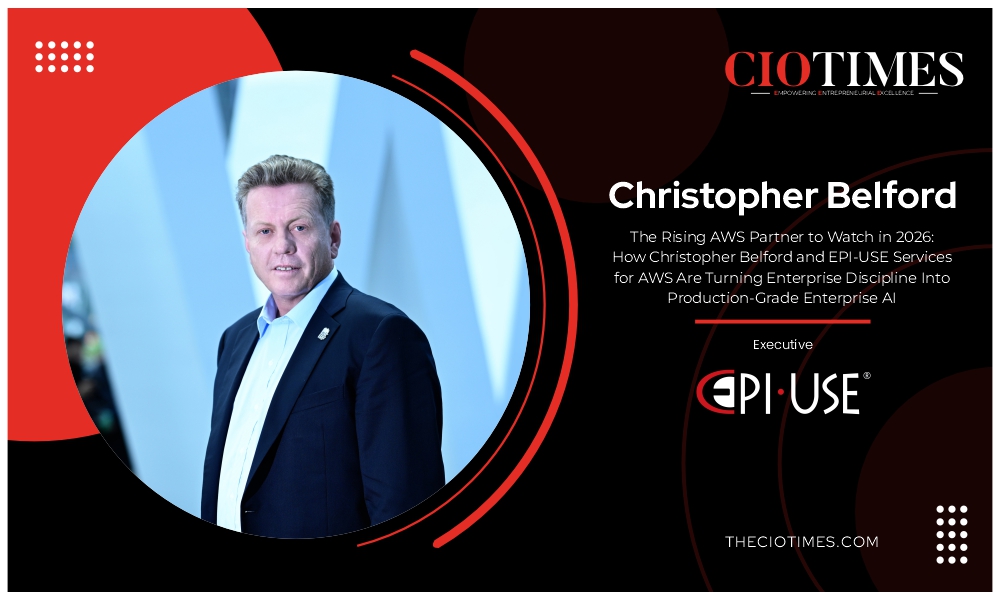
BUILDING CLOUD INTELLIGENCE, TOGETHER
Christopher Belford has spent more than two decades seeing the same lesson from a dozen different angles: enterprise technology only matters once it survives contact with reality: the messy exception, the regulator’s question, the claim that has to pay out correctly the first time. An Executive at EPI-USE Services for AWS, he now applies that discipline to one of the most consequential shifts in enterprise computing, moving Agentic AI out of the proof-of-concept carousel and into governed, auditable production, inside the SAP and ERP environments and other large application landscapes that already run the world’s mission-critical work.
EPI-USE Services for AWS is an enterprise cloud expert, part of a Group with 42+ years of SAP and ERP heritage, now serving 170+ clients globally as an AWS Premier Tier Services Partner and holder of the AWS AI Services Competency, a designation held by only a select group of AWS partners validated to design, deploy, and govern production-grade AI at enterprise scale. Together, Belford and EPI-USE Services for AWS call this discipline Cloud Intelligence: the practice of treating cloud migration not as a finish line, but as the foundation for autonomous AI agents on Amazon Bedrock, deep ERP-native integration, and the kind of rigorous governance that lets enterprises put their name behind what the technology decides.
We sat down with Christopher Belford to explore how that philosophy shapes his approach to enterprise AI, transformation, regulated industries, and where he believes cloud and AI are heading over the next decade.
CLOUD INTELLIGENCE & ENTERPRISE AI
EPI-USE Services for AWS sits at an unusual intersection: 42+ years of enterprise SAP and ERP heritage, now deploying autonomous AI agents on Amazon Bedrock. How did that deep ERP background shape the way you approach AI in the enterprise, and why does it matter for clients running mission-critical workloads?
Two decades inside and around ERP teaches you one discipline that AI hype tends to skip: the system has to be right every single time, because someone gets paid, taxed, or treated on the back of it.
That’s not abstract for us. We ran an Intelligent Document Processing program for a major insurer: roughly a million insurance documents across 20,000 company template variants, with unknown template distribution. The hard part wasn’t choosing a model. It was the 42 iterations it took to fine-tune AWS Bedrock Nova Lite to 93% field extraction accuracy in four weeks, and then standing up a production architecture on Amazon EKS, Textract, MariaDB, Amazon MQ and S3 that could actually be trusted inside an extraction process, one that scales under enterprise load and handles the exceptions the model couldn’t.
That’s what production AI looks like. Not a demo. Not a proof of concept someone quietly switches off six months later.
ERP heritage gives you the instinct to ask the unglamorous questions first: where does the data originate, who owns the exception, what happens when it’s wrong, how do we audit it? In a regulated environment, those questions aren’t bureaucracy. They’re the difference between AI you can put your name against and AI you can’t.
There is a significant gap between generative AI experimentation and Agentic AI running in production at enterprise scale. What does it actually take to get AI from proof of concept to production in a regulated enterprise environment?
The model is maybe 20% of the problem. The other 80% is everything the demo never shows you.
We built an Agentic AI program for ERP exceptions: cognitive automation applied to procure-to-pay. The ROI case came back at 53.8% automation, roughly 197 FTEs in freed capacity, over $1.2M in annual net benefit, payback under 2.5 years.
None of that came from a better prompt. It came from a deliberate four-layer architecture (data integration, agent deployment, workflow orchestration, user interaction) wired into the real process: the approval hierarchies, the audit trail, the fallback to a human when confidence drops, the monitoring that tells you when behavior drifts.
Crossing that gap means designing for the unhappy path, not the demo. You need clear guardrails, measurable accuracy thresholds, and a named owner accountable for outcomes.
In regulated environments, you also have to prove every decision after the fact.
Organizations that treat agents as software that must be operated, governed, and trusted (rather than as magic) are the ones that actually reach production.
EPI-USE Services for AWS uses the term ‘Cloud Intelligence’ to describe what it delivers. What does that mean beyond infrastructure, and how do you see cloud evolving from a migration destination into a genuine source of competitive advantage?
When we automated the deployment infrastructure for an enterprise test-automation platform on AWS, we took provisioning from two weeks to under two hours. That’s what Cloud Intelligence actually buys you, and it has nothing to do with where your servers live.
Cloud Intelligence is what happens before, during, and after a migration. The instinct to replicate your data center on a new platform is genuinely dangerous: you carry your old constraints onto a new foundation and wonder why nothing has improved. The cloud isn’t infrastructure with a better price tag. It’s the place where AI services, data, and automation sit on top of the workloads you’ve modernized, so decisions get made faster, not just stored somewhere cheaper.
That’s why our proprietary SHIP methodology (Safe Harbor, Inclusive of Passage) treats migration as a starting point, not a finish line. Its stages run Assess, Mobilize, Migrate, Manage, Modernize, supported by
EPI-USE’s Semantik software, so the modern data and AI layer is reachable from day one rather than bolted on years later. For large enterprises, the advantage isn’t being on the cloud. It’s being able to act on what the cloud now lets you see.
ENTERPRISE TRANSFORMATION AT SCALE
You have worked across government, financial services, insurance, and utilities. What are the leadership and organizational blind spots most likely to kill a transformation program, regardless of how strong the technology is?
Transformations rarely die of bad technology. They die of unowned decisions.
Prior to joining EPI-USE, I led the group that re-engineered South Africa’s Unemployment Insurance Fund’s Claims process: 18 paper forms, 700,000 claims a year, a five-week turnaround. We cut it to one week, removed two-thirds of the forms, and took 80% out of the processing time. The technology was almost the easy part. What made it work was that the process redesign and the people who ran it came along with the platform. When the system is right but the organization isn’t ready to absorb it, the system gets quietly rejected no matter how good it is.
The pattern repeats everywhere from self-service tax filing to the cloud migrations I’m running now. The first blind spot is treating it as an IT project when it’s an operating-model change. If the people whose jobs change aren’t in the room early, you’ve already lost. The second is the absence of a single accountable owner.
When everyone owns the outcome, no one does. The third is ignoring the edge cases, the exceptions, the data that’s wrong on arrival: the messy operational reality the system has to survive in long after the consultants have gone. Readiness for that reality is a leadership job. It always has been.
You are directing SAP ECC to S/4HANA and RISE cloud migration programs using EPI-USE’s SHIP methodology, and you published the AWS Partner Network white paper on SAP payment reconciliation. How is the S/4HANA migration journey changing as AI becomes embedded in ERP?
The migration used to be the destination. Now it’s the on-ramp.
The work behind our ERP PAY on AWS capability shows what that means in practice, and the key is that you can modernize at any stage without losing data context. On ECC today, ABAP-style integration through the AWS SDK for SAP ABAP lets us reach AWS AI and cloud services directly from inside ABAP, so reconciliation, document processing, and exception handling run where the financial data already lives, without brittle middleware.
Once you’re on S/4HANA, you extend that with SAP Event Mesh, streaming business events out to AWS in real time, again keeping the SAP data context intact. Utilizing SAP’s native AI capability internally and bridging externally where appropriate. That’s not a theoretical capability. It’s what we put in the AWS Partner Network white paper on revolutionizing SAP payment reconciliation, and very few partners can actually deliver it.
So, whether you’re laying a foundation to carry with you when you move to RISE or public cloud, or preparing the foundation on S/4 itself, the modernization compounds rather than restarts. These possibilities become even more dramatic when you add Data Lakehouses like Databricks and Snowflake. To paraphrase Sherlock Holmes: “Data, data, data. I cannot make bricks if I do not have clay.”
My advice to enterprises scoping these programs: stop treating S/4HANA as a technical replatform and start treating it as the foundation for embedded intelligence. The migration is where the future capability becomes reachable. Plan for the move and for what the move unlocks. Ultimately, the agents will run the software, the humans will run the agents.
EPI-USE Services for AWS serves 170+ clients globally across highly complex, regulated environments. What genuinely distinguishes enterprises that transform at scale from those that cycle through modernization programs without meaningful outcomes?
The ones that succeed pair technical depth with a serious respect for change management, and they design for the day we leave. Plenty of organizations can buy the same technology we deploy. What distinguishes the ones that actually transform is that they build the internal muscle to operate and evolve it, rather than treating each program as a one-off event to be survived. We are always on call for our clients and in some instances we manage the infrastructure entirely for them, but that doesn’t change the fact that using the systems effectively means understanding them and pushing them for better outcomes.
The cyclers tend to chase the platform and skip the operating reality. They re-platform, declare victory, and then discover nothing about how decisions get made has changed. The transformers obsess over the unglamorous middle: who owns the exceptions, how the new process holds up under real volume, how knowledge transfers to their own people. Across 170-plus clients the correlation is remarkably consistent: meaningful outcomes come from combining real engineering with honest organizational change, and from building systems that can survive in the messy operational world long after the consultants have gone.
REGULATED INDUSTRIES & DATA GOVERNANCE
Your career spans financial services, government, insurance, and utilities across South Africa, the UK, and the US. As AI and cloud capabilities deepen, how do you see the relationship between innovation and compliance evolving, and how does EPI-USE Services for AWS position compliance as a design principle rather than a constraint?
Christopher Belford learned this the hard way running technology for a business that sat between South Africa’s major banks, the Reserve Bank, and National Treasury, environments where you guide every product through New Product Approval before it touches a live rand. You internalize quickly that the controls aren’t friction. They’re the license to operate.
The old framing (innovation versus compliance, speed versus control) is increasingly false. In regulated industries, compliance is what makes innovation deployable. If you can’t prove how an AI agent reached a decision, you can’t put it anywhere near a regulated process. The governance isn’t the brake; it’s the enabler.
We carry that into the cloud now. The SOC 2, ISAE 3402, and PCI compliance roadmaps we lead across multiple geographies aren’t a checklist we run before go-live. They shape the architecture from the first design session: how data is segregated, how decisions are logged, how access is controlled. Designed in early, compliance actually accelerates you. Treated as an afterthought, it’s the thing that kills your timeline at the worst possible moment.
Enterprises generate enormous volumes of operational and workforce data, yet most still struggle to convert it into actionable intelligence. From where you sit, working across IoT, IDP, Agentic AI, and ERP environments, what are the structural and architectural changes that bridge that gap?
We built a smart metering analytics platform for a utility client that shows the pattern clearly. Chirp and MQTT sensors feed AWS IoT Core in real time, readings land in Amazon Timestream (purpose-built for time-series) alongside Aurora, and DeepAR demand forecasting plus Amazon Q run on top for capacity planning and anomaly detection. The system predicts demand and flags anomalies while there’s still time to act, instead of explaining yesterday.
That’s the gap in a sentence: most enterprises don’t have a data shortage. They have a latency and a context problem. The data exists, but by the time it’s been copied, batched, and reconciled into a report, the moment to act has passed.
Bridging it is mostly architectural. Stream rather than batch. Store data in a form that matches how you’ll query it: time-series in Timestream, not a general warehouse. Push the model to the data, not the data to the model. Zero-copy architectures, data catalogues, and enterprise-wide accessible taxonomy are technology realities today, not aspirations. The organizations that re-architect around those principles close the gap. The ones still bolting dashboards onto a warehouse stay stuck describing the past.
LEADERSHIP, PURPOSE & THE ROAD AHEAD
Your background is genuinely unusual: you have sat on boards and managed P&Ls, and you have also tuned models, written architecture documents, and reviewed deployment pipelines. How does that dual perspective shape the way you lead programs and work with clients?
Having been a board member and CIO, Christopher Belford have sat across the table from Central Bank and banking executives, C-suite executives and government policy makers. But I’ve also stayed close enough to the engineering that I know when something will hold up under load and when it won’t. Holding both makes you very hard to hand-wave at, in either direction.
Christopher Belford came into technology through process and problem-solving, which is probably why I’ve never been precious about staying on one side of the line. But the reason it matters more now isn’t biographical. It’s structural. AI collapses the distance between strategy and delivery. A single architectural choice about how an agent makes decisions is now also a governance, cost, and trust decision at board level. Leaders who can only operate on one side of that increasingly make expensive mistakes on the other.
Practically, it means Christopher Belford can translate. I can tell a CIO what a payback period under 2.5 years actually depends on technically. I can tell an engineering team why a particular control isn’t negotiable in a regulated context. The further AI moves into production, the more that translation becomes the job, not a supplementary skill.
EPI-USE Services for AWS is part of Group Elephant, which operates under a philosophy of going ‘Beyond Corporate Purpose.’ Some of your most formative work sits at the intersection of technology, public service, and societal impact. How does that philosophy shape the way you think about what enterprise technology is actually for?
To understand Beyond Corporate Purpose you have to start with where it came from: a nonprofit named Elephants, Rhinos & People, or ERP. There’s a deliberate irony in that acronym for someone in my field: in our world ERP means Enterprise Resource Planning, but at Group Elephant it’s a conservation NGO protecting Southern Africa’s wild elephants and rhinos, animals being lost at a rate of roughly four elephants an hour and five rhinos a day. Group Elephant is ERP’s leading benefactor.
What makes it unconventional is the strategy: the root of poaching is poverty, so ERP endeavors to alleviate poverty in the rural communities adjacent to those herds. The Group plows 1% of worldwide revenue into Beyond Corporate Purpose, and at present, that is entirely about ERP. In due course, there may be other focus areas.
It lands for me because the work that shaped me most had exactly the same shape. The UIF transformation sat between unemployed people and the support they were owed: 700,000 claims a year where, when the system fails, someone simply doesn’t get paid. The SARS e@syFile platform I designed serves 6.8 million taxpayers, pre-populating returns with the correct employer and tax data before the filing season opens.
The Home Affairs reconciliation system reaches 22 million citizens across four banks and the Reserve Bank. The Smart City platforms (Santa Cruz, Johannesburg, Tshwane, Ekurhuleni) let millions self-serve against real-time ERP data. Same three letters, same instinct.
Technology is ultimately for the people on the other end of it. You cannot architect those systems as if downtime is a line item, because the failure mode is human. When you build with that in mind, the commercial case tends to look after itself.
If you were advising a large enterprise CIO or CTO preparing for the next decade (defined by Agentic AI, autonomous operations, and the deepening of cloud as strategic infrastructure), what would you tell them to stop doing immediately, and what investments would you consider non-negotiable?
Stop running AI as a portfolio of disconnected pilots. The endless proof-of-concept carousel feels like progress and produces almost none: it generates slideware, not capacity. If a use case can’t articulate the production path, the named owner, and the number it moves, kill it and put the energy somewhere real.
The non-negotiables are three. First, your data foundation: agents are only as good as the data and governance underneath them, and that’s unglamorous, expensive, and the thing everyone wants to skip. Second, governance and observability for autonomous systems, built in from the start: you will be operating agents that make decisions on your behalf, and you must be able to see, audit, and stop them. Third, your own people: the capability to operate this has to live inside your organization, not permanently rented from a partner.
Christopher Belford think the next decade will reward enterprises that treat AI as an operating discipline to be built and governed. It is a systemic change to design and implementation. Thinking like this will open the way for competitive edge and innovation.
ABOUT CHRISTOPHER BELFORD AND EPI-USE SERVICES FOR AWS
Christopher Belford is an Executive at EPI-USE Services for AWS, where he leads Agentic AI and enterprise cloud transformation programs for organizations running mission-critical workloads on AWS.
Christopher Belford His technology career spans more than two decades across South Africa, the United Kingdom, and the United States in the financial services, government, insurance, and utilities sectors, including architecting the transformation of South Africa’s Unemployment Insurance Fund claims process, the SARS e@syFile platform serving 6.8 million taxpayers, the Home Affairs reconciliation system reaching 22 million citizens, and Smart City platforms across Santa Cruz, Johannesburg, Tshwane, and Ekurhuleni.
Christopher Belford has served as both board member and CIO, giving him a rare ability to translate between boardroom strategy and production engineering, a perspective that now shapes how EPI-USE Services for AWS moves Agentic AI from proof of concept to governed, auditable production inside the SAP, ERP and large application landscapes that run the world’s mission-critical work.
EPI-USE Services for AWS is part of Group Elephant, a global technology group of 4,200+ professionals across 42 countries. As an AWS Premier Tier Services Partner and holder of the AWS AI Services Competency, the practice holds 162+ AWS certifications and is a validated AWS Managed Service Provider trusted by 170+ clients globally.
EPI-USE Services for AWS • www.epiusecloud.com
Also Read :- CIO Times Magazine for More Information