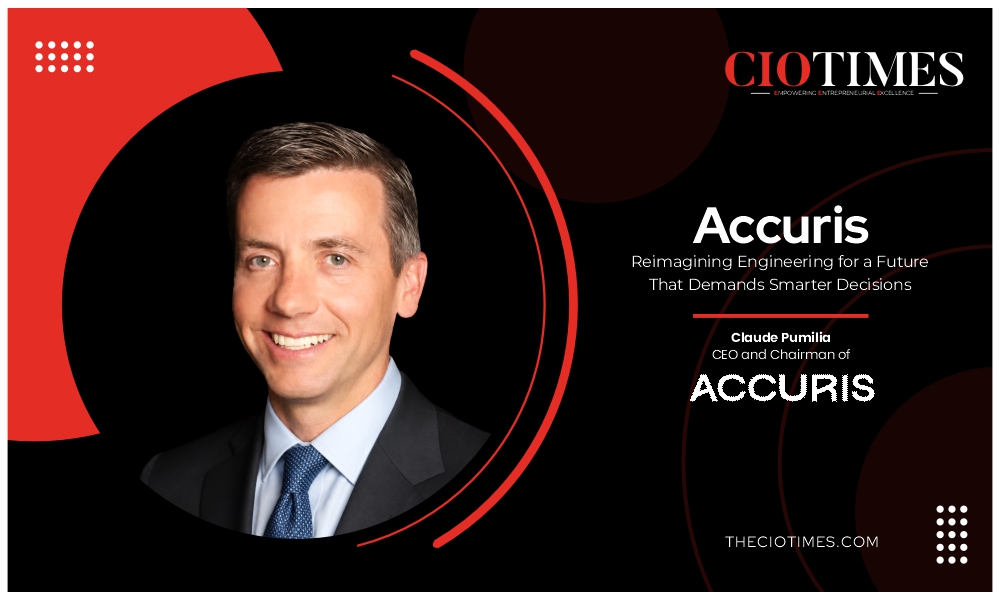
Engineering has entered a new era. An overwhelming abundance of information defines it. Today, the greatest competitive advantage no longer lies in accessing more data. It lies in making better decisions with trusted engineering intelligence. Claude Pumilia, CEO and Chairman of Accuris, believes this shift is reshaping the future of engineering. At Accuris, it is driving the emergence of an entirely new category: engineering intelligence. The organizations that will lead the future are those that can convert trusted engineering information into confident decisions.
Digital Precision
Technical excellence increasingly depends on having the right information at the right moment. Accuris has built its position around that need. It develops software and intelligence solutions that help engineering and supply chain teams work with greater accuracy. Whether teams are selecting electronic components, managing technical standards, ensuring regulatory compliance, or navigating supply chain risks, Accuris helps them work with greater accuracy and confidence. Its portfolio serves industries including aerospace, automotive, electronics, manufacturing, energy, and healthcare. These are sectors where even small decisions can have far-reaching consequences.
Decisive Engineering
The engineering and industrial sectors have moved from an era of information scarcity to one of information overload. In this environment, the difference lies not in collecting more data, but in turning it into a strategic advantage.
For much of the past 50 years, engineering organizations have struggled with limited information access. Today, the challenge is the opposite: organizations have more data than any individual—and increasingly any team—can realistically absorb.
The organizations that stay ahead will be those that provide engineers with trusted, contextual intelligence at the moment decisions are made. By bringing together engineering standards, historical knowledge, design context, supply chain intelligence, and compliance requirements, Engineering Intelligence helps organizations turn trusted information into confident, defensible decisions.
Generative AI has only heightened the importance of trusted information. While generative AI can summarize content, it cannot independently guarantee that the underlying information is authoritative, current, or legally defensible. That is why Accuris’ long-standing relationships with standards development organizations and national standards bodies remain so important. For more than 60 years, these organizations have trusted Accuris to safeguard intellectual property, present their work accurately, and make it accessible to the engineers who rely on it. In the AI era, Accuris believes this stewardship is more important than ever.
A Reliable Knowledge Network
Although technology has evolved significantly over the decades, the industry’s core need has remained unchanged. Accuris traces its roots to IHS, founded in 1959 on a simple premise: engineers need one place to find the standard, specification, or regulation they can trust. Standards development organizations and national standards bodies also needed a trusted partner to protect their intellectual property, preserve accuracy, and extend the reach of their mission to the engineering communities they serve.
The essential question for every engineer is whether the information is trustworthy enough to support a product or design decision. Accuris has evolved beyond providing content alone. It now connects trusted engineering knowledge, AI, and enterprise workflows within the environments where engineers already work. The mission remains the same, but the way Accuris delivers on it has fundamentally changed.
Decision Agility
Precision and rigor remain the foundation of engineering excellence. Those principles have not changed. What has changed is the pace of change engineers are expected to manage without compromising established standards for quality, safety, and compliance. A single export-control update or a new sustainability regulation can affect a bill of materials that took years to certify, yet organizations are now expected to respond in days rather than quarters.
The best engineering teams are those that maintain uncompromising quality while continually adapting to regulatory changes, supply chain disruptions, evolving customer expectations, and now the rapid rise of AI.
Excellence was once measured by building the right product. Today, it is increasingly defined by an organization’s ability to keep making the right decisions even as the landscape continues to shift. That requires connected data and connected workflows, because no engineer, regardless of experience, can keep up with that pace of change alone.
Balanced Intelligence
Quality must come before speed. This is what the team at Accuris aims for. Making poor decisions faster only accelerates risk. One of the biggest misconceptions surrounding AI is that productivity is its primary benefit. AI’s greatest contribution is not faster engineering; it is better engineering decisions. Speed follows when decision quality improves. A single engineering decision can influence certification, manufacturing, sourcing, warranty costs, cybersecurity, or public safety, with consequences that last for decades. Engineering Intelligence ensures AI recommendations are grounded in trusted engineering knowledge and complete traceability.
Organizations should view AI as a decision-quality multiplier, not simply as a productivity tool. The most successful implementations combine human expertise with AI recommendations backed by authoritative data and complete traceability to the source. When that foundation is in place, greater speed follows naturally. Without it, AI may simply enable organizations to make poor decisions faster.
Leadership Essentials
Technology eventually becomes accessible to everyone. What sets organizations apart over time is how effectively they combine it with proprietary knowledge, trusted information, and institutional expertise. According to Accuris, five capabilities will define the leaders of the next decade:
- Trusted data governance
- AI-ready knowledge resources
- Cross-functional decision-making
- Continuous learning
- Ability to rapidly operationalize new knowledge
Many organizations investing in AI today are competing to adopt the latest model. In Accuris’ view, that is the wrong benchmark, as models will continue to converge. The real advantage lies in building capabilities that are far more difficult to replicate and that strengthen over time. Accuris believes those qualities will matter even more five years from now than they do today.
An AI-Ready Environment
Many established organizations are balancing two priorities: preserving operational stability while embracing disruptive innovation. Accuris has found that the most successful organizations introduce innovation within reliable, well-governed frameworks.
The clear lesson in this: customers rarely want to rip out the PLM, ERP, or CAD systems they’ve built their processes around. They want these systems to become more intelligent and efficient without requiring teams to rebuild the underlying infrastructure. Integration matters more than replacement.
AI creates the most value when it operates within environments engineers already trust. It should connect isolated systems while preserving the governance and compliance controls organizations have spent years establishing. Innovation succeeds when it removes friction from existing processes; it fails when it requires customers to rebuild trust from scratch.
Nurturing Engineering Intelligence
Accuris sees Engineering Intelligence becoming a board-level priority because engineering decisions increasingly affect financial performance, operational resilience, regulatory exposure, and reputation. A single component substitution made without clear visibility into a supplier’s compliance status can surface months later as a recall, a warranty claim, or even a cybersecurity gap. A decision like this can quickly become as much a financial and reputational issue as an engineering one.
Accuris notes that engineering information was once integrated mainly to support engineering teams. Today, the same decision can shape supply chain resilience, regulatory exposure, and manufacturing costs simultaneously. Engineering decisions now influence:
- supply chains
- compliance
- cybersecurity
- product quality
- financial performance
For Accuris, organizations that treat Engineering Intelligence as a strategic business asset are better equipped to identify and address risks before they materialize. This is the point where true business resilience begins.
Confidence by Design
Trust begins with authoritative information. In engineering, that means every recommendation must be backed by evidence, not assumption. Every insight generated by the AI Assistant in Engineering Workbench and Accuris Thread is linked directly to a clause or section within a licensed standard. Accuris provides access to more than 3 million global industry standards through partnerships with more than 1,000 standards and content publishers from around the world.
This trust was built long before AI became part of the conversation. It reflects decades of working alongside the organizations that develop and maintain the world’s engineering standards. Accuris sees its role as making that knowledge accessible to engineers while protecting its accuracy, licensing, and intellectual property.
Transparency matters just as much as accuracy. Engineers should be able to understand why a recommendation was made, what supports it, and when their own expertise should take priority.
AI should increase confidence, not introduce uncertainty. Achieving that requires trusted content, explainable AI, and governance built into the workflow from the beginning.
Knowledge Access
One long-standing assumption is ready to be left behind: that engineers should spend a large part of their day searching for information instead of using it. Engineers create the most value by solving complex problems, not by moving between disconnected systems to find the right standard.
That is the problem Accuris set out to solve with its AI Assistant. Instead of searching across multiple applications, engineers receive answers within the tools they already use. The assistant provides citation-backed answers linked directly to the relevant clause in the licensed source document.
Accuris believes this is where engineering software is headed: intelligence built into the workflow itself, rather than simply adding a better search experience.
Smarter Decision-making
Accuris sees a clear distinction between digitization and transformation. One changes how work is carried out; the other changes how decisions are made. Many engineering teams spent the last decade replacing paper approvals and PDF-based standards with digital workflows. While that made processes faster, key decisions were still being made in much the same way, only through a digital interface. The process became faster, but engineers still had to determine manually:
- Whether the right standard was being used
- Whether it had been updated
- Whether certification remained valid
Actual transformation occurs when the decision itself is reshaped. Bringing together standards, historical design context, and supply chain insights at the moment engineers need them creates a smarter way of working that improves over time. Accuris believes that is the difference between simply digitizing a process and genuinely transforming it. This evolution represents the shift from digital engineering to Engineering Intelligence.
The Decision Imperative
Several forces are remolding engineering, but Accuris believes two stand out. Supply chain reshoring and geopolitical uncertainty are forcing organizations to requalify suppliers and components far faster than existing compliance processes were designed to handle. At the same time, expanding AI, cybersecurity, and sustainability regulations are placing new demands on engineering teams that were never built to carry them alone.
For Accuris, both trends point to the same challenge: decision-making infrastructure has not kept pace with the speed of change. Talent shortages only make that gap more difficult to manage, with too few experienced engineers available to absorb the growing complexity.
The future belongs to organizations that consistently convert engineering information into confident decisions. Those still relying on fragmented information and manual processes risk falling behind, regardless of which challenge arrives first.
Future Focus
Accuris measures innovation by the value it creates for customers, not by technology milestones alone. The Accuris AI Assistant is a good example. Its first objective was straightforward: help engineers find citation-linked answers within Engineering Workbench instead of making them search and verify information themselves. That meant delivering value from day one.
The same retrieval and traceability capabilities that make those answers reliable today also lay the groundwork for the broader engineering intelligence platform of the future. In its view, there is no trade-off between solving today’s challenges and preparing for tomorrow.
Accuris also believes innovation must support the standards ecosystem. The focus is on helping engineers access trusted technical knowledge in modern ways while protecting the integrity, licensing models, and long-term viability of that ecosystem. Accuris aims to establish Engineering Intelligence as a foundational enterprise capability, much as ERP transformed business operations decades ago. The objective is not simply faster answers; it is helping engineers make higher-quality decisions with confidence.
Trusted Future
Accuris envisions a new era of engineering—one that fundamentally rethinks how decisions are made. Its goal is to become the trusted intelligence layer behind those decisions. Success will not be defined by growth alone, but by helping engineers innovate faster, build safer products, and manage greater complexity with confidence.
Accuris wants to see the standards ecosystem thrive in the AI era. Authoritative standards should never lose their context or become detached from the organizations that create them. Instead, AI should expand their reach while preserving their integrity.
Looking ahead, Accuris hopes trusted Engineering Intelligence becomes as essential to engineering as ERP is to business—a legacy worth building for organizations that turn trusted information into confident decisions.
Also Read :- CIO Times Magazine For More information