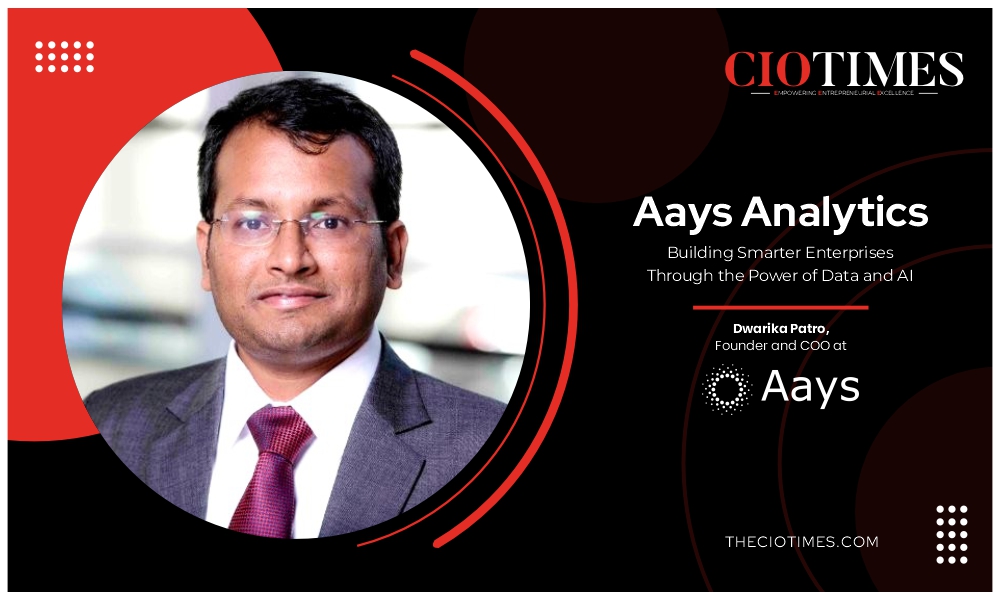
Artificial intelligence is being embedded gradually in the way modern businesses operate. The actual shift lies in how business leaders are turning emerging AI capabilities into meaningful organizational progress. Such efforts lead to forward-looking organizations placing higher emphasis on responsible adoption and building the right foundations for scale. Dwarika Patro, Founder and COO at Aays Analytics, exhibits a broader impact in such enterprise thinking. His experimental nature gives way to voluntary innovation and technology that becomes a catalyst for differentiation and serves as long-term organizational value.
In an insightful conversation with him, we got some real-time and valuable insights on how data, technology, and analytics, combined with innovation, make our lives easier without us even noticing. Please go through this intellectual interview of his with CIO Times to learn more.
- Aays Analytics has evolved from analytics and data engineering into a broader Decision Intelligence and AI partner. What fundamental shift in enterprise decision-making is Aays Analytics responding to, and how is it reshaping its own business around that shift?
We have always been a consulting partner to our clients, using technology as the underlying layer to solve business problems. What’s changed is the conversation we are having with them. Most large enterprises already have the cloud platforms, models and often the talent. What they need is a partner who can look at their data and say, with conviction, here is what’s possible, and here is where AI can change what you decide, not just what you see.
A CPG client, for example, had its Databricks platform and data in place but needed clarity on which decision to automate first. That’s the role we are increasingly playing – helping clients move from having technology and data to using them to make better decisions. We have brought data engineering, platform modernisation, AI and Agentic AI together because clients don’t experience these as separate capabilities. They experience one decision getting better or not.
- Aays Analytics has delivered more than $2 billion in measurable business impact across 200+ data engagements. What separates an analytics initiative that produces a compelling model from one that actually changes a business metric, decision or operating outcome?
Almost always, it’s what happens before the model is built. The engagements that move a metric start by defining the decision, who owns it, and what acting on it actually looks like. The ones that produce an impressive model but change nothing usually skipped that step. The team optimised for a technically strong result rather than changed behaviour.
We have been a business-first consultancy since day one. Business context comes before technique. And after go-live, adoption matters as much as accuracy. A model that nobody uses hasn’t changed the business, however good it looks in testing.
- Many enterprises have invested heavily in data platforms yet remain unable to convert fragmented information into timely decisions. Where does Aays Analytics see the real bottleneck today data architecture, organizational behavior, technology, or the absence of contextual business intelligence?
It’s rarely just one, but I would start with missing business context rather than architecture. We see organisations with well-built platforms, clean lakehouses and sensible governance that still struggle to make decisions in time. Often, the platform was designed without enough visibility into how the people making those decisions actually work.
The data isn’t necessarily wrong; it’s just not shaped around a specific decision. A forecast doesn’t improve simply because the data team produces a better model. It improves when the planners closest to the SKU trust the number, challenge it when needed, and act on it.
Technology matters, but in these situations – people, context and accountability tend to matter more.
- Aays Analytics combines deep industry expertise with advanced analytics and AI. In an era where foundational AI models are increasingly commoditized, how does proprietary domain knowledge become a genuine competitive advantage?
Model commoditisation is good for firms like ours. When everyone has access to similar foundation models, differentiation moves into knowing which business decisions actually matter and understanding the context in which those decisions are made.
In CPG, for example, the value isn’t in having access to a better model. It’s in understanding what drives a category’s P&L, how supply and demand interact, and knowing when an AI recommendation doesn’t make sense for that particular business. The models will keep changing. Domain understanding, business context and the ability to apply AI to the right decisions are what create lasting advantage.
- Aays Analytics is moving from predictive analytics toward Agentic AI and autonomous decision workflows. What changes when AI moves beyond generating an insight to reasoning through a problem, recommending an action and potentially executing it?
The biggest change is trust. A predictive model that is wrong produces a bad number someone can catch before acting on it. An agent that reasons through a problem and executes a step is now inside the decision. That requires a different level of transparency.
We build our agents so their actions are readable and auditable. A finance controller or supply planner should be able to understand what happened and override it when necessary. We are building toward autonomy one well-understood decision at a time. Trust given too quickly tends to get pulled back just as fast.
- Aays Analytics ’ Agentic AI work emphasizes context, multi-agent orchestration, enterprise integration and explainability. What governance framework does Aays Analytics believe organizations need before they can responsibly delegate increasingly consequential decisions to AI?
We think of it as a maturity ladder. How much autonomy an agent gets should depend on how consequential its decision is, not on how impressive the underlying model looks. Governance has to cover the full lifecycle – how the system is built, what data it uses, how it is monitored and how it is evaluated once it’s live.
Explainability also has to be designed in from the beginning. And for consequential decisions, a human should remain meaningfully in the loop, with real authority to intervene. Good governance doesn’t slow AI down. It is what gives leaders the confidence to scale it.
- Through AaDi, Aays Analytics is building domain-specific Decision Intelligence for finance, combining enterprise data, knowledge structures, AI and agentic workflows. What does this reveal about the future of the CFO organization and which traditional analytical workflows are most likely to disappear?
I think the bigger change is not automation. It is – separating the work that needs judgment from the work that doesn’t. We are already seeing this in our work. Our PayClear tool handles the routine work of reading, checking and clearing invoices, while people focus on exceptions and our Variance Copilot explains why performance moved, traces it to the underlying drivers and prepares the analysis for the CFO or FP&A team.
The CFO organisation doesn’t become less important. Its centre of gravity shifts – from producing and explaining numbers to challenging them, making trade-offs and deciding what to do. AI removes more of the work around the decision. The decision remains human.
- Aays Analytics has worked extensively across supply chain, procurement, finance, operations, CPG and manufacturing. Which business functions are currently seeing the most meaningful shift from “analytics-assisted” to “AI-led” decision-making, and why?
We are seeing the biggest shift in functions where decisions are frequent, data-rich and have a measurable business outcome.
Finance is one. Supply chain is another – particularly demand, inventory and planning decisions. We are also seeing strong potential in R&D, where AI can accelerate the cycle of generating and evaluating product ideas, and in revenue growth, where pricing and promotion decisions can become much more dynamic.
The common thread isn’t the function. It’s the decision. Where there is enough data, a repeatable decision process and a clear business outcome, AI can move from analysing the decision to actively helping drive it.
- Aays Analytics ’ data-engineering practice spans architecture, governance, DataOps and Data Mesh, while its AI work increasingly targets production environments. How does Aays Analytics prevent organizations from building sophisticated AI capabilities on fundamentally unreliable data foundations?
We are willing to say “not yet” when the data foundation is not ready. Agentic systems built on poor data foundations don’t remove the problem. They can amplify it at scale.
We focus on the fundamentals – data quality, lineage, access, governance and increasingly on domain-owned data products, so the people closest to the business also have ownership of the data. And this isn’t a one-time exercise. Data changes as the business changes, so the foundation has to be continuously maintained.
If you want AI to make decisions you can trust, you need data you can trust first.
- Enterprise AI often succeeds in pilots but struggles to reach production at scale. From Aays Analytics ’ experience, what are the most overlooked barriers to scaling AI and what must leadership get right beyond the technology itself?
The gap is rarely the model. It’s whether the solution was designed for production in the first place. We start with the business problem, the data and the operating environment. We think about integration, reliability, governance, monitoring and adoption alongside the model, so the path to production is part of the engagement from the beginning.
The other difference is use-case discipline. We don’t build PoCs simply to prove that AI can do something. We build them around a business decision or workflow where there is a clear path to value. That’s reflected in our numbers: 75% of our AI/ML PoCs have moved to production.
The client’s business ownership still matters enormously, but our job is to make sure the technology is ready to become part of how the business actually operates.
- Aays Analytics emphasizes explainability, governance and enterprise-grade deployment alongside innovation. How does the company balance the pressure to move quickly with the need to make AI systems auditable, reliable and trusted by business leaders?
I don’t think speed and trust are opposing goals. In an enterprise, the only way to move fast repeatedly is to have the right discipline underneath. That’s why we build explainability, governance and reliability into the system from the beginning, rather than adding them later. If an AI system is observable, traceable and operating within clear boundaries, you can innovate with much more confidence.
What slows organisations down is not governance. It is uncertainty – not knowing why a system behaved a certain way, whether it can be trusted, or how it will perform in production. For us, governance is not a control layer around AI. It is what allows the innovation to scale.
- With AI increasingly capable of automating analytical work, the value of human talent is also changing. What capabilities does Aays Analytics believe the next generation of data and business leaders will need as organizations move from analysts interpreting data to intelligent systems shaping decisions?
The skill that matters most is knowing when to question an AI system and when to override it. That’s a different muscle from building models or writing queries. Leaders will need to understand not only what an AI system can do, but where it can fail. Curiosity matters more than ever because the technology is changing faster than any individual can fully track. The people who do well will be comfortable saying, “I don’t understand this yet,” and then going to find out. We increasingly hire and develop people for that mindset, alongside technical and business capability.
- Aays Analytics is building toward a model where data, domain intelligence and autonomous AI converge into an enterprise decision layer. Five years from now, what does Aays Analytics believe will fundamentally change about how large organizations make decisions and what role does it intend to play in that transformation?
I would be careful making a confident five-year prediction here. This space moves fast enough that many forecasts don’t survive eighteen months, and I would rather admit that than sound impressive and be wrong. What I do believe is that decisions in large organisations will increasingly involve systems that can reason across a business, rather than simply report on one part of it. Exactly what that looks like will evolve. We have adapted through every technology wave so far, and we will continue to do so.
What I am more certain about is the role we want to play: not the firm with the most advanced models, but the firm whose systems people trust enough to act on. We will build that decision by decision, with the same patience that took us from 3 clients in 2019 to 50+ clients today – bootstrapped and profitable throughout.
To know more, please visit: https://www.aaysanalytics.com/
Also Read :- CIO Times Magazine For More Information