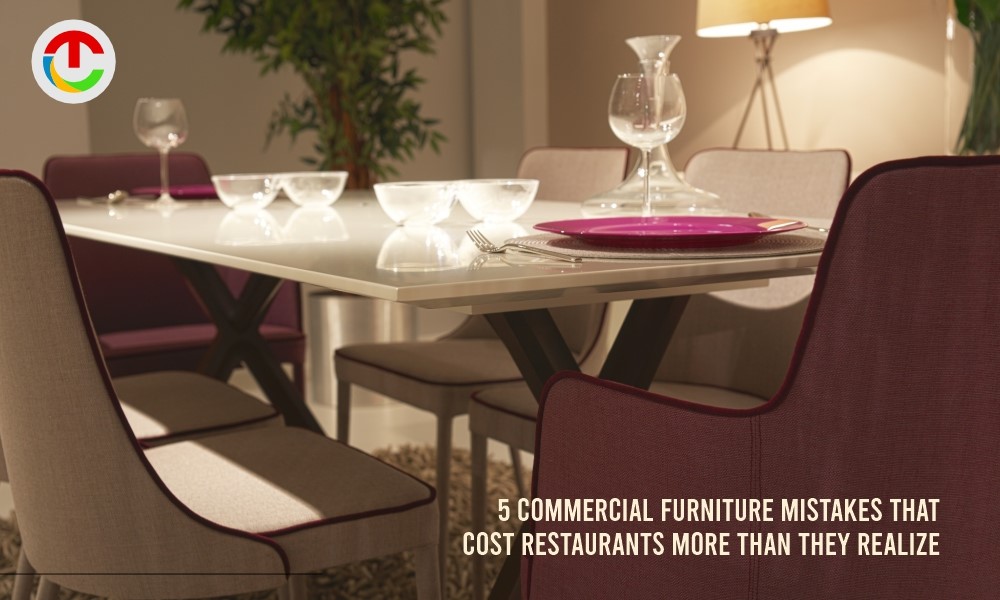
Menu quality and staffing get most of the attention during restaurant planning. Furniture decisions tend to get squeezed into the final stages, often with whatever budget remains. That habit is expensive. The wrong seating raises replacement costs, slows table turnover, and gives guests a quiet reason to choose somewhere else. These five Commercial Furniture Mistakes show up repeatedly across food service businesses, and each one carries a financial consequence that compounds well past the original purchase date.
Most Important Commercial Furniture Mistakes
1. Prioritizing Price Over Durability
1.1 Low Cost Rarely Stays Low
Affordable furniture feels like smart budgeting on paper. In a busy dining room, pieces built to residential standards rarely survive the daily load. Frames crack, joints loosen, and upholstery starts splitting within the first year.
Replacing chairs and tables every twelve to eighteen months costs considerably more than buying commercial-grade pieces from the start. Operators who skip that math often find themselves spending twice over, once on the original purchase and again on emergency replacements mid-season.
2. Ignoring the Local Climate and Environment
2.1 Materials React to Conditions
A humid coastal restaurant and a dry inland one need fundamentally different materials. Wood warps in moisture-heavy air. Certain metals rust faster than expected. Some upholstery fabrics trap heat or absorb humidity in ways that accelerate breakdown.
Operators sourcing commercial furniture in Dallas need to account for the region’s intense heat and strong sun exposure, especially for patio seating. UV-resistant finishes and moisture-tolerant frames are not optional extras in that climate; they are baseline requirements for pieces expected to last more than a single season.
3. Choosing Style Over Function
3.1 Aesthetics Do Not Replace Comfort
A chair that photographs well but offers no lumbar support is a liability in a dining room. Guests notice discomfort before they notice design, and that physical experience shapes whether they return.
3.2 Turnover Depends on Seating Design
Seat depth, chair height, and cushion firmness all send signals about pace. Fast-casual concepts benefit from firmer seating that naturally encourages guests to move along. Fine dining spaces need the opposite. Selecting furniture without considering service rhythm is a structural mismatch that affects revenue directly.
4. Overlooking Space Planning
4.1 Wrong Sizes Create Bottlenecks
Oversized furniture shrinks capacity and creates traffic problems. Pieces that are too small make a room feel bare and unwelcoming. Either outcome affects the guest experience in ways that are hard to reverse without a full reorder.
Accurate planning requires precise floor measurements and a realistic picture of staff movement patterns. Servers need clear paths between tables. Guests need enough separation to feel comfortable. Sorting these issues out before placing an order prevents costly reconfigurations down the line.
4.2 Flexibility Gets Overlooked
A fixed layout limits how well a space handles private events or seasonal volume swings. Stackable chairs and modular table configurations let operators reshape the floor without significant investment. For restaurants that host buyouts or see sharp seasonal peaks, that adaptability has a direct effect on revenue capacity.
5. Skipping Commercial-Grade Certifications
5.1 Certifications Signal Structural Reliability
The label “commercial furniture” does not guarantee consistent quality across suppliers. Certifications from bodies like the Business and Institutional Furniture Manufacturers Association confirm that pieces have been tested for load capacity, joint stability, and sustained daily use.
Purchasing uncertified pieces to trim costs creates real liability exposure. A chair that fails under a seated guest can result in an injury claim, and the legal and reputational costs of that scenario far outweigh any savings made at the point of purchase. Documentation should always be requested before finalizing supplier agreements.
Conclusion
These Commercial Furniture Mistakes share a common pattern: each one appears to save money or time in the short term, then surfaces as a larger problem months later. Durability gaps, climate mismatches, comfort trade-offs, poor sizing, and missing certifications all carry costs that show up long after the delivery date. Treating furniture as a considered investment, rather than a budget line to compress, leads to lower long-term spending, fewer operational disruptions, and a dining environment that holds up to the demands of daily service.
Also Read: – 8 Questions Worth Asking Before Trusting Any Furniture Store With a Major Purchase