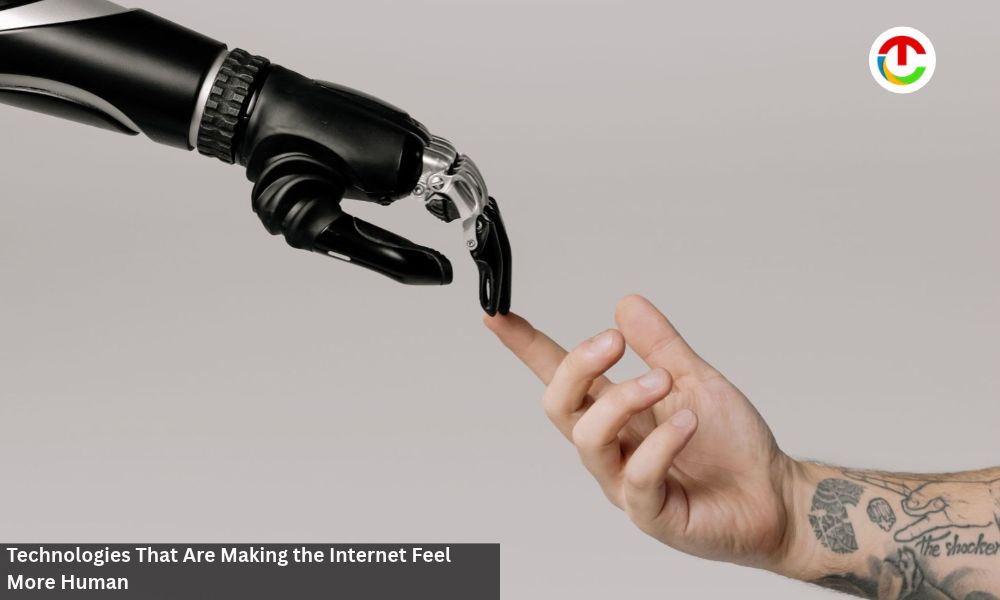
The internet was built to move data. Not feelings. For years, you could tell. Emails read like memos, forms felt like walls, and getting help meant an hour on hold. Today, about 6 billion people are online, roughly three-quarters of the world’s population. At that size, cold design stops being a small flaw. It becomes everybody’s problem.
Designers noticed.
The idea behind humanising technology is simple: tools should bend to people, not the other way around. Here is where that shift shows up most clearly.
1. Voice Assistants That Actually Listen
Typing is a skill we have to learn. Talking comes free. Voice assistants lean on that. Forecasts put the number of voice assistants in devices at 8.4 billion by 2024, more than the world’s population. Phones, speakers, watches, cars: they all listen now.
Picture a parent with both hands full of shopping, or someone with low vision who can’t read a tiny screen. One spoken sentence solves the problem in seconds. This is one of the best Humanising technology which technology give
2. Chatbots That Understand Normal Language
Older bots made you press 1, then 2, then give up. Newer language models read your sentence the way you wrote it, typos and slang included. Ask a messy question and you often get a tidy answer.
3. Real-Time Communication Puts Faces Back Online
Text is quick, but it strips out tone. A joke can land like an insult while talking to strangers. Live voice and video fix that. You catch the smile, the pause, the laugh a half-second before the punchline. Social platforms like fun Omegle offer real-time communication, where a chat begins with a person rather than a profile or a like count. OMGFun gives a completely different feeling than scrolling through your feed.
Open chat spaces still call for common sense. Used with care, live conversation is one of the clearest examples of humanising technology we have.
4. Video Calls That Feel Less Like Work
Remote jobs and long-distance friendships pushed video calling into everyday life. Then the small stuff got better. Noise cancellation hides the barking dog. Background blur hides the laundry.
None of this sounds dramatic. Yet together these fixes remove the friction that made calls tiring, and a call starts to feel closer to sitting in the same room.
5. Live Captions and Translation Remove Barriers
More than 1.5 billion people live with some degree of hearing loss, according to the World Health Organization. Automatic captions give them a way into videos, meetings and phone calls that once shut them out.
6. Translation Tools Dissolve Language Walls
Roughly 7,000 languages are spoken around the world, according to Ethnologue. Now live translation in browsers, video calls and phone cameras lets a farmer in one country chat with a designer in another. Live subtitles turn one shared meeting into something everyone can follow.
The results are not perfect. Jokes and slang still trip the software up. But even a rough translation turns silence into a conversation, and that is a big step.
7. Accessibility Features Built Into Everyday Devices
Screen readers, eye-tracking controls, text-to-speech, adjustable fonts. Not long ago, many of these were pricey add-ons. Now they ship inside ordinary phones and laptops.
That’s humanising technology at its most practical. Nobody has to ask for special treatment, because the option is already sitting in the settings menu.
8. Emoji, Stickers and Reactions Carry Feeling
A thumbs-up. A crying-laughing face. A tiny dancing cat. They look silly, but they do real work. They bring back the tone of voice that plain text loses. One well-chosen reaction can say “I’m with you” faster than a full sentence.
Platforms keep adding more: animated stickers, voice notes, quick video replies. Each one is another way to sound like yourself.
9. Wearables and Smart Homes That Adapt to You
A thermostat learns when you wake up. A watch taps your wrist to say it’s time to stand. Lights warm up as the evening goes on.
The best help doesn’t demand your attention. It reads the situation and acts, a bit like a considerate housemate who notices the room is cold before you say a word.
10. Personalisation That Helps Without Creeping You Out
Recommendations feel human when they act like a friend who knows your taste: you liked that film, try this one. They feel creepy when they know too much. The line is thin.
Good design keeps it clear. Show why something was suggested. Ask before collecting more. Technology that respects a boundary earns far more goodwill than technology that quietly crosses it.
11. Technology as a Bridge Against Loneliness
The World Health Organization reports that one in six people worldwide experience loneliness, and it links loneliness to roughly 871,000 deaths each year. Those numbers are heavy. Screens didn’t cause all of it, and they can’t fix all of it either.
What they can do is open doors. The best tools lead you toward people, not away from them.
Final Thoughts
Also Read :- The Role of Smart Technology in Making Homes Safer for Aging Adults