For most of its history, online retail has been sold on a simple promise: the store is open whenever the customer wants to shop. The promise holds up well for anything a parcel courier can leave on a doorstep. It gets shakier when the product is large or heavy enough to travel by freight. For years, a buyer in that position could reach the checkout page and find no shipping price at all, only an instruction to call for one.
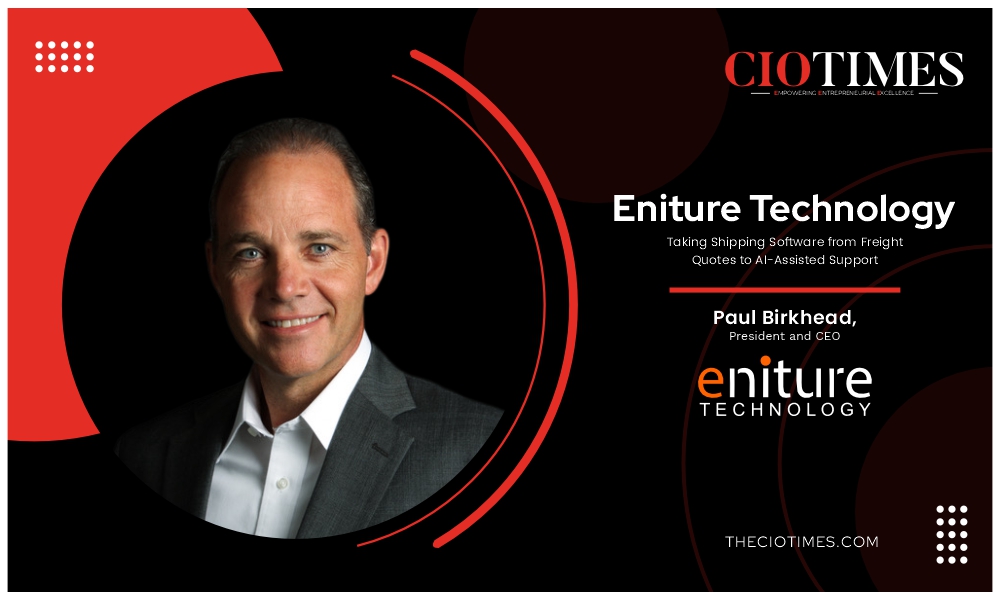
Eniture Technology was built to remove that phone call. Founded in 2015 by Paul Birkhead, its President and CEO, the company introduced off-the-shelf applications that bring real-time LTL freight quotes directly into the e-commerce checkout. Its software now covers parcel shipping, LTL freight, truckload transportation, and specialized delivery services across additional e-commerce platforms, but the purpose behind it has stayed the same. As Paul puts it, “Our mission remains to eliminate technological barriers that prevent merchants from fully participating in e-commerce.”
Three Careers, One Gap
Paul’s interest in online retail goes back to around 1995, when e-commerce was still in its infancy. Fascinated by what it might become, he launched a small online store called mytrainstore.com, selling Thomas the Train wooden toy trains. He ran it for about a year, mostly as a hobby and a way to learn how e-commerce actually worked.
His professional background is broader than retail, combining technology, telecommunications, manufacturing, logistics, and entrepreneurship, and he credits that mix with shaping how he approaches business and product development.
Earlier in his career, he held a variety of management positions at Nortel Networks, eventually reaching the director level, with responsibilities that spanned product management, marketing, operations, finance, manufacturing systems, and enterprise technology. That range shaped how he judges software. He explains, “Those experiences taught me to approach technology from a broader business perspective. A successful system must do more than perform a technical function. It must integrate with business operations, solve meaningful problems, and deliver measurable value.”
Beginning in 2001, Paul spent nearly 15 years in the shipping industry as a Worldwide Express franchisee, dealing with thousands of businesses and seeing their transportation problems firsthand. From 2008 through 2014, he also served as the franchisor’s Senior Vice President of Technology, where he was its highest-ranking technology executive. In that role he led the rebuilding of the company’s internal and customer-facing systems to support LTL freight and, later, truckload transportation.
Those years gave him a clear view of a significant gap in e-commerce. Merchants selling large or heavy products frequently had no way to show customers a real-time freight quote during checkout. Asked why Eniture began with freight, Paul keeps the answer simple: “Shipping, particularly LTL freight, became our initial focus because two things aligned: I had extensive experience in transportation technology, and there was a significant unmet need in e-commerce.” He set out to build something merchants could buy off the shelf.
The Checkout That Never Closes
Eniture Technology’s first products, launched in 2015, were what Paul describes as pioneering off-the-shelf, real-time LTL freight rating applications for Shopify, WooCommerce, and Magento. The goal was to let merchants sell products requiring LTL freight, truckload transportation, and specialized freight services through a checkout that runs on its own, 24 hours a day, seven days a week.
Until then, customers buying those products usually had to call for a freight quote. Paul is blunt about what that cost: “That interrupted the transaction and undermined one of e-commerce’s fundamental advantages: the ability to conduct business whenever the customer chooses.” Many merchants responded by leaving freight-dependent products out of their online stores. Others stayed away from e-commerce altogether.
Eniture Technology applications put real-time freight quotes on the checkout page, so a customer can complete the purchase without waiting for someone to calculate shipping charges. Accuracy matters too. The software retrieves rates from transportation providers and then applies the merchant’s own shipping configurations and business rules. That lowers the risk of undercharging, which erodes profitability, and of overcharging, which can discourage the purchase.
Over time, the product line grew well past LTL. Eniture added parcel shipping, truckload transportation, specialized delivery services, and increasingly sophisticated shipping rules, while extending its reach to more e-commerce platforms. Paul calls the result a more complete e-commerce experience. Merchants can sell a broader range of products around the clock, and customers get transparent shipping charges along with the convenience of buying whenever they choose.
One Cart, Many Shipping Realities
The harder problems show up when a single order doesn’t fit a single shipping method. Paul states the difficulty plainly: “One of the greatest challenges in e-commerce shipping is that products within the same catalog, or even the same shopping cart, may require entirely different transportation methods.”
Eniture Technology its technology evaluates the contents of a cart to decide whether parcel shipping, LTL freight, or both are appropriate. Depending on the e-commerce platform and the merchant’s configuration, the applications can present alternative shipping methods for an entire order or handle orders where different portions need different transportation services. That flexibility is particularly useful to merchants whose catalogs combine conventional parcel products with large, heavy, or oversized items.
Behind that logic sits a good deal of plumbing. The applications connect with multiple transportation providers, accommodate negotiated carrier rates, support multiple shipping origins, and apply configurable shipping rules. Specialized services such as liftgate delivery, delivery appointments, limited-access delivery, and other freight-related requirements can be incorporated as well.
Paul describes the aim in practical terms. “The objective is to make sophisticated shipping requirements manageable without forcing merchants to adapt their businesses to the limitations of conventional shipping applications.” The same idea shapes what Eniture does after the order comes in.
From Checkout to Bill of Lading
Paul splits the shipping job into two parts. He says, “We view e-commerce shipping as two interconnected challenges: determining the appropriate shipping charge during checkout and efficiently executing the shipment after the order is received.” Eniture’s quoting applications cover the first. For the second, the company offers FreightDesk Online, its cloud-based, multi-carrier transportation management system.
FreightDesk Online can retrieve orders from the merchant’s e-commerce store along with the information used to build the original shipping quote, such as packaging configurations, shipping origins, and additional transportation services. Fulfillment staff don’t have to reconstruct the shipment or reenter details on carrier websites. The system uses what it already has to streamline shipment preparation.
From that one system, merchants can generate parcel shipping labels, freight bills of lading, and other shipping documents for multiple transportation providers. FreightDesk Online can also connect to multiple e-commerce stores, so a merchant selling through several channels can consolidate its shipping activity in one place. Staff end up retyping far less, which cuts down on errors and on the time it takes to process each shipment.
Enterprise Technology at a Small-Merchant Price
Before Eniture Technology its off-the-shelf freight rating arrived, a merchant who wanted real-time LTL quotes at checkout faced a substantial technical and financial challenge. The merchant needed a shipping provider with a suitable API and developers capable of building a custom integration. Paul estimates that initial development could cost approximately $25,000, often for relatively limited functionality.
The build was only the beginning. E-commerce platforms update frequently, and transportation providers regularly modify their APIs. Merchants also had to maintain the server infrastructure, connectivity, and availability needed to support a business-critical checkout process. For smaller merchants, those ongoing responsibilities were often financially prohibitive.
In Paul’s telling, Eniture changed that equation by packaging carrier integrations, software development, maintenance, and production infrastructure into commercially available applications, with subscriptions he says start at just $20 per month. The SaaS model spreads the cost of developing and continuously improving the technology across the entire subscriber base. Each merchant keeps its own configurations and carrier credentials, while Eniture manages the applications and infrastructure centrally.
The lower price doesn’t come with a lighter product. Paul is firm on that point: “Importantly, small merchants and enterprise-sized businesses use the same applications. There isn’t a stripped-down version for smaller merchants.” The intent, as he describes it, is to make sophisticated, professionally maintained shipping technology available to businesses of virtually any size.
Carrier Independence and a Phone That Gets Answered
Asked what separates Eniture from conventional shipping and logistics tools, Paul starts with expertise. The company focuses on shipping requirements that, in his view, conventional parcel-oriented applications often cannot address, including the coordination of parcel and freight shipping within the same checkout experience.
He also points to how many carriers Eniture connects with. Merchants frequently want competing quotes from multiple transportation providers, particularly for LTL freight, where shipping costs can be substantial. Eniture Technology its applications let them present several carrier options or apply shipping rules that limit what customers see, including showing only the lowest-priced option. That improves the odds of presenting a competitive shipping charge.
Paul puts equal weight on carrier independence. Most merchants already have established shipping accounts and negotiated rates, and Eniture Technology is integrations generally let them keep those relationships instead of changing providers to suit their software. If a carrier relationship changes, the merchant can substitute another supported provider with minimal disruption.
Then there is the phone. Customers can reach Eniture by telephone, and email and support requests are typically answered within a day. Paul says, “It’s not uncommon for a prospective merchant to be genuinely surprised when someone answers the phone.” He believes sophisticated technology should come with equally accessible, knowledgeable support.
Within the Shopify ecosystem, Eniture has concentrated on needs that conventional e-commerce functionality often can’t accommodate, particularly LTL freight, truckload transportation, and specialized delivery services. Paul points to what he has seen on the platform: “We’ve seen merchants migrate from other e-commerce platforms to Shopify specifically because they wanted Eniture’s freight rating capabilities. We’ve also had instances where Shopify directed merchants seeking LTL freight solutions to us.” To him, those cases show the value specialized applications can bring to an e-commerce ecosystem.
He judges a technology partner by whether its applications solve meaningful business problems, expand what merchants can accomplish, and stay dependable as requirements change. Eniture keeps improving its applications as Shopify evolves, as transportation providers introduce new capabilities, and as merchants identify additional operational requirements. He sums up the bar this way: “Ultimately, an exceptional Shopify technology partner expands the platform’s usefulness, listens carefully to merchants, and provides dependable technology backed by knowledgeable support. That’s the standard we work to meet.” A good share of the work behind that standard happens where merchants never see it.
Built for Nearly a Million Daily Calls
Eniture Technology is applications run at the moment a customer decides whether to buy, which raises the stakes on every request. Paul explains, “Reliability is particularly important because our technology participates directly in the e-commerce checkout process. Shipping quotes must be delivered quickly and accurately, even as transaction volumes fluctuate.”
According to Paul, Eniture’s technology interacts with approximately 35 carrier APIs and processes nearly one million API transactions daily. Each transaction involves three independent parties: the e-commerce platform, Eniture, and the transportation provider. The merchant has a direct relationship with each one, and overall performance depends on all three systems working together.
To handle shifting demand, Eniture runs its production infrastructure on dynamically load-balanced server instances that scale automatically with transaction volume. The company also builds in diagnostics. Merchants can enable logging to examine carrier API interactions in real time, with carrier responses, latency, and error messages from transportation providers all on display. The logs help identify problems and separate carrier-related issues from those in other parts of the integration.
Because e-commerce platforms and shipping providers maintain their own APIs, they control how they communicate service interruptions and changes. When Eniture becomes aware of something affecting its applications, it shares the relevant information on its public status page, along with notices about its own services. Keeping all of it reliable, Paul says, means scaling the infrastructure, keeping problems visible, and watching for changes in every system Eniture integrates with, since each of them keeps evolving.
Listening With Discipline
Much of what Eniture builds begins with a merchant’s request. Paul says, “Our merchants are among our most important sources of product innovation.” They run businesses with an extraordinary variety of products, transportation requirements, and operational challenges, and their experiences keep revealing ways to improve the technology.
The company actively encourages feature requests and considers everyone. When a need has broader applicability, it often goes into an existing application, and depending on complexity, Paul says a release within a week isn’t unusual. Larger enhancements take longer.
Eniture Technology is also selective. It weighs whether an enhancement has meaningful utility beyond the merchant who asked for it, since building highly specialized, one-off requirements into a commercial application can add unnecessary complexity and compromise long-term maintainability. Merchant feedback, he says, has been a primary driver of the product’s evolution, always weighed against the reliability and integrity of the software.
Paul stays involved in virtually every aspect of product development. He says he originated the concepts for all 99 of Eniture Technology commercial software products, and as chief product architect he works with development teams on functionality, business rules, architecture, and user experience. He says, “My leadership philosophy is grounded in the belief that understanding the customer’s business problem is just as important as understanding the technology required to solve it.” He adds that successful innovation requires a willingness to tackle difficult problems that others may overlook.
AI That Keeps the Humans In
Automation has been part of Eniture’s mission since its founding, beginning with applications that removed the need to prepare freight quotes manually. Paul sees artificial intelligence as another significant opportunity to eliminate complexity, and the company already uses it to accelerate software development and maintenance, improve documentation, and speed up technical support and pre-sale responses.
Eniture Technology is now developing an AI-powered customer assistance system that Paul says goes far beyond a conventional chatbot. It can examine merchant configurations, identify carrier integration latency, interpret API errors, translate complex log data into understandable explanations, analyze screenshots, and give detailed guidance on shipping rules and application settings.
According to Paul, those capabilities are already functioning, and much of the current work focuses on making the conversation feel as natural and effective as talking with a knowledgeable member of the support team.
Paul says his view of AI differs from what he has seen at many companies: “Too often, businesses use AI to replace human support, making it increasingly difficult for customers to reach a person. I find that approach deeply frustrating, and we have no intention of following it.”
He is direct about the alternative: “Our AI Agent will complement, not replace, our existing human support organization.” He wants customers to prefer the AI Agent because it is available around the clock, can analyze complex problems in seconds, and provides a satisfying experience, and not because their other options have disappeared.
Support professionals can then concentrate on more unusual situations, which in turn point to new capabilities for the AI Agent. It also helps the company scale support efficiently and train new sales and support personnel. As Paul puts it, “I believe successful AI adoption should be measured by how much it improves the customer experience, not simply by how much it reduces staffing requirements.”
Beyond the Loading Dock
Paul calls Eniture Technology growth strategy opportunistic, guided by emerging market needs and by places where the company believes it can deliver meaningful value. Additional e-commerce platforms are evaluated continuously, but each needs APIs that support Eniture’s requirements and a merchant base that justifies the development investment.
Within shipping, carrier connectivity remains an ongoing priority. Paul is particularly interested in broadening white glove delivery integrations, and the company is watching LTL carriers that are beginning to offer truckload rates through their APIs. Shipping rules are another focus, as merchants increasingly want sophisticated control over how options and charges are calculated and presented. Paul says the company intends to stay adaptable, investing in commercially viable solutions that address meaningful business needs rather than pursuing technology simply because it’s new.
Eniture Technology also doesn’t plan to stay in shipping alone. Eniture has already introduced applications addressing other e-commerce requirements and is looking for opportunities to develop entirely new software products. Paul says he doesn’t view Eniture “as a company whose future must be confined to shipping.” He describes it as fundamentally a software development company, and its close contact with merchants surfaces operational problems, some with little or nothing to do with transportation, that existing commercial products don’t adequately address.
After more than a decade of building on its freight origins, Eniture plans to keep innovating in shipping as long as it can find meaningful problems to solve. Paul hopes the company will be recognized for consistently identifying underserved business needs and developing practical, commercially accessible software to address them, with its legacy defined by the problems it has solved and the value it has created for customers. In his words, “Shipping provided our starting point, but our commitment to identifying unmet needs and developing effective solutions is what will continue to guide the company.”
Also Read :- CIO Times Magazine For More information