Global tech budgets keep climbing, yet Forbes reports that only 16.2 percent of projects complete on time and within budget. Why? Because Complex Software Builds projects stall when internal teams hit their capacity limits, niche skills are missing, or new lines of business must be explored without distracting core engineering.
That’s exactly where a purpose-built external squad can change the odds. The following guide looks at ten vendors that specialize in building, running, and scaling serious software for enterprises, whether you call the model a pod, an embedded squad, or a completely remote R&D center.
Beyond Cost: The Strategic Upside of Dedicated Teams For Complex Software
Before diving into evaluation criteria, it helps to step back and ask why enterprises keep returning to dedicated development team services instead of simply adding more contractors one by one. The short answer is leverage – strategic, operational, and financial leverage that is hard to replicate with internal hiring alone.
The most successful programs rely on dedicated, cross-functional squads that own end-to-end outcomes. Those leaders cited four recurring advantages:
- A faster route to scarce skills such as applied AI safety, L4-L7 networking, or GPU optimization.
- A built-in culture of delivery discipline, honed across dozens of client codebases.
- Economies of scale on tooling (e.g., shared test labs, licensed security scanners).
- Reduced executive mindshare spent on payroll, benefits, and retention programs.
To make those benefits tangible, consider the following five-point checklist that seasoned CTOs run through before green-lighting a partner:
- Domain fluency. Has the provider shipped production workloads in my regulatory landscape?
- Velocity proof. Can they show cycle-time metrics, not just head-count promises?
- Retention playbook. How are senior engineers nurtured after month twelve?
- IP security posture. Is there an audited SOC 2 report and a clean track record?
- Joint roadmap governance. Do they co-own KPIs or merely clock billable hours?
A partner that scores well on all five fronts unlocks more than cost savings; it becomes a force multiplier that lets internal engineering stay focused on revenue-critical modules.
What to Look For When the Codebase Is Complicated
Veteran technology leaders rarely pick a vendor on rates alone. When evaluating dedicated development team services, seasoned CTOs check six levers:
- Talent depth in the precise stack or domain (chip design is not the same as retail mobile).
- Time-to-assemble: weeks, not months, is now the benchmark.
- Retention programmes that keep senior engineers glued to the project after year one.
- Governance that matches enterprise compliance without suffocating agility.
- Pricing logic that makes run-rate costs predictable.
- Cultural and time-zone alignment so that stand-ups feel natural, not forced.
Equally important is the provider’s stance on managed software teams versus pure staff augmentation. If you need outcome ownership, insist on the former. And when the brief involves new algorithms or experimental features, assess how much outsourced R&D experience the vendor can prove with past clients.
After short-listing, insist on a pilot sprint with a real backlog item. Metrics captured in that sprint – lead time, escaped defects, DevSecOps hand-offs – tell you more about day-to-day collaboration than any slide deck can.
The Leaders in Focus: Ten Providers Worth Your Short-List
Below are ten organizations that repeatedly surface in enterprise RFPs. Each brings its own flavour – European engineering hubs, Latin American nearshore agility, or India’s scale economics. The common thread: battle-tested delivery of complex builds.
1. Newxel
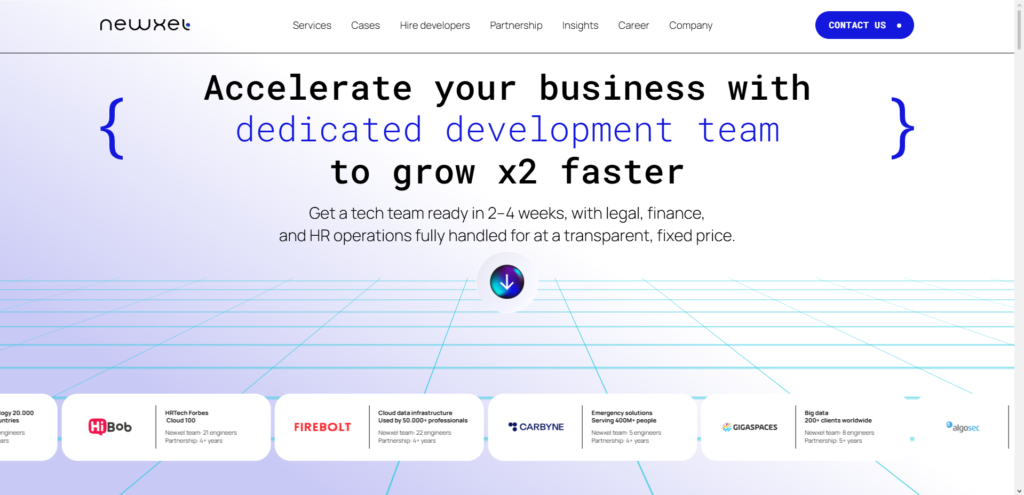
Kyiv-born and now operating from Warsaw, Newxel has honed a near-textbook playbook for spinning up outsourced R&D teams fast. First CVs land in your inbox within 10 business days; entire squads appear in under a month. A single flat monthly fee covers recruiting, HR, payroll, gear, and even local office space. It is Also Known for the Complex Software Builds.
What makes Newxel stand out is retention. With a 98% developer stay rate and an average 3.5-year tenure, the company all but eliminates mid-project attrition, a killer on long roadmaps, and it’s not just a self-reported number: Newxel carries a 4.5-out-of-5 employee rating on Glassdoor, with 85% of staff saying they’d recommend working there, which tracks with developers actually wanting to stay put. Case studies range from a five-person emergency-tech squad embedded with Carbyne, whose platform now reaches 400 million-plus people across 300-plus emergency centers worldwide, to a cross-border Ukraine-and-Romania team built for HR-tech company HiBob that’s grown past 15 specialists. If you want European (not only!) seniority without opening entities across eight countries, Newxel is a pragmatic, turnkey answer.
2. BairesDev

Founded in Buenos Aires and now boasting 4,000+ engineers, BairesDev built its reputation on delivering compliant, managed software teams to North-American enterprises. HIPAA, SOC 2, PCI-DSS, and even FDA rules appear routinely in its SOWs. That governance footprint explains why Google, Adobe, and Rolls-Royce keep coming back.
Engagements start around a $50k minimum, and Clutch pegs senior rates at $50-$99 per hour. Expect an internal PM and Scrum Master bundled into a dedicated team contract while you still steer technical direction. For BFSI, healthcare, or any domain where an audit may knock tomorrow, BairesDev’s blend of nearshore overlap and compliance maturity is appealing.
3. Tecla
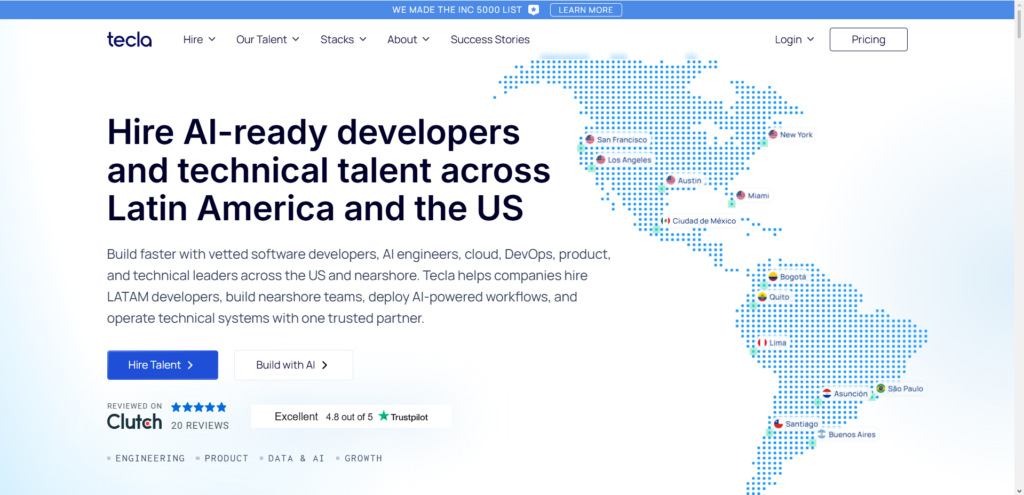
Need three data engineers and a QA lead by the end of the month? Tecla’s four-step vetting pipeline and 50k-strong candidate pool across LATAM make that timeline realistic. Beyond single placements, Tecla supplies complete “Pods” that arrive with their own PM, a turnkey flavor of managed software teams that mid-market firms love.
Rates are transparent: DevOps at roughly $7k/month, data engineers at $7-9k. Everything – payroll, compliance, even benefits – sits inside that single line item, de-risked by a 90-day replacement guarantee. If you’re tired of discovery calls that dance around budget, Tecla’s menu pricing is a breath of fresh air.
4. Mphasis
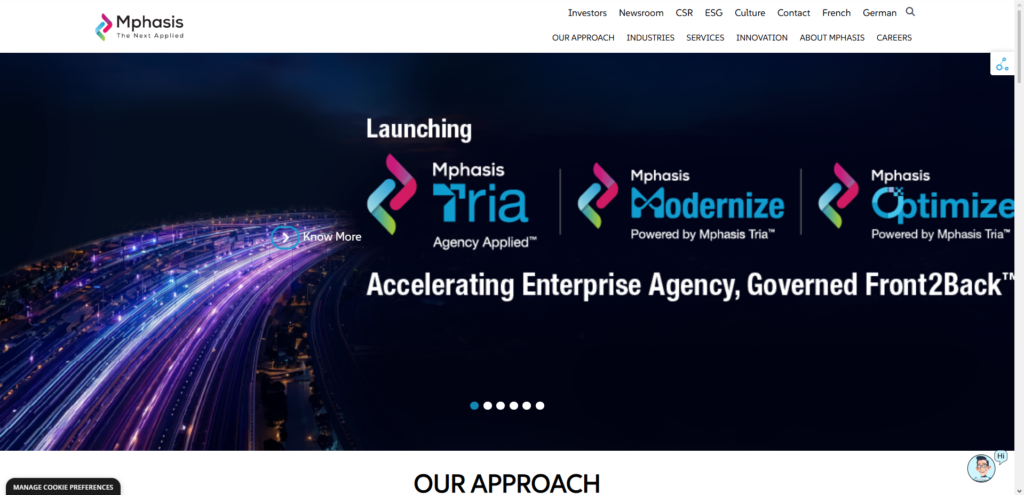
With 30,000+ staff and $1.8 billion in revenue, Bengaluru-based Mphasis dwarfs boutique shops. It is the only public company entry on this list and shines when the remit includes cloud migration, AI infusion via its Tria platform, and global follow-the-sun support. Inside that giant machine sit specialized tribes that deliver enterprise-grade dedicated development team services. . It is one of the top Known company for the Complex Software Builds.
Expect heavyweight governance, ISO-level security, and contractual complexity that mirrors Fortune 500 procurement norms. You pay for that rigor, but if the board demands a partner with balance-sheet muscle larger than the project itself, Mphasis answers the call.
5. Rootstack

Headquartered in Austin yet powered from Panama and Colombia, Rootstack strikes a sweet spot for mid-sized organizations upgrading legacy stacks. Its engineers are bilingual, agile-trained, and increasingly AI-assisted thanks to internal GPT/Copilot guidelines. Clients praise Rootstack’s structured sprint cadence and, importantly, its eye for incremental automation wins that free budget for new features.
For teams exploring chatbots, microservices, or CRM add-ons, Rootstack’s track record in outsourced R&D helps compress proof-of-concept cycles without rolling the dice on a bleeding-edge boutique.
6. Jobsity
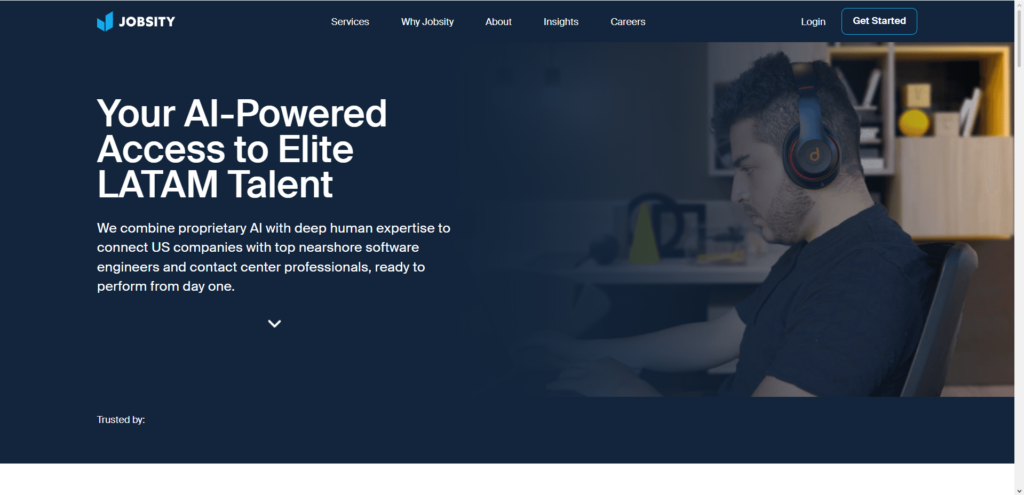
Jobsity’s promise is simple: vetted candidates in 72 hours and a 15-day risk-free trial. Pricing is a clean monthly amount; no markup surprises. Over the past decade, the company’s crews have pushed code for Google and McGraw Hill, all while sharing a Slack channel like any direct hire. It is Most versatile company to Known for the Complex Software Builds.
Because Jobsity also runs BPO operations, enterprises sometimes extend the relationship beyond code to Tier-1 end-user support. That bridge is rare among managed software teams, and it can be a budget saver when customer operations and engineering need to iterate side by side.
7. Sparq
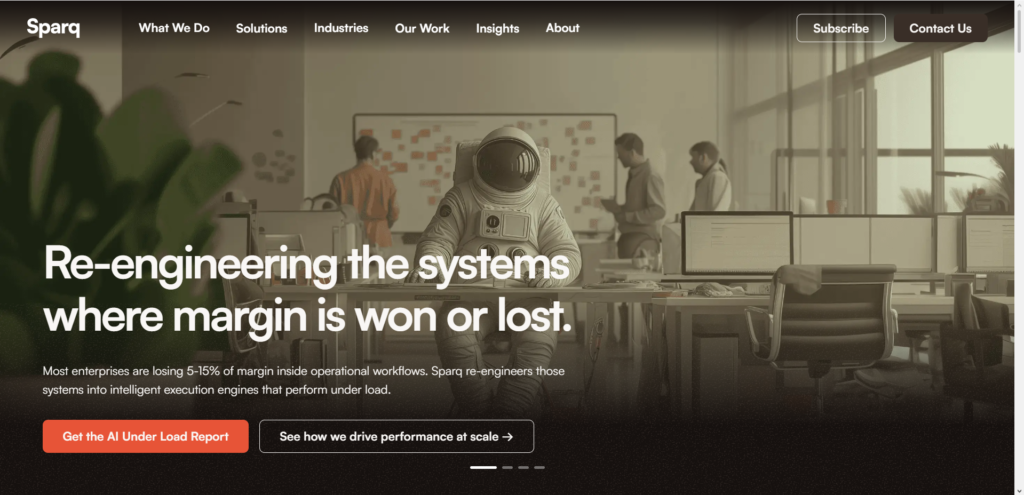
Backed by Bain Capital Double Impact and Harvest Partners, Sparq grew by acquiring niche leaders, giving it specialized benches in fintech, logistics, and AI governance. Its delivery model pairs US architects with Latin-American delivery squads, closing both the communication loop and the cost gap.
Sparq’s résumé boasts $220 million in client savings and 99% faster processing cycles after modernisation – figures audited during Bain’s due diligence. In other words, these are not marketing numbers. Add advanced DevSecOps and you get a partner tailor-made for outsourced R&D on systems that simply cannot go down.
8. UruIT (a Nortal Company)
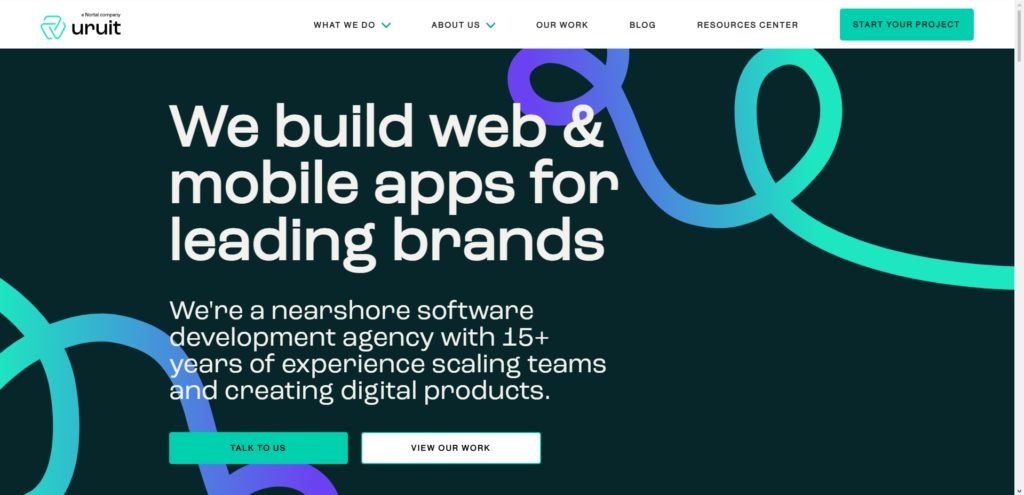
Montevideo-born UruIT slots small, cross-functional pods into a client’s SDLC with minimal ceremony. Discovery workshops frame scope; squads land about two weeks later. Now inside Nortal’s larger consultancy, UruIT offers scalability without surrendering its hands-on vibe, handy when the program mushrooms mid-flight.
For US teams, near-identical time zones and rapid visa processing make visits to Uruguay or Colombia smooth. And when C-level leadership wants proof of real agility, UruIT’s 150-product track record underpins its dedicated development team services, not just staff loans.
9. AgilityFeat
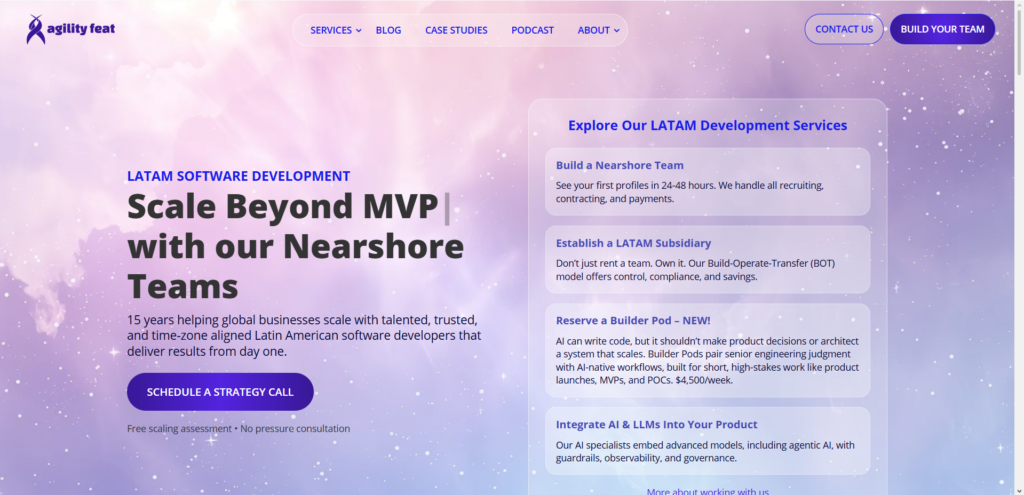
Some enterprises ultimately want their own captive center in Latin America. AgilityFeat’s BOT option makes that a contract clause, not a future headache. The vendor hires, manages, and then legally transfers the local entity once KPIs stabilise, a journey it has already completed with logistics-tech clients over 13 years.
Beyond BOT, AgilityFeat nurtures a WebRTC and real-time comms specialty via its in-house lab. If telehealth video or agentic AI chat is on your roadmap, you may kill two birds with one stone. And because the team is steeped in outsourced R&D, spikes and proofs-of-concept do not derail long-term platform goals.
10. Leanware
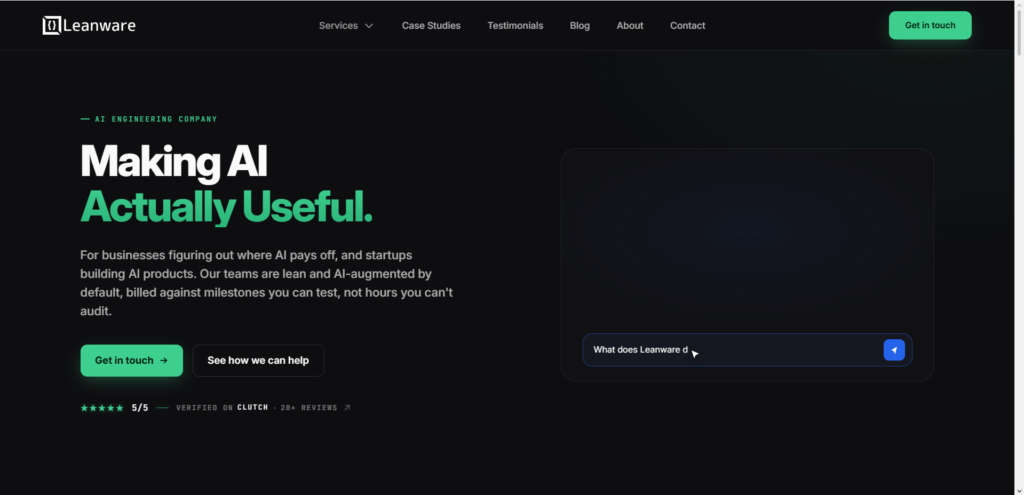
Founded in 2020, Leanware is the youngest outfit here yet and already a Clutch Global Award winner. Its pitch? Vet only 3% of applicants, publish salary-equivalent pricing openly, and focus obsessively on generative AI use cases.
Junior to senior ranges ($4k-10k) sit right on its homepage, shielding procurement from wild variance. Leanware’s squads have shipped fintech, health-tech, and legal-tech platforms rich in ML pipelines, a modern spin on traditional dedicated development team services for enterprises betting big on data products.
Navigating Commercial Models
Selecting a vendor for Complex Software Builds is only half the journey; agreeing on the right engagement model can mean the difference between velocity and vendor lock-in. Three patterns dominate today’s market, and each suits a different risk profile.
1. Pure Staff Augmentation
In this model, you pay for named individuals who report to your managers. It is attractive when process maturity already exists in-house, and the roadmap is crystal clear. However, be prepared to absorb the overhead of onboarding, code reviews, and performance management. Even with nearshore overlap, the burden of daily coordination rests on the client.
One under-appreciated pitfall is motivation drift. Because two chains of command evaluate augmented engineers, ambiguity can creep in after the honeymoon period. To mitigate this, enterprises often institute managed software teams for critical subsystems once the scale exceeds half a dozen engineers.
2. Hybrid Managed Teams
Here, the vendor provides a full-stack squad – devs, QA, DevOps, plus a part-time Scrum Master – while strategic decisions stay with your architects. Hybrid models shine when you need autonomy at the feature layer but still want to align with an internal platform vision.
Key advantages usually include:
- Easier vacation and absence coverage.
- Pre-baked DevSecOps pipelines supplied by the vendor.
- SLA-backed commitments on sprint goals.
- A single invoice covering delivery metrics, not hours.
Notice how accountability shifts from people to outcomes. KPMG reports that over 80 percent of enterprises now prioritize outcome-based contracts over traditional labor-cost models.
3. Fully Outsourced R&D Centers
Finally, some enterprises opt for an entire satellite centre, often 20 + engineers, run under the vendor’s legal entity. This suits moon-shot work or long-cycle platform rewrites. While capex is minimal versus an owned subsidiary, beware of exit clauses. Negotiate IP assignment, talent non-solicit terms, and a knowledge-transfer budget well before the first code commit.
A seven-item due diligence list helps de-risk that commitment:
- Local labour-law compliance track record.
- Employee retention incentives after year one.
- Dedicated security officer on the vendor’s payroll.
- Documented approach to technical debt management.
- Crisis-response protocol (power outages, political unrest).
- Language-training budget to maintain English fluency.
- Two-way knowledge-transfer cadence for eventual internalization.
Get satisfactory answers, and a full outsourced R&D center can transform innovation velocity without ballooning the HR budget.
Matching Your Project DNA to the Right Partner
Choosing among these ten is less about a beauty parade and more about alignment with your constraints. Most projects fall into one of four archetypes:
1. Regulated systems modernisation.
Think healthcare or payments platforms facing a looming audit. Here, BairesDev or Sparq combine compliance muscle with enterprise-grade tooling.
2. Green-field experimentation
Rapid proofs of concept in AI or edge computing? Leanware, Tecla, or Newxel’s fast-spinning pods excel.
3. Capacity overflow.
When internal feature backlogs pile up, Jobsity and Rootstack plug gaps without lengthy procurement.
4. Multi-year transformation
Mphasis or AgilityFeat (via BOT) scales into triple-digit head-count territory while supplying governance frameworks.
After selection, codify expectations. Shared OKRs, sprint demo templates, and a rolling three-month roadmap keep feedback loops tight. Remember, tools don’t fix incentives; only transparent KPIs and an early celebration of joint wins do.
Finally, treat culture integration as a first-class deliverable. Set up buddy programs, rotate code reviews across borders, and respect local holidays. Little gestures bake inclusivity into day-to-day rituals, strengthening the glue that keeps high-stakes road maps on track.
Conclusion: Turning Complexity Into a Competitive Edge
A decade ago, Complex Software Builds offshoring meant cost arbitrage. In 2026, the conversation has matured: enterprises crave velocity, domain skill, and retention more than rock-bottom hourly rates. The providers profiled here illustrate how varied the spectrum of dedicated development team services has become, from transparent small pods to globe-spanning transformation giants.
Select a partner whose strengths mirror your project’s weak spots, fund them for success, and keep governance lightweight but visible. Do that, and the right external squad stops being a contingency plan and becomes a strategic amplifier – one that ships, learns, and iterates faster than legacy hiring models allow.
Also Read :- Fortune 500 Companies Explained: Criteria, Rankings, and Business Impact