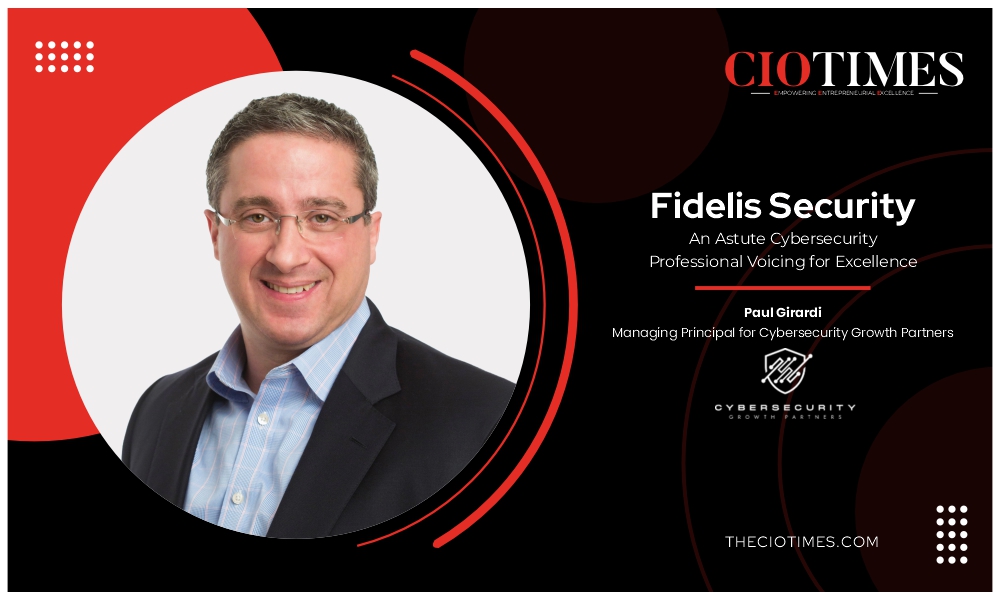
Cybersecurity has become a non-negotiable these days. It is the backbone of trust in today’s digital world. Industry leaders have transformed this space by protecting businesses from evolving threats and securing critical data at every level. Their expertise has helped organizations stay resilient, compliant, and future-ready. Among these leaders is Paul Girardi, Managing Principal for Cybersecurity Growth Partners. With deep industry insight and a strategic vision, he has played a key role in helping cybersecurity companies scale and innovate. His leadership reflects a strong commitment to building safer digital ecosystems and empowering businesses to navigate complex security challenges with confidence.
He also serves as a Senior Fellow and Adjunct Faculty Member at the Virginia Tech Hume Center. He is also a Board Member for the Master of Information Technology program within the Pamplin College of Business.
He founded the organization in 2023 with a vision to help bring innovative cybersecurity technologies and services to market, strengthen business growth strategies, and develop solutions aligned with evolving customer needs.
Before launching the firm, he spent over two decades with AT&T, where he led cybersecurity initiatives supporting Federal, State, and Local Governments. His leadership focused on compliance, threat protection, security operations, and emerging cyber risk management. He holds advanced degrees in Finance and Systems Engineering, along with a Bachelor’s degree in physics from Virginia Tech and George Mason University.
Human-Centered Cybersecurity Leadership
Recalling his leadership journey across engineering, cybersecurity, and large federal systems, Paul Girardi believes his insights about leadership in cybersecurity have changed substantially over the years. What once seemed rooted mainly in technical expertise gradually became far more human-centered.
Throughout his career, he learned that effective cybersecurity leadership is about judgment, trust, and the ability to make difficult decisions when the path forward is unclear. His experience across engineering, sales, and cybersecurity helped shape a balanced perspective, combining precision, accountability, and adaptability under pressure.
Paul also developed a leadership style grounded in both data and people. While metrics helped reveal performance gaps and guide decisions, he found that real success always came back to understanding the team itself, their strengths, motivations, and potential. For him, strong teams are part of the strategy.
Purposeful Reinvention
Paul Girardi admits the idea of starting a firm had been with him for a long time. His career at AT&T was fulfilling in many ways. He worked alongside talented people, supported important customers, and contributed to work that gave practical outcomes. Still, at the back of his mind, there was always a desire to create something from the ground up, something shaped by his own experiences, values, and vision.
Walking away from that kind of stability was not easy. He was not trying to escape anything. He had a strong career, meaningful work, and the backing of a respected organization. But sometimes comfort can make big decisions even harder. For him, the decision came down to one honest question: was he ready to trust everything he had learned over the years and build something of his own?
Retirement created the space for that reflection. Stepping away from the daily pace of a large company allowed him to think differently about the future and what he truly wanted to build next. That period of clarity eventually led to the launch of Cybersecurity Growth Partners in 2023.
He adds, “Starting Cybersecurity Growth Partners gave me the chance to build my own table, not just sit at someone else’s. After decades of preparation, I was ready for that responsibility.”
At the same time, the cybersecurity industry itself was evolving rapidly. He saw that many companies had strong technologies but often needed help turning those innovations into real growth, stronger partnerships, and practical customer value. Drawing from years of experience across engineering, sales, cybersecurity, and federal markets, he felt ready to help companies navigate that journey in a more focused and personal way.
Strategic Translation
His outlook on bridging the gap between engineering precision and commercial impact, he says, it comes down to communication and understanding how different people think. Throughout his career, he noticed that engineers and business leaders are usually trying to solve the same problems, but they naturally speak in different ways. Engineers focus on architecture, reliability, integration, and whether a solution will work. Business leaders, on the other hand, think about customer impact, growth, risk, and competitive advantage.
Over time, Paul Girardi realized that being technically right was not always enough. A strong solution still needed a clear purpose behind it. If people could not understand why a technical decision mattered to the customer, the mission, or the business, it was difficult for that idea to gain momentum. That became one of the most important lessons of his career.
His approach has always been to begin with the problem rather than the product itself. Instead of leading with features or technology, he focuses on understanding what challenge needs to be solved, what risks exist in the current environment, and what outcome the customer is truly trying to achieve. He believes those conversations create stronger alignment between technical teams and business priorities.
He also sees metrics as an important way to connect both worlds. In engineering, success may be measured through reliability or performance. In business, it may come down to growth and results. In cybersecurity, it often means reducing risk, improving visibility, and responding faster to threats. For him, good leadership means helping people understand how all of those pieces fit together.
He adds, “When you understand architecture, you can see opportunities others miss, explain them clearly, connect them to real value, and help the business make better decisions.”
That perspective is also why he values working with companies like Fidelis Security. He believes the real power of technology is not simply in the platform itself, but in what it helps organizations achieve: better decisions, stronger security, and greater confidence in a rapidly changing digital world.
An Active Earful
Paul Girardi highlights grasping customer needs well before pitching the product to them. This proved advantageous to them in their efforts towards DISA GSM-O and NETCENTS II. Winning begins with listening, he mentions. When working on large programs, one must understand beyond the written requirements. The customer’s mission, the components bothering them, what is not working today, and where the incumbent or current approach is falling short are elements that need to be paid attention to.
He adds, “When you know what the customer is really struggling with, the conversation changes, you are no longer just another vendor responding to an RFP. You become a partner who understands the mission.”
An important factor was bringing commercial innovation into a federal environment in a practical way. Government customers often have to operate within complex requirements, legacy systems, and acquisition constraints, making change difficult. Realistic ideas, when adopted from a commercial market, can be integrated into a federal mission, which gives the customer a clearer path forward.
Igniting excitement around the approach is another factor. Technical compliance is necessary, but it rarely wins on its own. The customer has to believe your solution will improve their mission. They have to see it, understand it, and feel confident enough to advocate for it internally.
He also stresses the importance of a team. Before crafting an ideal proposal, one needs to build a robust and proactive team. The right partners add credibility, fill capability gaps, and demonstrate to the customer that you have seriously considered delivery.
Last but not least, execution has to be blended with discipline. The factors like solution, proposal, and price need to come together. A great idea can be lost if the story is unclear or the price is wrong. The captures that win are usually those in which customer understanding, innovation, team strength, and execution all come together.
Harmonious Technology Integration
Paul’s leadership in cybersecurity operations for government clients at AT&T has shaped his outlook. The relationship of compliance and security needs to be paid more heed than it gets. Compliance is crucial, especially in the government sector, and needs to be considered at the starting point. It highlights that one has met a specific requirement as needed. It may or may not highlight the harm being caused.
He pinpointed a fact that organizations invest heavily in audits, policies, and checklists while feeling more secure than they are. Compliance frameworks are designed that way; he wasn’t criticizing. His goal is to use compliance as a foundation and build from there.
He also feels there needs to be more honest conversation around legacy infrastructure. Many government systems were built decades ago and have expanded over time through custom applications, fragmented networks, and aging technologies that were never designed for today’s cyber threats. He often explains that there is only so much an organization can achieve by layering modern security tools onto outdated architecture. Real progress comes from recognizing where deeper modernization and long-term investment are necessary.
That is part of why he appreciates working with companies like Fidelis Security. In his view, technologies that improve visibility across large and complex environments give security teams a far better chance of identifying threats before they become major problems.
He adds, “When you consider what is at stake, public services, law enforcement, defense, and national security, the conversation naturally belongs to the leadership level alongside other mission-critical priorities.”
At the same time, Paul believes cybersecurity can no longer be viewed as only a technical responsibility. When public services, defense systems, law enforcement, and national security are involved, cybersecurity becomes a much broader leadership issue. And while technology will always matter, he feels the organizations that remain strongest over time are the ones that invest equally in people, processes, and continuous learning.
Lessons from Disruption
Looking back on his early career at companies like Sprint Corporation, Qwest, and Lucent Technologies, Paul believes that period shaped the way he thinks about cybersecurity today in a lasting way. Starting his career during the internet boom meant witnessing technology evolve at an incredible pace. For him, it was an early lesson in how quickly industries can change and how easily organizations can fall behind if they are not prepared to adapt.
One of the experiences he remembers most was working at Rhythms NetConnections during the height of the startup era. The environment was fast, unpredictable, and exciting. Everyone had to move quickly, solve problems, and contribute wherever they could. That experience taught Paul to stay comfortable with uncertainty and focus on results rather than titles or rigid processes.
When the Internet bubble burst, it gave him a very different lesson. He saw firsthand that innovation alone is not enough without discipline, strong execution, and real long-term value behind it. Those experiences still influence how he views cybersecurity today.
He adds, “When I look at AI, quantum computing, or the speed at which cyber threats are changing, it feels familiar. The organizations that wait for things to settle down are usually the ones that fall behind.”
Whether it is AI, quantum computing, or the speed of evolving cyber threats, Paul sees many of the same patterns repeating themselves. He believes the organizations willing to adapt early are usually the ones best positioned for the future. That blend of startup resilience and large-company discipline continues to shape the way he leads and builds Cybersecurity Growth Partners today.
Career Realities
Through his work with Virginia Tech and his interactions with aspiring cybersecurity professionals, Paul Girardi has noticed a common misconception among young professionals entering the field: the belief that high demand automatically makes cybersecurity easy to break into.
He states, “Cybersecurity teams are stretched. They are responding to real threats, managing complex environments, and trying to keep up with adversaries that move quickly.”
Many students hear about the growing number of open roles and expect opportunities to come quickly, only to discover that many positions still require real-world experience and the ability to adapt quickly.
Paul Girardi understands why that can feel frustrating. Cybersecurity teams today are managing constant threats, complex systems, and fast-moving environments, leaving little room for lengthy onboarding. But he believes that does not mean young professionals are shut out of the industry. Instead, it means they should think more strategically about how they build experience.
He often encourages students to see careers in IT support, networking, infrastructure, or system administration as valuable starting points rather than detours. In his view, understanding how systems and organizations work in the real world creates a much stronger foundation for a future in cybersecurity. Certifications and coursework absolutely matter, but hands-on experience is what truly helps people grow into confident and capable cybersecurity professionals.
Adaptive Security
He believes cybersecurity organizations can remain agile by understanding the mission clearly. In his experience, organizations move more effectively when they know exactly what they are protecting, which threats are most relevant to them, and where their real vulnerabilities exist. He feels many teams struggle because they rely too heavily on broad threat information instead of focusing on risks that directly affect their own environment, customers, and operations.
He also believes strong cybersecurity programs are built on constant visibility and honest measurement. Over the years, he learned that metrics are not just reports for leadership meetings. They help organizations recognize where they are improving, where weaknesses are starting to appear, and where attention is needed before small issues become major problems.
Beyond tools and reporting, he sees culture as one of the biggest drivers of agility. The teams that perform best are usually the ones willing to learn continuously, adapt quickly, and improve after every challenge rather than waiting for a crisis to force change. In fast-moving security environments, small adjustments made consistently can strengthen an organization over time.
He shares, “Automation is also critical. At scale, analysts cannot spend their time doing repetitive manual work. They need tools that reduce noise, improve context, and help them focus on the alerts that matter.”
One example that stood out to him came during efforts to improve SOC operations, where implementing technology from Fidelis Security significantly reduced false positives. That shift allowed analysts to spend less time chasing distractions and more time responding to meaningful threats. For Paul, that is what real agility looks like, not simply moving faster, but helping people make smarter and more confident decisions.
He also feels AI is rapidly becoming part of the cybersecurity reality. Since attackers are already using it to evolve their tactics, Paul believes defenders must embrace it thoughtfully as well, while still keeping strong oversight, governance, and human decision-making at the center.
Lasting Foundations
Looking back on his early experiences at Lockheed Martin and GSA FEDSIM, Paul Girardi feels those roles shaped the foundation of how he thinks, leads, and solves problems even today. For him, those years were less about job titles and more about learning how large, mission-critical environments actually operate under pressure.
At GSA FEDSIM, Paul gained an inside view of government decision-making that few people outside the public sector ever experience. Being involved in procurement, evaluations, and requirements development taught him that decisions are rarely driven by technology alone. Mission priorities, operational risk, budget realities, and long-term impact all influence the outcome. That perspective stayed with him throughout his career and later helped him better understand customers, not just from a technical standpoint, but from a mission and leadership perspective as well.
Working with Department of Defense environments also left a lasting impression on him. Supporting organizations connected to the Army, Navy, and Air Force taught him the importance of discipline, accountability, and careful decision-making. In those environments, even small mistakes can create significant consequences, and that naturally changes how a person approaches responsibility and risk.
His time at Lockheed Martin brought a very different kind of learning. Paul Girardi stepped into software and web development at a time when the internet was still evolving rapidly, and there were very few clear roadmaps to follow.
He adds, “Lockheed Martin shaped me differently. I moved into software development and web applications at a time when the web was still new. There were no mature playbooks. Everyone was learning. I loved that environment because it forced me to grow.”
He remembers enjoying that uncertainty because it pushed him to learn constantly, adapt quickly, and figure things out in real time. That experience helped him realize that he thrives most in environments where growth and learning never stop.
When Paul Girardi reflects on the path his career has taken, from government systems and telecommunications to cybersecurity leadership, he sees one consistent pattern: choosing opportunities that challenged him rather than staying where things felt comfortable. That broader perspective still shapes how he approaches problems today. Before focusing on solutions, he first tries to understand the people, the mission, the system itself, and the larger impact behind every decision.
Well-suited Answers to Questions
Paul Girardi highlights that a good go-to-market organization from an exceptional one is the one with clarity, is the right fit in the market, and is accountable for its actions. Before hiring a candidate, the employer needs the answers to questions like:
- Who are the target customers?
- Which segments matter most?
- What specific opportunities are worth pursuing?
This clarity becomes a roadmap for the team that the employer builds. Regarding cybersecurity, the ideal candidate is the fully relevant one. Again, Paul puts forth thoughtful questions like:
- Does the person understand the customer?
- Have they sold into that market before?
- Do they have real relationships?
- Do they understand the problems the company is trying to solve?
Not all business development executives can work in all sectors. He got this insight by crafting teams from scratch and by consolidating existing teams. Starting from scratch is tough, he says, but the advantage of aligning the whole team around the organizational strategy is crucial. Accommodating teams can be tougher as one inherits different cultures, habits, loyalties, and performance levels.
The organizations that struggle usually have a disconnect between the market strategy and the people expected to execute it. They say they want to pursue a certain customer or market, but they do not have the relationships, domain expertise, or sales motion required to win there.
Exceptional organizations close that gap deliberately. They put the right people in the right seats, give them clear ownership, measure the pipeline honestly, and support them in the field. Accountability matters, but so does leadership support. He says that his job is to set direction, dodge obstacles, and help the team win.
Collaborative Alignment
Speaking about the ongoing challenge of collaboration between academia, industry, and government, Paul Girardi believes the difficulty is not a lack of interest, but the reality that each group naturally operates with very different priorities and pressures. In his experience, everyone may be working toward progress, but they are often measuring success in completely different ways.
Paul Girardi explains that universities are typically focused on research, innovation, student growth, and long-term academic goals. Industry leaders are thinking about customers, growth, execution, and how to bring ideas to market quickly. Government organizations, meanwhile, are responsible for mission outcomes, accountability, policy requirements, and national security concerns. He feels those differences are understandable and, in many ways, necessary because each side contributes something important that the others cannot fully provide on their own.
Where Paul Girardi believes these collaborations become truly valuable is when all three groups rally around a real problem that needs solving. The government can provide mission direction and funding support. Industry can bring practical experience and the ability to turn ideas into scalable solutions. Academia contributes research depth, innovation, and emerging talent. When that balance comes together properly, he believes the impact can be significant.
At the same time, Paul has seen partnerships lose momentum when expectations are not aligned early. Sometimes the structure itself becomes the issue. Timelines may not match, responsibilities may feel unclear, or different organizations may move at completely different speeds.
He says, “The collaborations that work best are those in which those motivations overlap in a real way. Government research projects are a good example. The government can bring mission problems and funding focus.”
Academia often needs space to explore ideas thoughtfully, while industry tends to operate with urgency and fast execution. Government teams also have to navigate regulations, acquisition processes, and budget cycles that can slow decisions down.
For Paul Girardi, successful collaboration ultimately comes down to understanding each other better from the start. He believes the strongest partnerships happen when organizations acknowledge those differences openly, communicate clearly, and build around shared goals instead of assuming everyone works the same way.
AI Realism
When thinking about the shift cybersecurity leaders need to prepare for right now, Paul is very clear that it comes down to artificial intelligence. For him, AI is no longer a future trend or something to “watch.” It is already here, already active, and already reshaping how both attackers and defenders operate.
He has seen how quickly threat actors are adapting. They are using AI to speed up attacks, automate steps that once took time, write more convincing phishing messages, and scan systems for weaknesses at a scale that is difficult for human teams to match. Because of this, he believes organizations that still treat AI as something distant or experimental are already behind the curve.
At the same time, he keeps a grounded view. He does not see AI as something magical or fully reliable. It still makes mistakes, it can be misused, and it can create risks that many organizations have not fully thought through yet. In his eyes, the real issue is not whether to use AI or not, but how it is being approached. He feels chasing every new tool leads to confusion, while ignoring it entirely creates long-term risk. The smarter path is to stay practical, understand what AI is genuinely good at, and build around that.
That is also why he values the role of companies like Fidelis Security. He believes the real progress in cybersecurity will come from helping analysts see more clearly, understand context faster, and respond with greater confidence.
He shares, “This is where I think companies like Fidelis are important. The future of cybersecurity will depend on giving analysts better visibility, better context, and faster ways to detect and respond to threats.”
AI can support that, but only when it sits on top of strong data, clear processes, and systems designed to enhance human decision-making rather than replace it.
He also feels many organizations make the mistake of treating AI as just another product they can buy. In reality, becoming “AI-ready” is a much deeper shift. It requires new skills, better governance, updated workflows, and a clear sense of where human judgment still has to lead. Having seen earlier technology waves firsthand, including the internet boom, Paul recognizes familiar patterns in today’s AI moment. In his experience, the organizations that stay open-minded, learn early, and adjust their people and processes as the technology evolves are the ones best positioned for what comes next.
Also Read :- CIO Times Magazine for More information