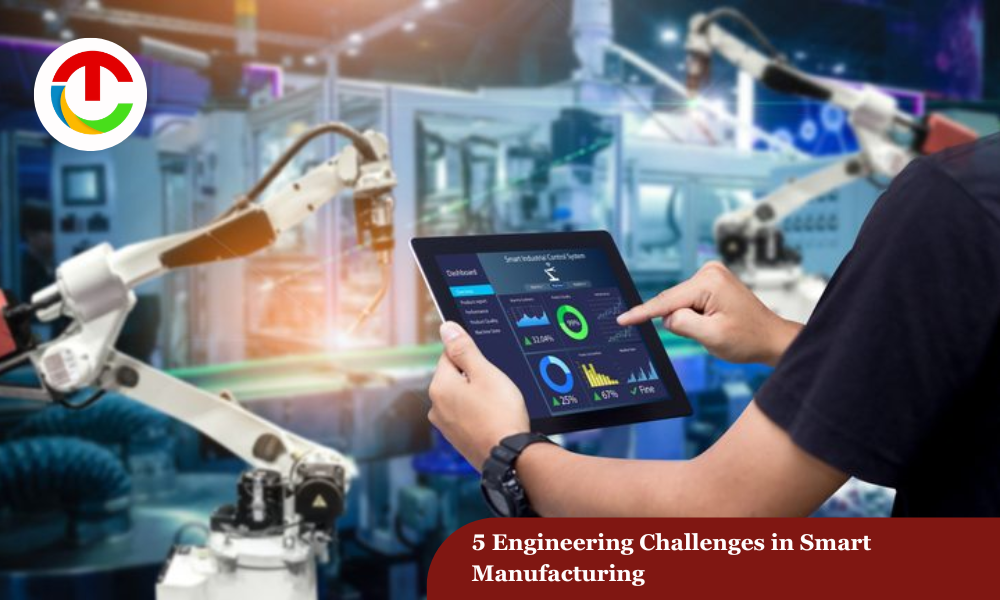
It is incredibly easy to get swept up in the marketing videos for modern smart factories. They show sleek, fully automated production lines where robotic arms glide in perfect synchronization, autonomous mobile robots navigate effortlessly across clean floors, and digital dashboards display real-time operational data without a single glitch.
But behind those polished promotional clips lies a messy, highly complex engineering reality. Transitioning a traditional production plant into a fully connected, intelligent ecosystem isn’t a simple plug-and-play software upgrade. It is an intricate architectural puzzle.
True smart manufacturing requires a seamless blend of mechanical systems, industrial software, raw data streams, and highly customized hardware. When you attempt to force these different worlds to communicate, unexpected frictions arise.
For control engineers, system integrators, and plant managers, achieving a reliable digital transformation means systematically overcoming a predictable matrix of technical hurdles. Let’s break down the five most common engineering challenges in smart manufacturing and look at the real-world frameworks used to solve them.
1. Overcoming Legacy System Protocol Interoperability
How do engineers solve interoperability in smart manufacturing?
Engineers solve interoperability challenges by deploying middleware translation layers and adopting open communication standards like OPC UA or MQTT to bridge the gap between legacy machine languages and modern corporate networks.
The vast majority of modern automation initiatives do not take place in pristine, newly constructed “greenfield” facilities. Instead, engineers are tasked with deploying Industry 4.0 integration strategies inside existing “brownfield” plants.
Inside a typical facility, you will find a patchwork of machinery built across different decades. A single line might feature a brand-new CNC machine running advanced Ethernet protocols sitting right next to a twenty-year-old hydraulic press that communicates via a legacy, analog Modbus connection.
Forcing these machines to speak a unified language is a massive hurdle. To solve this protocol bottleneck, engineering teams utilize specialized edge gateways or industrial computers that act as universal translators. By converting disparate proprietary machine data into a single, standardized stream, factories can finally pull holistic information into their Manufacturing Execution Systems (MES) without replacing millions of dollars of functional heavy machinery.
2. Embedding Advanced Hardware and Bridging the Physical-Digital Gap
What is the primary hardware challenge in smart factories?
The primary challenge is designing and deploying ruggedized, high-precision electronic controllers and distributed sensor nodes that can process data reliably in harsh industrial environments.
Smart manufacturing relies entirely on distributed intelligence. To feed an automated system, engineers must place smart sensors, advanced telemetry trackers, and localized microcontrollers directly onto the moving parts of the factory floor. This means your digital architecture is only as reliable as the physical hardware protecting it.
Industrial environments are notoriously hostile to delicate electronics. Massive electric motors create intense electromagnetic interference (EMI), heavy press operations generate continuous structural vibrations, and chemical lines introduce ambient moisture and heat cycles.
Designing custom IoT gateways or machinery monitoring nodes that can survive these conditions requires absolute precision at the component level. When building these specialized embedded controllers, operations teams must invest in high-reliability pcb fabrication and assembly to ensure that multi-layered circuit boards feature the correct structural shielding, thermal vias, and ruggedized substrates needed to prevent signal drift or early component failure under constant operational stress.
3. Managing Network Latency and Edge vs. Cloud Architectures
How do engineers manage network latency in smart manufacturing?
Engineers manage latency by implementing edge computing architectures, processing time-sensitive control loops locally on the floor while reserving the cloud for long-term data storage and macroscopic business analytics.
A major mistake early-stage integrators make is attempting to route every single raw sensor data point directly to a centralized cloud database. When a high-speed packaging line is running thousands of units per hour, waiting for a cloud server to receive data, process a control decision, and send a command back down to a valve introduces a catastrophic delay known as latency.
Advanced smart factory automation requires a decentralized data strategy. Engineers use Time-Sensitive Networking (TSN) protocols and local industrial PCs (IPCs) at the machine level to handle microsecond-level control loops. The cloud is then utilized exclusively as a historical vault, receiving summarized data bursts every few minutes to assist with high-level supply chain tracking and predictive modeling without clogging the facility’s active communication bandwidth.
4. Securing the Vulnerable OT/IT Convergence Layer
Why does smart manufacturing introduce severe cybersecurity risks?
Connecting previously isolated Operational Technology (OT) factory floor machines to corporate Information Technology (IT) networks exposes physical hardware to external internet malware, ransomware, and unauthorized data intrusions.
Historically, factory floor machinery operated in a secure bubble. Programmable Logic Controllers (PLCs) and human-machine interfaces (HMIs) were completely “air-gapped”—meaning they had zero connection to the outside internet.
Smart manufacturing intentionally shatters this wall to enable real-time data visibility. However, opening this door means a corporate phishing email received in the human resources department can potentially introduce malware that travels down the corporate network to stall a physical assembly line.
Securing this convergence layer requires engineers to completely rethink industrial network architecture. Teams must implement a strict zero-trust model, segregating the OT and IT spaces using industrial firewalls and clear Demilitarized Zones (DMZs). Every machine connection must be strictly authenticated, and legacy PLC firmwares must be updated regularly to protect physical infrastructure from digital sabotage.
5. Translating Industrial Data Bloat into Actionable Analytics
It is incredibly easy to purchase a thousand wireless sensors, stick them onto your facility’s pumps, and capture terabytes of raw vibration and temperature data. It is a completely different challenge to transform that massive tidal wave of numbers into meaningful operational choices.
Many plants suffer from “data bloat.” Their databases are full, yet their maintenance teams are still operating blindly because the data isn’t contextualized.
To achieve true real-time data analytics, engineering teams must build clear automated data pipelines. Raw, high-frequency data must be filtered and processed directly at the sensor level to strip away standard operational noise. By configuring your software to highlight only the specific statistical anomalies that point to early bearing degradation or structural stress, your maintenance crew can pivot from reactive firefighting to precision repairs before a breakdown occurs.
Myth vs. Fact: Smart Manufacturing Realities
1. Myth:
Advanced automation means your factory floor will run entirely on its own without needing human intervention or oversight.
2. Fact:
Automation doesn’t eliminate the human element; it redefines it. While repetitive physical labor decreases, the demand for highly skilled technicians, hardware diagnostics specialists, and control loops engineers increases significantly.
1. Myth:
To build a true smart factory, you must completely gut your facility and purchase all-new connected machinery.
2 .Fact:
Complete replacement is rarely financially viable. The most cost-effective and successful smart factory initiatives rely on smart retrofitting—placing external sensor arrays and modern translation modules onto older, highly reliable mechanical assets.
Summary
Building an efficient, resilient smart manufacturing environment is a continuous exercise in structural and digital balance. Start by breaking down localized data silos through open communication standards, ensuring your legacy machinery can speak fluently with your modern operating software. Insulate your physical intelligence by utilizing high-integrity hardware and precision pcb fabrication and assembly designed to withstand the harsh realities of the plant floor. Distribute your processing loads smartly using edge computers to conquer latency, enforce strict industrial security boundaries to protect your assets, and filter out raw data bloat to fuel clean predictive insights.
Ultimately, a smart factory is not a single software product or a specific robotic tool—it is an integrated ecosystem. By respecting the boundaries of physical hardware while optimizing your digital data streams, you transform your operational floor from a collection of isolated machines into a unified, responsive production engine built to adapt and grow.
Also Read :- Smarter Offices, Stronger Teams: A CEO’s Guide to Smarter Workplaces