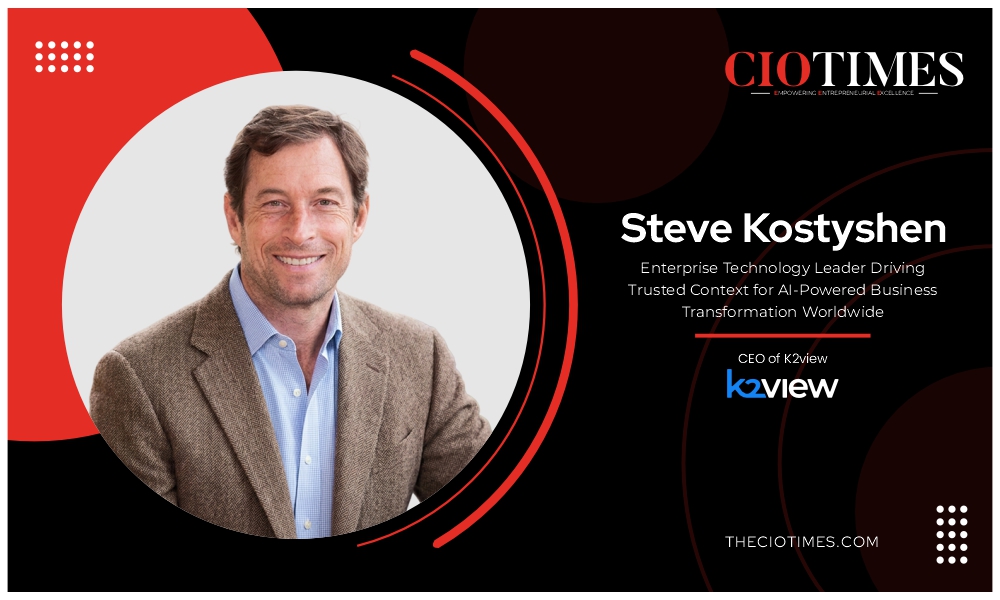
Data has become one of the most valuable assets for modern enterprises. When managed effectively, it drives better decisions, fuels innovation, and creates lasting business value. Unlocking that potential requires leaders who can align business strategy with technology. Steve Kostyshen, CEO of K2view, is one such leader. With more than three decades of experience in the technology industry, he has built a distinguished career in enterprise data and digital transformation. K2view, under his leadership, continues to help organizations unlock greater value from their data.
In conversation with him, we present to you a peek inside his journey till now, his expertise, and his outlook on data and related technology. Here is the conversation:
Q.1. Enterprise data strategies have evolved from warehouse-centric models to highly distributed, real-time ecosystems. In that context, where do you believe traditional data integration architectures are fundamentally failing modern enterprises today, and how is K2view attempting to redefine that paradigm?
I’d say the biggest failure is that many traditional data integration architectures were designed around the movement and consolidation of data for analytical and reporting purposes, not the moment of business action.
For years, the dominant thinking was: collect the data, replicate it, centralize it, and then analyze it. That made sense for reporting, analytics, and historical insight. Today, enterprises still need those capabilities, but they also need to support far more dynamic, operational use cases. They need to support live customer interactions, real-time decisions, AI agents, compliance requirements, personalization, and operational updates across many systems at once. In that world, simply moving more data into another repository does not solve the problem.
The real challenge is context. An enterprise does not just need a copy of a customer record or an order table. It needs a live, trusted, governed understanding of a business entity, such as a customer, account, employee, loan, claim, or device, at the moment a decision or action is taking place.
That’s the paradigm Steve Kostyshen Ceo of K2view is redefining. We organize data around business entities rather than around systems, pipelines, or databases. Through entity-centric data products and data agents, we deliver the precise operational context an application or AI agent needs, while enforcing governance, privacy, and access controls at runtime.
So, for us, the future of integration is not about building bigger data pipelines. It’s about making enterprise data immediately usable, governed, and actionable in the flow of business.
Q.2. Much of the current AI conversation is centered on models and compute power, yet many enterprises remain constrained by fragmented, low-context, and inaccessible data. Do you believe the industry is underestimating the importance of data integration as the true foundation of enterprise-scale AI?
Yes, I do think the industry is underestimating it, although that is starting to change.
For the past two years, much of the AI conversation has focused on model performance, GPU capacity, and prompt engineering. All of that matters, of course. But in the enterprise, the real bottleneck is usually not whether the model is smart enough. It’s whether the AI system has access to the right data, with the right context, under the right governance, at the exact moment it needs to make a decision or support an action.
A good example is work we’re doing with a major bank in the mortgage business. Their telephone mortgage advisers handle very complex customer questions, such as refinancing scenarios, eligibility, account history, and policy constraints. K2view provides an AI chatbot with precise operational context for each customer request, assembled on the fly from the underlying enterprise systems. Within seconds, the chatbot delivers the right answer to the adviser.
That’s where enterprise AI becomes real. The value is not just that a model can generate language. It’s that the AI system can respond with current, trusted, customer-specific context. The bank sees shorter handle times, higher first-contact resolution, better customer satisfaction, and faster ramp-up for new advisers.
So yes, models are important. But enterprise AI will be won or lost on the ability to deliver trusted operational context in real time.
Q.3. K2view’s “entity-based” approach challenges the long-standing dependence on massive centralized replication. Philosophically and technically, what drove that architectural direction, and why do you believe it represents a more sustainable model for the future of enterprise data management?
The entity-based approach came from a very simple observation: businesses don’t operate around databases. They operate around customers, employees, accounts, orders, loans, claims, devices, and other real-world entities.
Traditional data architectures often start with systems and tables. They ask, “Where is the data stored?” We believe the better question is, “What business object are we trying to understand or act on?” Whether you’re serving a customer, processing a claim, or resolving a service issue, success depends on having the complete context for that entity at the moment of action. Once you start there, the architecture looks very different.
A customer, for example, may have data in CRM, billing, support, order management, marketing, and compliance systems. In a centralized replication model, you keep moving and copying that data into larger repositories, then rebuild the customer context again and again for each use case. That creates latency, cost, duplication, governance complexity, and inconsistency.
K2view takes a different approach. We organize data around the business entity itself. Each entity becomes a governed, operational data product that brings together the relevant data for that customer, account, order, or claim – and continually keeps it up to date. At the technical level, our Micro-DB architecture allows each entity instance to be managed, accessed, secured, and synchronized independently.
We believe this is more sustainable because it aligns data architecture with how the business actually works. Instead of building one massive copy of everything, we create live, governed context around the things the business actually cares about.
Q.4. Enterprises today are simultaneously pursuing speed, personalization, compliance, and cost efficiency objectives that often conflict with one another. How does K2view reconcile these competing priorities without forcing organizations into additional operational complexity?
I think the reason these priorities feel conflicting is that most organizations are trying to solve them separately.
They have one initiative for speed, another for personalization, another for compliance, and another for cost reduction. Each one introduces its own tools, integrations, data copies, controls, and operating processes. Very quickly, the organization becomes more complex, not less.
Our view is that the way to reconcile these priorities is to create a common data and context foundation around the business entity. When the customer, account, employee, order, or claim is already assembled as a governed data product, different teams can use the same trusted context for different purposes. A customer service team can resolve an issue faster. A digital channel can personalize an offer. A compliance team can enforce access and privacy policies. An AI agent can take action within defined guardrails.
The important point is that governance is not added after the fact. It’s built into how the context is created, accessed, and used. That means organizations do not have to choose between speed and control, or between personalization and privacy.
Steve Kostyshen say Cost efficiency also improves because you’re not constantly rebuilding the same integrations or moving the same data into different environments for every new application or AI use case.
So the answer is not to add another layer of operational complexity. It’s to simplify the data foundation, make context reusable, and apply governance consistently at the point where the business action happens.
Q.5. Data gravity has become a significant issue for large organizations operating across multi-cloud, hybrid, and legacy environments. How do you see the economics of data movement evolving over the next decade, particularly as AI workloads dramatically increase infrastructure pressure?
Data gravity is becoming one of the defining economic issues in enterprise technology.
For many years, organizations responded to new data requirements by moving more data into more places. A new analytics platform needed a copy. A new application needed another integration. A new cloud initiative created another data pipeline. That approach was manageable when the primary use case was reporting or periodic analysis. But AI changes the economics because the demand for data becomes far more continuous, contextual, and operational.
Steve Kostyshen say AI workloads do not just ask for data once. They may need fresh context repeatedly, across many users, entities, workflows, and decisions. If every AI use case requires large-scale replication, complex joins across centralized environments, or constant querying of massive data platforms, the infrastructure pressure and cost will grow very quickly.
Over the next decade, I think enterprises will become much more selective about what data they move, where they move it, and why. The goal will not be to centralize everything by default. It will be to bring the right context to the right workload with the least unnecessary movement.
That is where entity-based architecture becomes very important. If you can organize and govern data around the customer, account, order, claim, or device, you can provide AI and applications with precise context without constantly moving entire datasets around the enterprise. So the economics will shift from “move more data” to “deliver more relevant context.” That is a much more sustainable model.
Q.6. In sectors such as telecom, healthcare, banking, and logistics, real-time access to trusted data is increasingly mission-critical. Which industries do you believe are currently the most advanced in their data maturity, and which are still approaching transformation through an outdated lens?
Steve Kostyshen would be careful about saying one industry is universally ahead and another is behind, because within every sector you can find leaders and laggards. But there are patterns.
Telecom has traditionally been very advanced in operational data, largely because the business depends on real-time customer, network, billing, and service data. If you cannot understand the customer and the service state quickly, the business feels it immediately. Banking is also relatively mature, especially around governance, risk, security, and customer data, although legacy systems can still slow down transformation.
Healthcare is very interesting. The need for trusted, real-time data is enormous, but the environment is highly fragmented and heavily regulated. You have clinical data, administrative data, payer data, patient engagement systems, and privacy requirements that are extremely complex. So the opportunity is huge, but the architecture challenge is also significant.
Logistics and supply chain organizations are becoming much more advanced because real-time visibility has become central to competitiveness. Delays, inventory issues, routing decisions, and customer expectations all depend on timely data.
The outdated lens, in my view, is not industry-specific. It is the belief that transformation means simply centralizing more data or modernizing one system at a time. The more advanced organizations understand that the goal is not just data modernization. It is operational responsiveness: the ability to use trusted data in the moment, across systems, channels, and workflows.
Q.7. There is a growing shift from “big data” toward what many now describe as “right data,” contextual, governed, and immediately actionable information. Do you see this transition as a technological evolution or a broader philosophical change in how enterprises understand data itself?
The “big data” era taught enterprises to believe that more data was always better. Collect more, store more, centralize more, analyze more. That created tremendous value, especially for analytics and reporting. But it also created a mindset that volume itself was the goal.
In operational environments, volume is not enough. If a customer service agent, a digital application, or an AI agent is trying to make a decision, it does not need every piece of data the company has. It needs the right data, in the right context, at the right moment, with the right permissions.
That is a very different way to think about data value. Data becomes valuable not because it exists somewhere in the enterprise, but because it can be trusted and used in a specific business situation. Is it current? Is it complete enough for the task? Is it governed properly? Can it support an action? Can we explain where it came from and how it was used?
Technology is enabling this shift, but leadership has to embrace it. The future is not about building bigger repositories of data. It is about creating a data environment that understands business context and can deliver it precisely when and where it is needed. That is the real move from “big data” to “right data.”
Q.8. AI governance and regulatory scrutiny are intensifying globally. As enterprises become more cautious about data lineage, sovereignty, and model transparency, how important will integration architecture become in determining whether AI systems are commercially viable at scale?
Steve Kostyshen Integration architecture will be absolutely central to the commercial viability of enterprise AI.
When AI is used in a limited pilot, the risk is usually contained. The data sources are narrow, the users are controlled, and people are watching the outputs closely. But when AI moves into production workflows, the situation changes completely. The system may be accessing sensitive customer data, making recommendations, triggering operational actions, or interacting across multiple jurisdictions and regulatory environments.
At that point, governance cannot be handled as a manual review process or an afterthought. It has to be embedded in the way data is accessed, assembled, delivered, and acted upon. The AI system needs to know what it is allowed to see, what it is allowed to do, which policies apply, where the data came from, and how every interaction is recorded and audited.
This is why integration architecture matters so much. If AI systems are pulling fragmented data from many systems without a governed context layer, it becomes very difficult to control lineage, privacy, sovereignty, access, and accountability. It also becomes difficult to understand why a system produced a particular outcome or how to improve it over time.
Enterprises will not scale AI simply because the model is impressive. They will scale AI when they can prove that the system is operating safely, transparently, and within policy. In that sense, the data integration architecture becomes part of the trust architecture for enterprise AI, enabling governance, evaluation, observability, and accountability at scale.
Q.9. Over the past three decades, you have witnessed multiple enterprise technology cycles from early networking and ERP systems to cloud computing and now AI. Which current assumptions about enterprise AI transformation do you believe are most likely to be challenged over the next five years?
Every major technology cycle starts with a period where people overestimate the technology by itself and underestimate the operational change required to create value from it. I think AI is following that same pattern.
One assumption I believe will be challenged is that enterprises can simply add AI on top of existing processes and get transformation. In reality, many processes will need to be redesigned. If you put AI into a broken workflow, you may only make the broken workflow faster.
A Steve Kostyshen second assumption is that the model will be the main differentiator. Models will continue to improve, and many capabilities will become more accessible. The real differentiation will come from how well a company connects AI to its data, policies, systems, people, and decision processes.
A third assumption is that pilots naturally become production systems. They usually do not. A pilot can succeed with a narrow dataset, manual controls, and a small group of users. Production requires governance, reliability, observability, security, integration, and change management.
The last assumption is that AI will replace human judgment broadly and quickly. I think the more realistic path is that AI will change where human judgment is applied. People will spend less time gathering information and more time supervising decisions, handling exceptions, and designing better operations.
The winners will not be the companies that experiment the most. They will be the ones that industrialize AI responsibly.
Q.10. Your career reflects a rare combination of operator, founder, investor, and board-level experience. How has moving between those roles changed the way you evaluate leadership, particularly in technology companies navigating periods of rapid disruption?
Steve Kostyshen say Moving between those roles teaches you that leadership looks different depending on where you sit, but the fundamentals do not really change.
As an operator, you learn that execution matters more than strategy on paper. A good idea is only valuable if the organization can turn it into decisions, products, customer outcomes, and repeatable processes. As a founder, you learn resilience. You have to live with uncertainty, make decisions with incomplete information, and convince customers, employees, and investors to believe in something before it is obvious.
As an investor and board member, you develop a different kind of discipline. You’re not running the company day to day, so your role is to ask better questions, identify patterns, and help leadership teams see around corners without taking ownership away from them.
What all of these roles have taught me is that in periods of disruption, leadership is less about having perfect answers and more about creating clarity. Technology markets move quickly, especially now with AI, but companies still need focus, trust, and operating discipline.
The leaders I respect most are the ones who can balance ambition with realism. They see the opportunity, but they also understand the hard work required to build something durable. They do not chase every trend. They know what problem they are solving, who they are solving it for, and how to bring the organization with them.
Q.11. Having backed and advised companies that later achieved significant exits, what distinguishes founders who build enduring enterprise businesses from those who merely capitalize on short-term market momentum?
Steve Kostyshen say The founders who build enduring enterprise businesses usually have a very deep relationship with the problem they are solving.
They are not just reacting to a market trend or positioning themselves around the latest category. They understand the customer’s pain at an operational level. They know why the problem is hard, why existing solutions have not solved it, and what has to change for customers to adopt something new.
In enterprise technology, that matters tremendously because customers do not buy vision alone. They buy trust. They need to believe the company will be there, the product will scale, the implementation will succeed, and the vendor understands the realities of their environment.
The best founders Steve Kostyshen are ambitious, but they are also disciplined. They know how to say no. They do not confuse noise with traction or fundraising with validation. They build around customers, not headlines. They are willing to make unglamorous decisions if those decisions create long-term value.
Short-term momentum can take a company quite far, especially in a hot market. But it usually does not create durability by itself. Durable companies are built through product depth, customer intimacy, strong execution, and the ability to keep adapting without losing focus.
That is what I look for: founders who can see the future, but who are grounded enough to build the operational foundation required to actually get there.
Q.12. You have worked extensively with global enterprises and leadership teams across different regions and cultures. In your view, how are enterprise technology priorities evolving differently across North America, Europe, and emerging innovation markets?
The priorities are evolving differently, but they are also converging in important ways.
In North America, the emphasis is often on speed, innovation, and competitive advantage. Enterprises are moving quickly to experiment with AI, automation, and new digital operating models. The question is usually, “How fast can we turn this into business value?” That creates urgency, but it can also expose gaps in data readiness and governance.
In Europe, there is typically more emphasis on trust, privacy, regulation, and sovereignty. Enterprises are absolutely investing in AI and modernization, but they tend to think earlier about compliance, explainability, and control. In many ways, that mindset is becoming more relevant globally as AI governance becomes a board-level issue.
In emerging innovation markets, I often see a very pragmatic approach. Organizations may not have the same legacy infrastructure burden, so they can sometimes leapfrog older architectural models. They are focused on solving immediate business problems, improving digital access, and scaling efficiently.
What is common across all regions is that technology priorities are becoming more operational. It is no longer enough to have a cloud strategy, a data strategy, or an AI strategy in isolation. Leaders want to know how these investments improve customer experience, reduce cost, manage risk, and create resilience.
So the regional starting points may be different, but the destination is similar: trusted, actionable data that can support faster and more intelligent business operations.
Q.13. As K2view enters its next phase under your leadership as CEO, what broader role do you envision the company playing in the future enterprise AI ecosystem infrastructure provider, orchestration layer, strategic intelligence platform, or something even more foundational?
Steve Kostyshen see K2view playing a foundational role in the enterprise AI ecosystem.
AI is forcing enterprises to rethink the relationship between data, context, governance, and action. For many years, integration was viewed as a technical layer that moved information between systems. In the AI era, that is no longer enough. AI systems need trusted operational context. They need to understand the customer, account, employee, claim, loan, or device they are acting on. They need to know what data they are allowed to use, what actions they are allowed to take, and how those actions should be governed.
Steve Kostyshen say That is the role K2view is built to serve. We’re not trying to be the AI model, and we’re not simply another data pipeline. We provide the operational context layer that allows AI agents, applications, and enterprise systems to work with live, governed, entity-level data.
As Steve Kostyshen enterprises move from AI experimentation to AI execution, this layer becomes more strategic. It determines whether AI can be trusted, whether it can act safely, and whether it can deliver value beyond isolated pilots.
So, if Steve Kostyshen look ahead, I believe K2view can become part of the critical enterprise infrastructure for operational AI. Our role is to help organizations turn fragmented enterprise data into the trusted, actionable context that intelligent systems need in order to reason, decide, and act responsibly.
Also Read :- CIO Times Magazine For More information