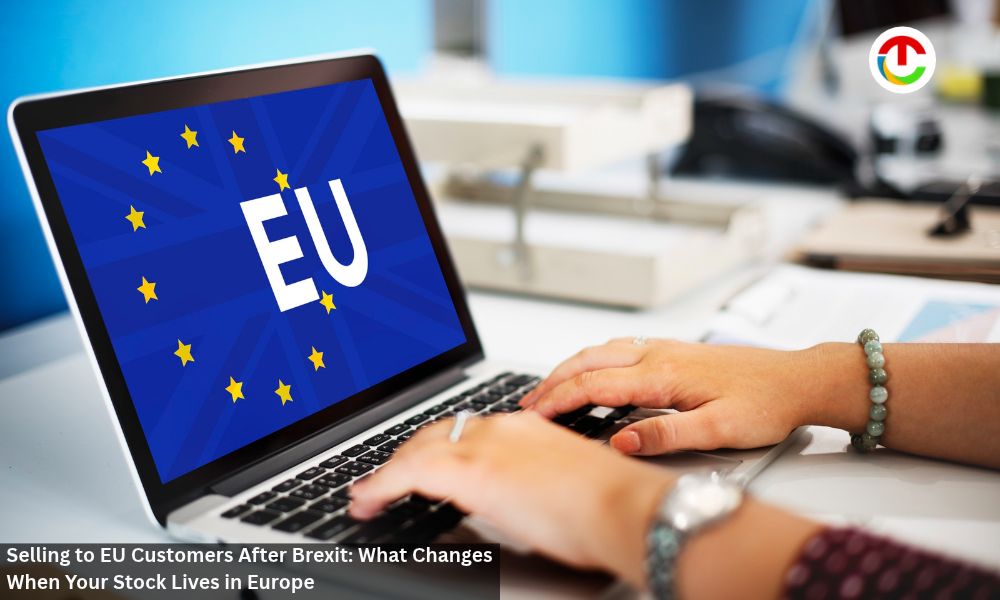
Every order a UK online shop sends to an EU customer now crosses a customs border, and since 1 July 2026, even low-value parcels are subject to customs duty. That has pushed many brands to ask whether stock should sit inside the EU instead. This guide is for UK eCommerce sellers with a meaningful share of EU stock orders. It explains what changes for VAT and customs when EU stock moves across the Channel, where the break-even sits, and how delivery and returns change.
What Changes When a UK Brand Holds EU stock ?
Holding EU stock thousands of small international shipments into one larger import. Goods cross the border in bulk on a single customs declaration, duty is settled once on the consignment, and each customer order then travels as a domestic or intra-EU parcel with no customs paperwork at all.
The trade-off is that your business now has a taxable presence in the country where the EU stock sits. That means a local VAT registration, regular returns and a provider that can receive bulk imports properly. When comparing providers of eCommerce fulfilment in Europe for UK brands, check that they can act as the import point for your EU stock , hold it in the countries that suit your order map and share the stock data your accountant will need for VAT filings.
One more point catches many UK sellers out. Goods made outside the UK, such as products sourced from China, do not qualify for zero tariffs under the UK-EU Trade and Cooperation Agreement simply because they passed through a UK warehouse. If they are imported into the UK and then sent on to the EU, duty can be paid twice. Shipping them from the factory straight into an EU warehouse avoids that.
Do You Need IOSS or a Local EU VAT Registration?
The answer depends entirely on where the goods are when the customer buys them. The table below sets out the two main routes.
| Shipping from the UK | EU stock | |
| VAT scheme | IOSS for parcels up to €150 | Local VAT registration where stock is held, plus Union OSS |
| Registration threshold | None | None, from the first sale |
| Customs duty | €3 per item category on parcels up to €150 since 1 July 2026 | Paid once on the bulk import |
| Paperwork per order | Customs data on every parcel | None for EU deliveries |
| Who you need in the EU | An EU-established IOSS intermediary | Local VAT agent or accountant |
Both routes need ongoing compliance work, so the choice comes down to volume, product origin and how much you value faster delivery.
Under IOSS, VAT is charged at checkout and filed monthly, but a business based in Great Britain cannot register directly and must appoint an EU intermediary. Once EU stock sits in an EU warehouse, IOSS no longer applies. A UK seller must register for VAT in each country where it stores goods, with no sales threshold, and can then use the Union One-Stop Shop, filed through the country the goods ship from, to report sales to consumers in other EU countries on one return.
When Does Holding EU stock in the EU Pay for Itself?
The direct savings are easiest to see with UK-made products, which can enter the EU duty-free when they meet the rules of origin. In that case, shipping parcels from the UK costs at least €3 in duty per item category on every order under €150, while bulk imports pay no duty at all.
Against that, set the fixed cost of compliance. One provider’s published 2026 pricing for a German VAT registration is €1,199 a year, plus €250 to set up Union OSS and €150 a quarter to file it, for €2,049 in the first year. Dividing €2,049 by €3 gives roughly 680 orders a year, or around 57 a month, before duty savings alone cover the compliance bill.
Most brands reach break-even earlier than that. Carriers often add a clearance or handling charge to each cross-border parcel; every abandoned basket caused by a slow or uncertain delivery date costs margin, and returns become far cheaper. For goods made outside the UK, the saving is larger still, because direct shipping can mean paying duty twice. The figure that matters is your own monthly EU order count and average basket, so run those numbers before committing.
How Do Delivery Times and Costs Change?
Orders shipped from an EU warehouse move through domestic carrier networks, so delivery times match those of local competitors rather than adding a customs stage. Customers see the price they pay at checkout with no charge at the door, which avoids the surprise import charges that lead some customers to refuse parcels.
Costs move in two directions. Per-parcel postage within the EU is usually lower than an international parcel from the UK, but you now pay for inbound freight to move stock across the Channel in bulk and for storage in a second location. Brands with a narrow, fast-selling range tend to gain most, while those with long tails of slow-moving products may tie up too much cash in duplicate stock.
What Should You Do About EU Returns?
Returns are where holding stock in the EU often pays off fastest. A few practical steps make the difference.
- Give EU customers a local returns address, so returns travel as domestic parcels rather than crossing customs back into the UK.
- Grade returned items in the EU warehouse and put saleable stock straight back on the shelf for the next EU order.
- Decide in advance what happens to damaged or unsaleable items, since shipping them back to the UK adds customs paperwork for low-value goods.
- Keep returns data separate by country, because VAT on refunds is adjusted in the return for the country where the original sale was taxed.
Handled this way, a return becomes a restock within days rather than a cross-border shipment that may take weeks to clear.
FAQ
1. Do I need an EU company to hold stock in Europe?
No. A UK business can register for VAT in an EU country without setting up a subsidiary, although some countries require a fiscal representative for non-EU sellers.
2. Can I still use IOSS if my stock is in an EU warehouse?
No. IOSS only covers goods sold outside the EU. Once stock is held in the EU, local VAT registration and Union OSS apply instead.
3. Does the €3 duty apply to stock shipped in bulk?
No. The flat €3 charge applies to low-value consignments sent directly to EU consumers from outside the EU. Bulk imports into a warehouse pay standard customs duty, which is zero for goods that meet UK-EU rules of origin.
4. How many EU countries do I need to register in?
One for each country where your goods are stored. A single Dutch or German warehouse means one local registration, plus Union OSS for sales to customers elsewhere in the EU.
Also Read :- From Venture Backing to Public Markets: Understanding Pre-IPO Access vs. Traditional IPO Investing