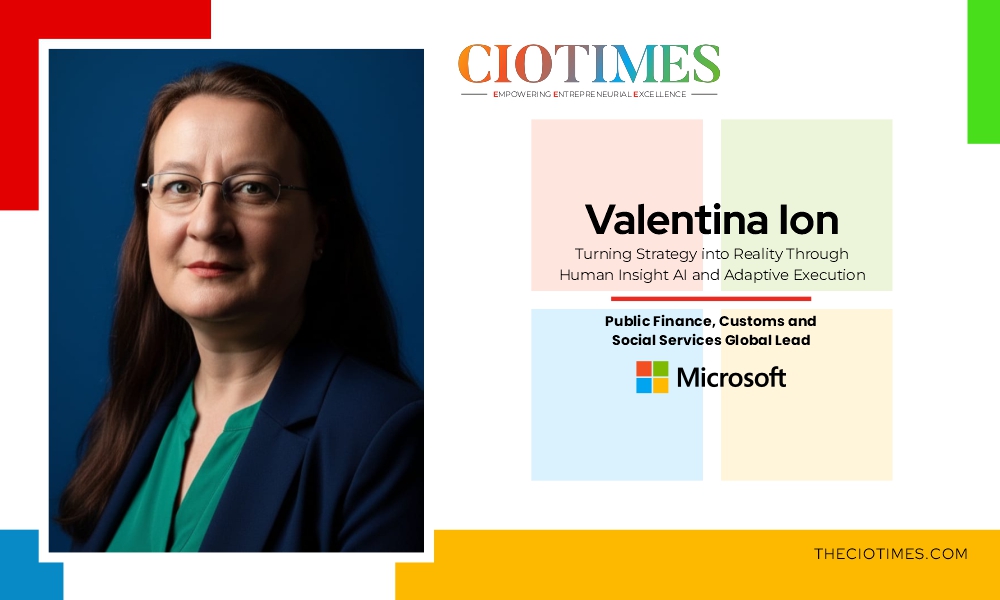
Microsoft is unarguably a technology powerhouse and has maintained a stature for years. It has consistently redefined the market segments of digital evolution. We come across tech leaders who are pushing boundaries and setting fresher benchmarks for such organizations to evolve and operate. Among these leaders is Valentina Ion, Public Finance, Customs and Social Services Global Lead, Microsoft, who powerfully shapes the technological progress and crafts large-scale ecosystems.
Her 25 years of expertise have been focused on driving strategy, transformation, and growth at scale, working at the intersection of platform innovation, AI, go‑to‑market execution, and partner ecosystems. She is synonymously famous as a market maker and change agent. Clarity in strategies, measurable operating models, and scalable business outcomes is her go-to motto. She has spearheaded and ascended multi‑billion‑dollar portfolios, doubled global businesses, built new industry practices from the ground up, and mobilized diverse, global teams and partner ecosystems to deliver sustained impact.
She is energized by AI‑driven transformation, ecosystem leadership, and developing people. She champions in pressure situations where strategic clarity, strong narratives, and execution rigor make the difference between vision and results.
The 3 Learnings
In her 25 years of triumphant career, there have been 3 moments that have shaped her perspective on the job. She has kindly shared it with us.
- Much before joining Microsoft, she witnessed a technically flawless project fail because nobody made the case for why it mattered to the people living inside the change. This brought her an insight that evolution is a human event, not a technological event. She cherishes that lesson to date. She believes that technology reaches higher skies only when it empowers people to achieve more.
- Two decades at Microsoft served as her masterclass in the gritty realities of global scale. Navigating the diverse needs of government ministries, whether in tax, trade, or diplomacy, she realized that progress isn’t about forcing a single blueprint onto the world. Instead, she mastered the art of contextual relevance, learned that the most effective systems are those that adapt to local needs while remaining anchored by a clear, human-centered strategic intent.
- More recently, she has been evolving the business as AI evolved from a background feature intothe foundation of how we operate. By orchestrating the design of AI-driven models for public institutions, she has moved the needle from simple digital modernization to a radical reimagining of the government services. For her, this isn’t just a technical shift; it’s a leadership challenge that requires her unique ability to bridge the gap between complex policy, frontier technology, and human potential.
A Treasured Achievement
Valentina has been active in growing multi-billion-dollar businesses. Growth carries depth when it is focused on the expected outcome. It is tested on site, where one can measure revenue to an actual problem solved, and the resultant value creation for citizens. A second component she highlights is adopting depth and asking the question: Is AI helping the institutions deliver measurably better services, or are they still experimenting at the edges?
She adds, “AI is not merely a technology investment; it is an economic and societal growth multiplier. When a government digitises its tax collection with AI-assisted compliance tools, revenue capture improves, leakage decreases, and the resulting fiscal outcome funds schools, hospitals, and infrastructure.”
This situation arises when AI directly affects cumulative growth in a nation. In social services, if AI is deployed to assist vulnerable families earlier, the downstream savings in healthcare, housing, and justice are enormous. That is societal growth driven by intelligent technology, but only because human professionals remain at the heart of every intervention.
She believes that sustainable growth demands periodic patterns. Her team at Microsoft crafted these solution scenarios for tax modernisation, public finance transformation, and social services that field teams across countries can adapt and deploy. It asks for a partner ecosystem that can carry the work forward at the local scale. The achievement that has her heart is the kind that compounds: a tax authority that starts with cloud adoption, progresses to AI-assisted compliance, and evolves toward a human-AI operating model where agents handle routine processing and public servants focus on the cases that require human judgment and empathy.
The Ecosystem Magnet
To bifurcate shifts, Valentina has a simple principle: does this change the structure of how decisions get made, or does it merely speed up what already exists? An accelerated spreadsheet, she considers it noise. An Agentic AI system that guides a public servant to go through a citizen’s tax filing, cross-referencing policy, flagging anomalies, and surfacing a recommendation for a human to review and approve is an ideal magnet for her. It transforms or delegates the tasks while keeping human judgment in its place.
Her responsibility is leading the Public Finance, Customs and Social Services industry within Microsoft’s Worldwide Public Sector. There, she witnesses this difference each day. Valentina isn’t one to get distracted by the usual hype around chatbots or quick document summaries; she sees those as handy, but ultimately just surface-level tweaks. Her real focus is on Frontier Transformation, that sweet spot where AI handles the heavy lifting of core workflows while keeping a person firmly in the driver’s seat. She loves the idea of a finance minister using real-time AI models to weigh budget options, or a customs officer who relies on smart pre-screening but still makes the final call. For her, the tech only truly sticks when it serves to amplify, not replace, human intuition and expertise.
She also has a sharp eye for what she calls ecosystem pull to tell if a trend is actually real. When she sees partners and integrators building out new capabilities not because they’re being pushed to, but because their customers are practically banging down the door for them, she knows we’ve moved past the buzzwords into something structural. In her view, sovereign cloud and agentic AI in government have officially hit that tipping point. They aren’t just experimental features anymore; they’ve become the essential tools that public institutions are now actively pulling into their everyday reality.
AI for Output Growth
In Pubic finance and social systems, AI plays a quiet but dominant role.. Valentina is deeply passionate about this context. She reminds us that the relationship between a government and its citizens has historically been mediated by forms, queues, and processes designed for a paper era. AI is transforming that mediation layer and reshaping what citizens rightfully expect.
She considers public finance agencies as core to the wider government evolution. She guides the team to collaborate with revenue agencies on AI systems that move from reactive enforcement to proactive guidance. It helps citizens comply correctly rather than penalising them after they fail. The public servant’s role shifts from auditor to advisor, with AI handling data analysis and the human providing judgment, context, and empathy. The public sector agencies become a partner in compliance, not an adversary.
In social services, AI-powered triage avoids vulnerable populations falling through cracks, analysing patterns across housing, health, and employment data so a social worker can intervene early with full context. The citizen does not navigate a dozen agencies; an AI system connects the dots and a trained professional takes action.
But, and this is critical, none of this is legitimate without robust governance, explainability, and security.
She shares, “When an AI system recommends an action, that decision must be explainable. The user must be able to understand why. The data must be protected with enterprise-grade security.”
Sovereign cloud infrastructure must ensure that a nation’s most sensitive citizen data is governed under its own legal framework. Mutual faith is the bedrock on which every aspect of this evolution relies.
All of this increases the economic value. Governments that adopt AI-assisted public finance tools improved revenue capture, reduced fraud, and faster service delivery, freeing fiscal resources that fuel broader economic growth for the entire population.
The Choice Matrix
Where government technology is involved, Valentina follows her signature blueprint. The automation involves multiple stakeholders, regulatory constraints, and competing priorities. She breaks down complexity into three layers:
- What is being decided?
Breaking down complexities is what an ideal strategist needs to do, she highlights here. A large complex decision is just several simpler verdicts connected.
- Who needs to act, and what do they need to believe to act?
A CIO and a finance minister have diverse roles to play. Coherence is associated with interpretation and not simplifying.
She shares, “I invest heavily in making the same strategy speak coherently at very different altitudes.”
- What is the smallest commitment that unlocks the next step?
At times, people feel intrigued when the end state is a long path. She makes a sequential decision path that results in crafting evidence and nurturing conviction. Valentina’s rapid prototyping capability is rooted in a simple belief: provide decision-makers tangible outcomes, fast. She brings AI to life alongside their teams, keeping humans firmly in charge of every final call, so what once felt abstract becomes something they can see, test, and trust. That is how she nudges complex institutions from deliberation into decisive action.
Collaboration of AI and Human
A shared approach goes a long way. Each voluntary collaboration has a common aspect: both sides have something to gain as having something meaningful at risk. When a collaborator co-invests in building a government tax modernisation solution, putting their domain expertise, customer relationships, and delivery capacity alongside our platform, that is when genuine value creation happens.
Partnerships in such situations share three characteristics:
- First is the complementary capability. The partner brings something Valentina’s team cannot mirror. It is their local regulatory expertise, deep domain knowledge, or implementation capacity at scale.
- Joint go-to-market, not a referral arrangement, but co-selling where both teams are in the room.
- A feedback loop, the partner’s field experience shapes our roadmap, and the platform investments unlock new possibilities for their solutions.
She believes the most empowered ecosystems will be those that connect human expertise and AI agents in joint efforts.
She shares, “Imagine a partner’s domain specialists working alongside Microsoft’s AI platform, with AI agents handling data preparation, analysis, and scenario modelling while human consultants focus on institutional context, stakeholder relationships, and strategic advice.”
This partnership will go a long way as none of the parties involved can achieve this without each other’s support. The future ecosystem is a picture where human-AI teams co-exist.
Purposeful Insights
Valentina focuses on that fragile moment when a strategy leaves the quiet of the boardroom and meets the messy reality of the teams expected to deliver it. She’s seen that most plans don’t fail because the logic was flawed; they stumble because the people on the front lines never truly felt the why behind the what.
During her 19 years at Microsoft, she has experienced the risk of a this disconnect play out across every continent. Leadership crafts a polished deck and a tight operating rhythm, yet the signal softens as it travels as it faces local pressure and local context introduces variations
The fix isn’t more micromanagement; it’s about better encoding. Strategy needs to live as a set of repeatable habits and intuitive cues that help people make the right calls in the heat of the moment. When she built her repeatable solution scenarios, the goal was to bake strategy into the daily workflow so it felt like second nature, not a puzzle to be solved.
As an AI leader, she sees the technology as a quiet, stabilizing ally. AI shouldn’t replace human judgment; it should bridge the gap, ensuring the right insight finds the right person exactly when they need it. To her, the future is human strategists working with AI to filter out the noise, finally allowing true clarity to lead the way.
Relevant Tech Integration
Leaders misinterpret transformation, at times. In the process, Valentina highlights that they can underestimate the middle part. Leaders envision the steps ahead, while the actual evolution stays in the eighteen months post the excitement fades, and before the results arrive. This is where organisational resistance activates, budgets tighten, and the people get overworked.
Another consistent misunderstanding is believing transformation has an end. It is a skill that organizations need to work on without any halts. Developing this muscle fixes: governance structures, data foundations, talent pipelines, and the cultural permission to experiment and learn.
Especially in the public sector, she pinpoints another misunderstanding: the belief that AI can simply be layered onto existing institutional structures. An outdated AI-powered operating model will take a leader nowhere. According to her, the technology, the institutional architecture, and the human capabilities must evolve together.
Establishing Right AI Conversations
Principled leaders will integrate AI as an institutional design question, not a technology adoption question. While integrating them is easy, it is a daunting task to redesign workflows, governance, and accountability structures so that AI creates lasting value with humans firmly in command of the decisions that matter.
Others will delegate the AI tools to their AI teams and check in quarterly. Such tools are altering the way organizations make decisions, allocate resources, and serve citizens. It is a leadership conversation.
The enduring leaders will master three concerns:
- Speed versus trust:
Citizens want swift services but also demand that AI decisions are graspable, and need data that is secure. The leaders who invest in governance, transparency, and security alongside adoption will earn the legitimacy to keep leading.
- Efficiency versus growth:
AI introduces entirely new capabilities, new services, new revenue streams, and new forms of citizen engagement. Leaders who see AI as an economic growth engine, not merely a cost tool, will capture disproportionate value for their organisations and societies.
- Automation versus augmentation:
The enduring model is not one where AI replaces teams, but where humans and AI agents work together, AI handling data, pattern recognition, and routine processing while humans provide judgment, creativity, empathy, and accountability. Leaders who build these blended teams will define the next era of organisational performance.
An Earful to the Ecosystem
Valentina has worked in several regions as a leader. This exposure made her doubtful about a one-size-fits-all approach and had high regard for contextual aspects. Working in OECD regions, from European tax administration to Asian port authorities to the Middle East e-services transformation, gave her insights into principles that are diverse depending on institutional maturity, political culture, and citizen expectations.
Of late, she initiates listening. She asks questions like:
- What is the institutional history?
- Where is the real decision-making center?
- What does the population expect from its government?
These questions matter more than any technology architecture.
Bucharest was a region that shaped her perspective. Romania and Central-Eastern Europe have undergone extraordinary transformation in compressed timeframes, from post-communist rebuilding to EU integration to digital modernisation. The narrative has given her insights about how institutions change under pressure and where AI can genuinely help accelerate progress versus where patience is required.
The Scaling Abilities
Valentina highlights a leader’s ability to shift from doing to designingBeginning for every founder is where they handle each task. Crafting a system that does the work as expected, and is especially aware of how AI agents can handle routine operations and where human judgment is indispensable.
A second trait she mentions is institutional fluency. In the public sector ecosystem, founders who scale can sit with a deputy minister and speak in terms of policy outcomes, not product features. They understand procurement, governance, and the political calendar. They also understand that government customers will never accept a black box; they need explainable AI, transparent decision logic, and robust security. Founders who build for those requirements from day one, rather than retrofitting later, are the ones who earn trust at scale.
Agile Future is the Go-to
Valentina considers two aspects in times of ambiguity.
- Stepping into the customer’s shoes:
She asks certain questions to herself, like, What would this institution need from us to better serve its citizens? Not what they say they want, what do they actually need?
- Pattern observed through expertise:
Not to predict the future, but to narrow plausible outcomes She has seen plenty of transformations win or fail. The resultant being that she has developed calibrated instincts for which variables matter. Her opinion remains unshaken about the human element, adoption, trust, and capability, which almost always matter more than the technical element.
When neither path feels right, Valentina leans toward what preserves the most future flexibility. In uncertain moments, she trusts that staying flexible beats chasing a perfect answer. As she brings AI into the mix, she ensures every suggestion arrives with context and alternatives. This keeps the focus on the person in the loop, leaving room for the kind of human judgment no algorithm can ever truly replace.
Crafting the Future
There are a few underestimated shifts that leaders need to pay close attention to. Valentina points out two converging forces.
- Evolution of AI as a dominant infrastructure:
She points out that most leaders presume AI to be a productivity tool. A few of them perceive it as a governance and sovereignty issue. They presume it to be a governance and sovereignty issue, who controls the AI infrastructure that runs a nation’s tax system, its social services, its defence logistics. Countries are realising that digital sovereignty extends beyond data residency to who controls the intelligence layer processing that data. The nations that secure this capability early, with proper governance, explainability, and security safeguards, will hold a structural advantage.
- Pace of human-AI teaming:
Her team is crafting government AI accelerators that will ingrain AI agents into ministerial workflows within a very short timeframe. The winning model that stands out of the box is one where AI agents handle data analysis, scenario modelling, and routine processing while human professionals make decisions, exercise judgment, and maintain accountability.
The progressive buildup of the above forces, sovereign AI infrastructure plus human-AI collaboration at scale, will define the path of economic competitiveness and societal progress for the next decade.
She shares, “Leaders who see AI as merely an efficiency tool are underestimating the single largest engine of value creation since the internet. Those who see it clearly as a force that enhances human ingenuity, strengthens institutions, and fuels broad-based growth, will shape the future rather than react to it.”