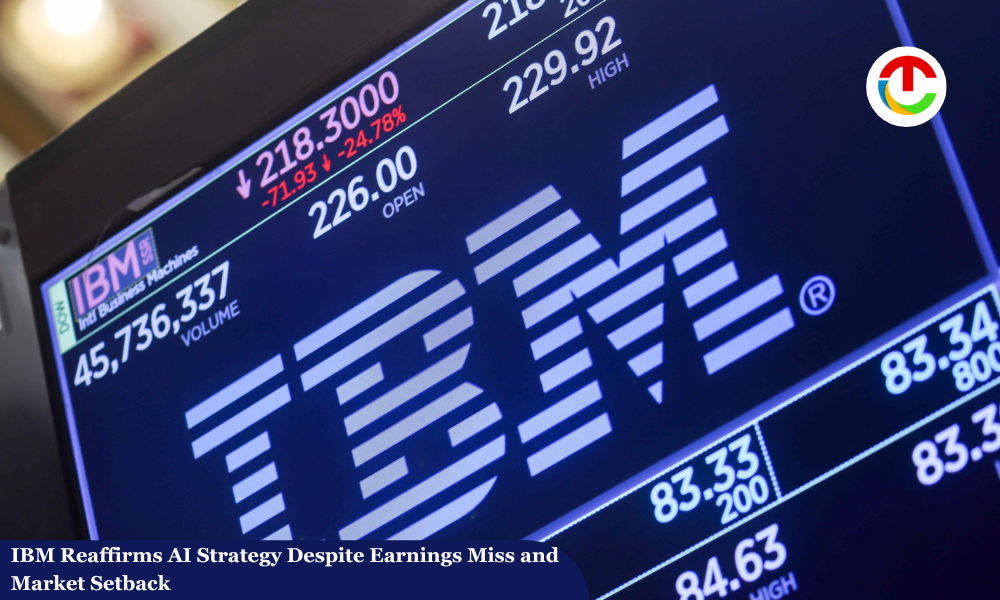
IBM Chief Executive Officer Arvind Krishna has defended the company’s artificial intelligence strategy after a disappointing second quarter triggered one of the company’s sharpest stock declines in recent years. Speaking on IBM’s latest earnings call, Krishna acknowledged the company had fallen short of expectations but maintained its long-term AI vision remains firmly on track.
“Our AI strategy is the right one for IBM,” Krishna said, emphasizing the company’s focus on hybrid cloud, data sovereignty, and trusted enterprise AI solutions. He added that while IBM possesses a strong technology portfolio, improved execution will be critical to realizing its growth ambitions.
Although IBM shares recovered slightly following the earnings release, investor concerns remain over the company’s ability to capitalize on the rapidly evolving AI market.
Mixed Financial Performance
IBM reported second-quarter revenue of $17.2 billion, representing a modest 1% year-over-year increase and matching analysts’ revised expectations. Diluted earnings per share rose 5% to $2.93, also in line with forecasts.
However, the underlying business performance painted a mixed picture. Infrastructure revenue declined 7%, reflecting weaker demand, while consulting revenue remained flat. Software revenue increased by 5%, a noticeable slowdown from the 11% growth recorded in the previous quarter.
The company also lowered its full-year outlook, now forecasting constant-currency revenue growth of 4% to 5%, compared with its earlier expectation of more than 5%.
AI Investments Reshape Spending Priorities
IBM Chief Financial Officer Jim Kavanaugh attributed much of the recent weakness to broader shifts in enterprise technology spending rather than a decline in demand for software.
According to Kavanaugh, many organizations are aggressively investing in AI infrastructure, prompting significant purchases of servers, storage, and memory components. Sharp price increases from hardware suppliers over the past month have also encouraged companies to buy equipment in advance to avoid higher future costs.
IBM itself increased inventory by approximately $600 million year-over-year through strategic purchases of server and storage components, a move Kavanaugh described as a prudent response to rising infrastructure costs.
Productivity Remains a Key Strength
Despite slower revenue growth, IBM continues to rely on operational efficiency to protect profitability. Kavanaugh highlighted the company’s ongoing productivity initiatives, which are expected to generate more than $5.5 billion in annualized cost savings by year-end.
These efficiency gains have enabled IBM to maintain healthy profit growth and expand operating margins while continuing to invest in research and development, AI innovation, and go-to-market capabilities.s
While the latest results underscore the challenges facing IBM in an increasingly AI-driven technology landscape, company leadership remains confident that disciplined execution and sustained investment in enterprise AI will support long-term growth.
Also Read :- IBM Unveils World’s First Sub-1 Nanometer Chip Technology