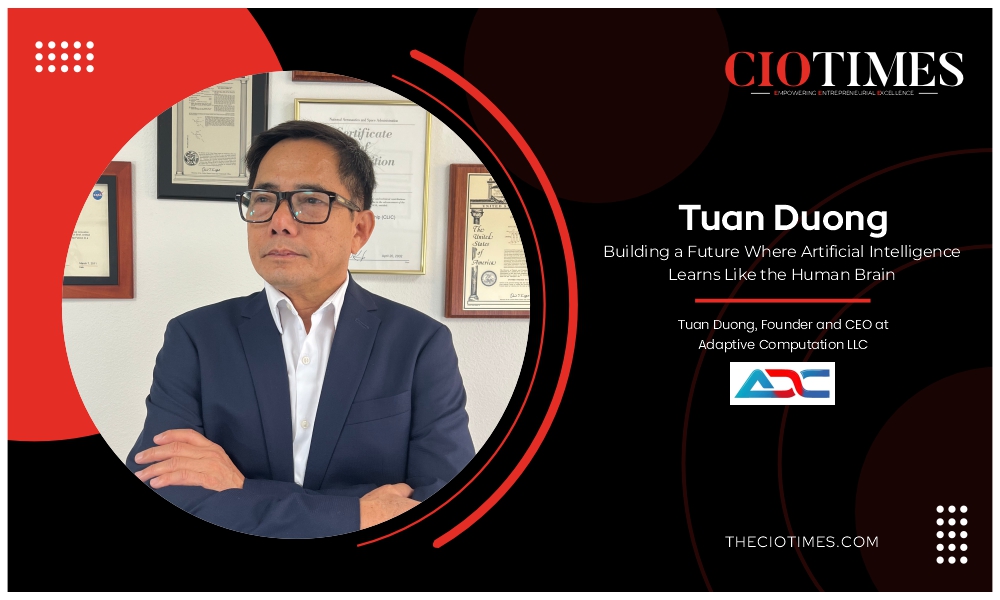
Artificial intelligence is no longer just a story about technology. It is becoming a story about leadership and the choices that shape progress. The leaders driving meaningful change understand that intelligence is most powerful when it strengthens human judgment rather than replacing it. They are looking beyond short-term gains and focusing on lasting impact. Decisions of leaders like Tuan Duong, Founder and CEO at Adaptive Computation LLC, are guided by purpose, responsibility, and a clear vision for the future. A true measure of leadership will be how thoughtfully innovation is applied to solve real-world challenges.
Cognitive Computing
The organization is driven by a simple yet ambitious vision: creating intelligent machines that learn, adapt, and think more like humans. Born as a spin-off from the California Institute of Technology (Caltech), the organization brings together decades of expertise in artificial intelligence, neuroscience, and advanced computing from leaders with backgrounds at NASA’s Jet Propulsion Laboratory, Bell Labs, academia, and industry.
Adaptive Computation focuses on advancing machine perception and cognition through brain-inspired technologies to build intelligent systems that can better understand complex environments and support more informed decision-making in the real world.
Beyond Algorithms
Mr. Tuan Duong believes the AI industry has become increasingly focused on commercial success, often placing business growth ahead of a deeper understanding of intelligence itself. In his view, organizations are quick to embrace bold AI commitments to remain competitive, even when those claims are yet to be fully realized. Even so, he acknowledges that advances in expert systems, fuzzy logic, genetic programming, and neural networks have steadily moved the field forward.
At the same time, he feels the gap between today’s AI and true cognition remains significant. He believes much of the industry’s effort is still directed toward short-term gains, leaving the pursuit of genuine intelligence as a longer-term ambition rather than an immediate priority.
Nature-inspired Intelligence
For him, nature remains the greatest source of inspiration. He believes the human brain still holds countless lessons about perception, learning, and adaptation. Even science has yet to fully understand these aspects. While today’s AI systems borrow from some of the brain’s most visible structures and pair them with immense computing power, he sees that as only the beginning of a much larger journey.
He adds, “From an engineering perspective, software is only focusing on algorithms and coding, while hardware is more in system architecture and design, in which there is little room for a biological view to be inspired and integrated.”
He also feels engineering has traditionally evolved in silos. Software often revolves around algorithms, while hardware focuses on system design, leaving limited room for biological thinking to shape innovation. The next leap forward, in his view, will come when engineering embraces a more interdisciplinary mindset. It brings together neuroscience, biology, software, and hardware to understand better. This ultimately recreates the remarkable intelligence found in nature.
Next Paradigm
The future of AI lies in developing fundamentally new computational architectures. It is not reliant on simply building larger models, according to Mr. Duong. Recalling his yesteryears of deep learning, he says he struggled with an approach that relied on massive datasets, powerful machines, and time-consuming training through backpropagation and statistical learning. While he acknowledges its effectiveness in static environments, particularly for commercial and advertising applications, he sees large AI models as a linear approach that depends on more data, bigger machines, and greater computing power to generate statistical knowledge.
The real world is dynamic, with driving data arriving continuously, and purely statistical methods are likely to reach their limits. He argues that such models offer interpolation rather than true intelligence. It makes it essential to explore brain-inspired approaches that are more dynamic and adaptable.
Mr. Tuan Duong envisions a hybrid model where statistical AI provides an initial layer of static knowledge, while bio-inspired, adaptive systems build on that foundation to create more intelligent and flexible AI.
Edge Intelligence
Mr. Tuan Duong believes uncertainty is inevitable when AI operates in real-world environments. While nature itself is constantly dynamic, he says the challenge lies in how people collect and interpret information with still-limited sensing technologies. With imperfect tools and incomplete understanding, noisy and uncertain data are unavoidable.
To overcome these limitations in vision, he points to bio-inspired mechanisms, such as micro- or regular saccadic eye movements and adaptive feedback techniques, which can improve sensing and interpretation. He notes that conventional approaches, including statistical learning, can also help by using larger datasets, higher-resolution inputs, and preprocessing methods. These, he says, are practical fixes that continue to improve over time.
Ultimately, the best solution depends on the application. For systems with SWaP-C constraints, he sees bio-inspired software and hybrid in-memory processing architectures as better suited for dynamic, unmanned space applications, where edge computing, self-generated training data, and self-learning can support greater autonomy. In comparison, he believes statistical learning architectures may face greater challenges in such environments.
Scaling Smarter Systems
Mr. Tuan Duong thinks that computational efficiency will be one of the defining challenges for the future of AI. As models like DNNs and LLMs become increasingly power-hungry, he points to growing concerns around the energy demands of AI infrastructure. It is with data centers already facing electricity constraints.
He recalls a long-standing saying from the U.S. Department of Defense: “Swimming in sensors, but drought in data.” For him, it reflects today’s reality, where data continues to grow faster than our ability to process it efficiently. While techniques like model pruning and modified learning architectures help reduce power consumption, he sees them as incremental improvements rather than lasting solutions.
Instead, the answer for him lies in redesigning AI from the ground up. With Moore’s Law nearing its limits, he argues that efficiency must be built into every layer nearing its limits. He mentions that efficiency must be built into every layer of the system. From how data is captured to how it is processed and deployed. At ADC, that vision is driving efforts to significantly improve sparse input processing. It also includes hybrid in-memory computing, and operational efficiency to bring these advances into real-world applications.
Cosmic Intelligence
At NASA’s Jet Propulsion Laboratory, his work was driven by a vision of making deep-space exploration more autonomous and affordable. He envisioned fleets of exploration robots, where low-cost systems equipped with chemical and visual sensors worked with more advanced robots powered by enhanced sensing and hybrid in-memory processing. Built around SWaP-C principles, the goal was to enable large-scale life-detection missions without the high costs typically associated with space exploration.
He adds, “I developed real-time landing identification on Mars to ensure safe and productive landing for the exploration program using real-time adaptive learning capabilities.”
He also developed a real-time adaptive system to identify safe landing sites on Mars, helping improve both the safety and efficiency of future missions. He recalls such experiences that molded his mindset and crafted his intelligence and machine decision-making ability. For him, the most effective AI systems are those that can adapt quickly. This also includes making informed decisions in unfamiliar environments and operating independently when human intervention isn’t possible.
Dual Experience Counts
Mr. Tuan Duong’s experience in scientific discovery and practical implementation has only brought positive results. Emerging technologies need a dual perspective. Innovations that will give disruptive results and the other that offers benefits due to the market’s momentum. In this calculation, he believes there are two stages to reach for professionals: technology capability for scientific discovery and application capability for practical implementation.
In technology capability, it is based on innovation with a solid foundation, e.g., mathematical models, analysis, and scientific observations, etc. while application capabilities focus on applying the technology for specific markets. We view them as feedback systems to advance one after another.
Leadership Lessons
He has had a fair share of exposure to research, academia, government programs, and entrepreneurship. In the context of nurturing innovation where scientific ambition and practical constraints need to co-exist, he points out two crucial criteria:
- Technology capability to open an innovation and/or direction to get attention and support, and itself cannot survive in the long run and needs applications to re-energize the resources for further investigation and development.
- Practical applications that come along with practical constraints will harvest the needed resources to beef up the technology capability.
Smart Systems Adoption
A frequent theme in Mr. Tuan Duong’s work is the handling of machines that perceive and interpret the world through multiple sensory channels. He, along with his team, has completed a feasibility study on short-term and long-term memory intelligence. It had promising early results for autonomous systems. The next step is validating it in real-world environments.
If successful, he believes it could support low-cost, personalized health monitoring that focuses on individual needs rather than a general approach. For autonomous systems, he says it could strengthen self-perception and self-cognition, helping machines better achieve their intended objectives.
Adaptive Architectures
Mr. Tuan Duong sees the future of cognitive architecture in systems that grow with experience rather than simply becoming bigger. He believes early breakthroughs, including deep convolutional neural networks, solved key challenges around learning and scale. But they were still built on fixed statistical models that offered limited signs of true intelligence.
His work has instead focused on creating architectures that can evolve. Drawing on the Kolmogorov-Arnold framework, he has explored cascading, constructive learning models that develop as new information arrives. He notes that this direction closely mirrors ideas introduced by Scott Fahlman at Carnegie Mellon University and later echoed in David Hubel’s neuroscience research at Harvard.
He shared, “Our bio-inspired architecture accidentally synchronized with David Hubel’s (at Harvard University) work and used his report to guide it further.”
Adaptability is the foundation of intelligence. Since the world is constantly changing, he believes AI must do the same. That belief has shaped his Extended Visual Pathway (EViP) and dynamic supervised learning algorithms, which he hopes will move AI closer to genuine self-intelligence.
Practical Innovation
Founding Adaptive Computation was about taking research beyond the lab and proving its value in the real world. It also created opportunities to access the resources needed to unlock the full potential of his work.
Tuan Duong shares, “Since transitioning from an idealistic environment to a real-world raw environment, there requires a lot of analysis, re-adjusting, and optimizing to meet the raw environment, and it allows us to validate and re-correct the discrepancy between them.”
The transition reshaped his view of innovation. Mr. Duong says moving from an ideal research environment to real-world applications demands constant refinement and adaptation. It is where ideas are truly tested. He has also learned that success depends on far more than technology; balancing time, budget, and resources is just as important in turning innovation into impact.
Envisioning the Future
Self-intelligence in each domain is what Mr. Tuan Duong believes to be the next step. Possessing only general intelligence will not benefit as much. From a data science perspective, self-selected data from raw data can reduce the training set to salient reduced training data, optimize the learning process, and hence ease the power crisis in the future.
Tuan Duong states, “From a hardware perspective, a hybrid or analog approach (like analog flash) can be an optimal solution as asynchronous and in-memory processing and avoid the Von-Neumann architecture, where data movements and group-based electron/hole binary coding cost more speed and power in local computation and global architecture; hence it is a slow and power-hungry approach.”
Till the prices stabilize, the full capability of benefiting can be achieved for humans, not for big businesses themselves.
Also Read :- CIO Times Magazine for More Information