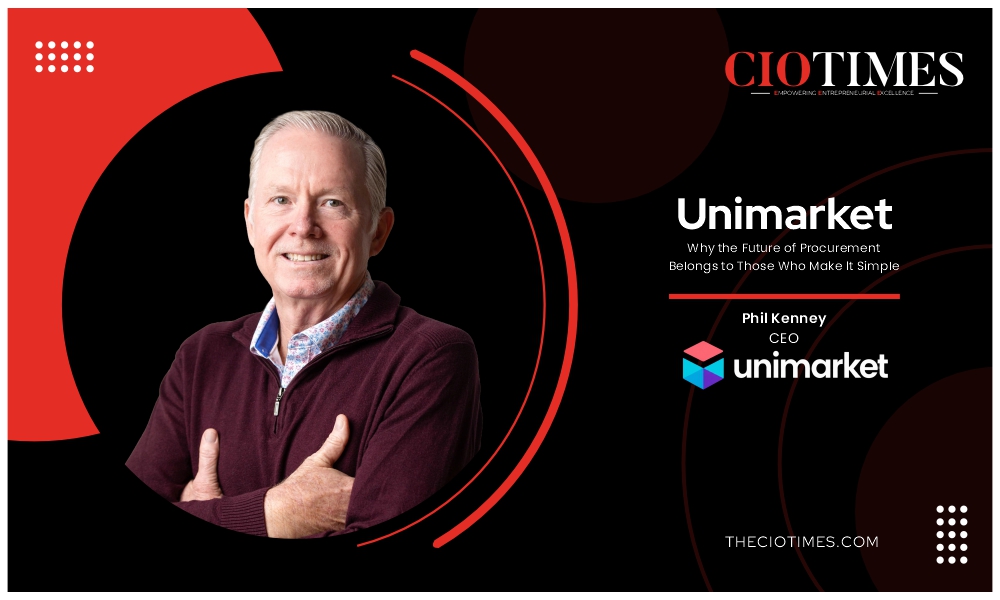
The best procurement process is the one people actually use. Unimarket has built its business on that conviction, and CEO Phil Kenney believes the next decade will reward connection, discipline and simplicity far more than features.
A decade ago, if you’d asked most executives where competitive advantage came from, procurement would rarely have made the list. But in 2026, that is starting to change. The function that once existed to process purchase orders and police budgets now sits at the center of the questions keeping leadership teams up at night. How exposed is our supply chain? Where is our money actually being spent? How can we prove that our spending reflects our values?
Unimarket has spent more than 15 years helping several organizations. Its cloud-based source-to-pay platform brings sourcing, contracts, purchasing, supplier management and invoicing into one place, replacing the patchwork of disconnected systems that leaves so many organizations asking questions about about their own spend. But talk to the people behind the platform and the conversation quickly moves past software. Their view is that procurement’s biggest problems are rarely technical, and that its biggest opportunities are only just coming into focus.
A Leader Shaped by Risk and Responsibility
Phil Kenney brings to Unimarket a perspective forged at the intersection of technology, governance and risk. His career spans higher education and corporate governance, and he has spoken and written on issues ranging from ransomware and executive risk management to national cybersecurity directives, work that has made him a trusted advisor to senior leaders navigating complex risk. For more than a decade, he has also supported the Community Resource Center, advancing its poverty alleviation and domestic violence programs.
The thread running through all of it is a leadership philosophy built on responsibility, resilience and sustainable innovation, with people firmly at the center. It shapes how he sees procurement’s future, and who he thinks will lead it.
The Next Generation of Procurement Leaders
Procurement has already come a long way from its roots as a cost-control function. It now influences risk management, sustainability and long-term organizational performance. Kenney believes the next decade will ask even more of it, and of the people in charge.
The leaders who will define this next era won’t just be skilled negotiators or process managers. They’ll be systems thinkers who can connect spend data to organizational outcomes, communicate in the language of the board, and build supplier ecosystems that create competitive advantage. — Phil Kenney, CEO, Unimarket
In other words, the skills that will set tomorrow’s procurement leaders apart look less like traditional purchasing expertise and more like strategy: fluency with data, the ability to lead change, and to tell a compelling story about the value procurement creates.
Data Rich, Insight Poor
Most organizations aren’t short of spend data. They’re drowning in it. What separates the organizations that use data well from those that merely collect it, Unimarket argues, has little to do with technology and everything to do with discipline.
That discipline starts with governance: clear ownership of spend categories, and leadership that insists on visibility before decisions are made rather than after. When those foundations are missing, the symptoms are familiar. Systems don’t talk to each other, approvals arrive after the money is already committed, and nobody can point to a single source of truth.
The organizations that break the cycle tend to do three things well. They set KPIs that genuinely mean something. They treat procurement as a strategic function, not an approval queue. And they invest in a connected procurement platform.
From Automation to Orchestration
The first wave of procurement technology was about automation: eliminating paper, speeding up approvals and stripping out manual work. It mattered enormously. But in Unimarket’s view, automation is now the baseline, not the differentiator.
The real opportunity is orchestration, connecting procurement with finance, HR, risk management and supplier performance so that information flows without friction. A contract signed today should inform tomorrow’s purchase order, which should flow into an invoice that reconciles itself automatically.
Organizations building genuinely strategic procurement are asking harder questions of their technology. Does the platform integrate cleanly with the ERP? Can finance leaders see committed spend in real time? Can suppliers serve themselves? Can an occasional buyer raise a requisition without a training manual? When the answer to all of those is yes, procurement stops supporting the business and starts leading it.
This is also where one of the most persistent myths in procurement modernization falls apart: the idea that a single ERP can do it all. ERP systems are essential for financial reporting and core operations, but procurement is rarely their primary focus. The strongest results come when an ERP is paired with purpose-built procurement software, each doing what it does best.
The lesson I’d carry forward is the value of optionality. — Phil Kenney
Control Without the Friction
For organizations in the public sector, healthcare, education and the nonprofit world, there is a constant tension between accountability and agility. Expectations of transparency keep rising, yet overly rigid compliance processes often backfire, slowing operations down and pushing people to buy outside approved channels altogether.
Kenney rejects the idea that organizations have to choose between the two.
When procurement processes are intuitive, fast, and connected to the tools people already use, you can get both. — Phil Kenney
The principle is simple: build compliance into the workflow so that the right way to buy is also the easiest way. When a procurement platform is easy to use, connected to everyday tools and accessible across the organization, oversight stops feeling like an obstacle and starts working the way it was meant to.
Resilience Is the New Efficiency
The supply chain shocks of recent years exposed an uncomfortable truth. Many organizations had optimized relentlessly for efficiency while giving too little thought to resilience. Heavy reliance on single-source suppliers, fragmented systems and limited visibility into spend left them with few options when conditions changed.
The lesson, as Unimarket sees it, is to build optionality into procurement itself: a diverse supplier base, spend data that is accurate and accessible, and the processes and relationships that make a fast response possible. That requires investment in both technology and people, and leadership that sees procurement as a strategic capability rather than an operational cost.
Suppliers as Partners, Not Vendors
Supplier relationships are changing too. Transactional engagements are giving way to long-term collaboration, and not simply out of goodwill. Trusted suppliers bring specialist expertise, fresh perspectives and capabilities that create value well beyond a lower price.
The strongest procurement teams treat suppliers accordingly. They share forecasts, flag upcoming needs early and remove unnecessary friction from everyday interactions. In this model, supplier portals, streamlined onboarding and open communication aren’t optional extras; they are the foundation of partnerships that work. When both sides can see clearly, both sides win.
That same visibility underpins procurement’s growing role in sustainability. From supply chain emissions and labor practices to support for local and diverse businesses, purchasing decisions shape outcomes far beyond the balance sheet. Leading organizations are building sustainability into sourcing and supplier evaluation rather than treating it as a separate initiative, and meaningful progress depends on clear insight into supplier practices, contractual commitments and spending patterns.
AI Where It Actually Counts
Unimarket sees enormous long-term potential for AI in procurement, but believes its biggest impact will come from unglamorous, everyday work rather than headline-grabbing use cases. Invoice processing, purchase order matching, discrepancy resolution and approval workflows still consume a huge amount of manual effort. That is where AI can deliver real gains in speed, accuracy and turnaround.
There is an important caveat. AI will not fix a broken process. The organizations that benefit most will be those that already have strong data foundations and well-structured workflows in place. AI amplifies good procurement practice; it doesn’t replace it.
People First, Technology Second
If there is one idea Unimarket returns to repeatedly, it is this: technology is rarely the reason a procurement transformation succeeds or fails. Leadership commitment, thoughtful change management and whether procurement is seen as a partner or a checkpoint matter far more.
That is why the common belief that technology is the hardest hurdle can be so costly. Success depends first on the fundamentals: clear processes, reliable data and alignment across the business before any new tool arrives. From there, lasting change comes from bringing people along, through clear communication, visible champions across the business and ongoing support. Intuitive technology helps by making the benefits obvious from day one. But without a compelling reason to change, even the most carefully planned transformation will stall.
Measuring What Matters
Judging procurement on cost savings alone misses most of the story. Savings still matter, but a truer picture comes from how procurement operates: contract compliance, purchase order coverage, invoice cycle times, supplier onboarding and off-contract spend. These are the measures that reveal whether procurement is creating real value or simply ticking compliance boxes. Unimarket expects supplier sustainability and diversity to join that list soon, as they shift from aspiration to expectation.
Two Shifts That Will Define the Decade
Looking ahead, Unimarket sees two forces reshaping the function. The first is user expectations. People now expect procurement software to be as intuitive as the apps on their phones, and as a new generation moves into procurement and finance roles, systems that demand weeks of training are becoming harder to justify.
The second is accountability. Particularly in healthcare, education and the public sector, staying on budget is no longer enough. Organizations must show that their spending is responsible, sustainable and aligned with their values. Those investing in strong data foundations today will be best placed to prove it tomorrow.
The Quiet Power of Good Software
If procurement comes to define the next decade, it will be because the function has moved from managing spend to shaping strategy. Visibility, supplier collaboration, AI and sustainability will stop being separate priorities and become a single, connected way of working.
We’ve spent over 15 years helping organizations in higher education, healthcare, and government transform their source-to-pay processes. Our focus has always been on building software that people want to use — because adoption is what makes everything else possible. — Phil Kenney
It is a philosophy that puts removing complexity ahead of adding features. Unimarket’s continued investment in intelligent automation, contract insights, spend visibility and connected workflows all points to the same belief: procurement creates its greatest value when technology works quietly in the background, freeing people to make faster, smarter and more confident decisions.
Also Rad :- CIO Times Magazine For more information