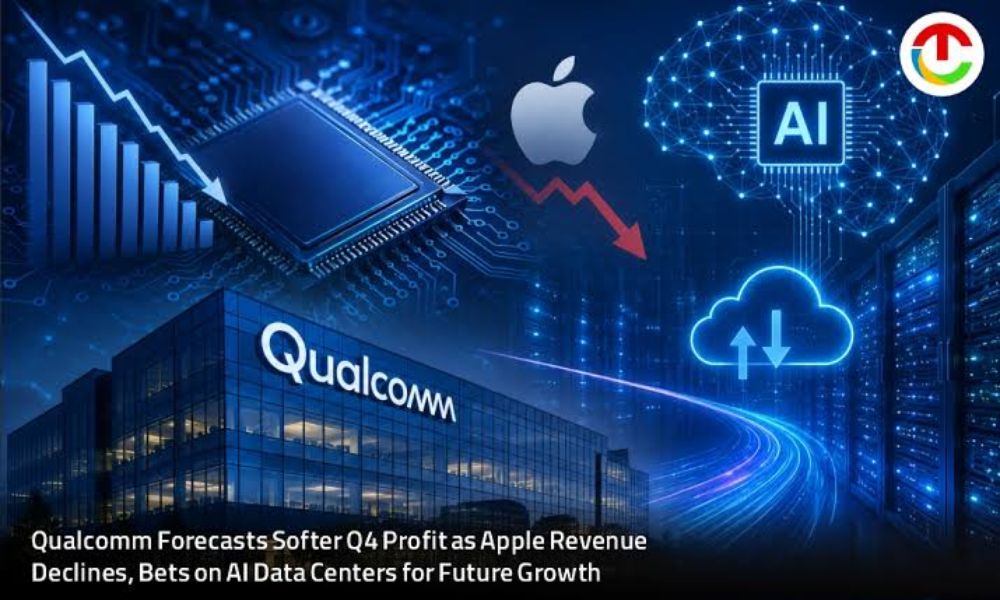
Qualcomm has issued a weaker-than-expected forecast for its fiscal fourth quarter, citing a sharper decline in revenue from Apple products and ongoing pressures in the smartphone market. However, the semiconductor giant remains confident that rapid growth in AI data centers, automotive chips and other non-handset businesses will offset the slowdown, with those segments expected to become its primary revenue drivers by fiscal 2027.
Following the announcement, Qualcomm shares fell more than 4% in extended trading, while Apple shares remained largely unchanged.
Apple Revenue Headwinds Intensify
The company said revenue from Apple-related products will decline faster than previously anticipated, as supply constraints reduce Qualcomm’s share of components used in Apple’s next iPhone lineup to well below its earlier estimate of 20%.
Chief Executive Officer Cristiano Amon attributed the lower share to component availability rather than demand.
“It’s availability of supply,” Amon told Reuters, adding that the company is also planning to increase prices from September 1 to offset rising costs across its supply chain.
According to Amon, higher production costs—not limited to memory chips—have pressured margins, prompting Qualcomm to pass some of those increases on to customers through price adjustments. He noted that the temporary gap between higher costs and pricing would weigh on gross margins in the near term as the company negotiates revised contracts with customers.
AI Data Centers Become Growth Engine
Despite weakness in its smartphone business, Qualcomm is accelerating its expansion into AI-powered data centers and other diversified markets.
The company expects that by fiscal 2027, the majority of its chip sales will come from businesses outside smartphones. Chief Financial Officer Akash Palkhiwala said growth in Qualcomm’s non-handset operations is expected to fully replace Apple-related revenue generated in fiscal 2026.
Qualcomm is targeting $5 billion in AI data center revenue by fiscal 2027, with ambitions to triple that figure to $15 billion by 2029.
“We kind of replaced Apple with the data center,” Amon said.
The company has already begun wafer production for two custom AI chip programs with hyperscale customers, with revenue expected to begin in the December quarter. It has also completed the tape-out of its first-generation high-bandwidth compute chip, which integrates computing and memory into a single package ahead of its planned mid-2027 launch.
Industry analysts view Qualcomm’s shift toward AI infrastructure and automotive semiconductors as a strategic move that reduces dependence on the cyclical smartphone market.
Smartphone Business Remains Under Pressure
For the fiscal fourth quarter, Qualcomm expects adjusted earnings of $2.05 to $2.25 per share, below analysts’ consensus estimate of $2.36. Revenue is projected to range between $9.7 billion and $10.5 billion, broadly in line with market expectations.
The company expects handset revenue of approximately $5.2 billion, supported by improving Android demand despite weaker Apple sales. However, Amon said smartphone manufacturers have been forced to raise prices, pushing consumers toward lower-priced premium devices and older models, resulting in a less favorable product mix and continued pressure on margins.
For the third quarter, Qualcomm reported revenue of $9.95 billion, exceeding analysts’ expectations of $9.67 billion despite a 4% year-over-year decline. Adjusted earnings came in at $2.21 per share, slightly below consensus estimates, while smartphone chip revenue fell 20% to $5.09 billion but still outperformed market forecasts.
As Qualcomm navigates a challenging smartphone landscape, the company is increasingly positioning AI infrastructure, automotive technologies and enterprise computing as the next phase of its long-term growth strategy.
Also Read :- Qualcomm Shares Surge as Chipmaker Raises Ambitious 2029 Revenue Targets