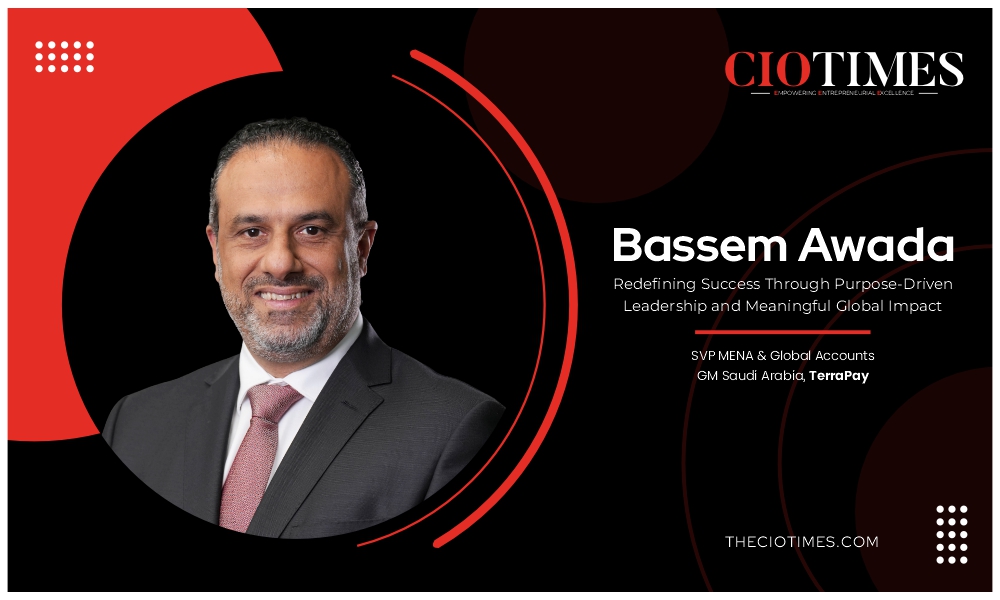
The future of business is reliant on dynamic leaders. Leaders who possess the hunger to challenge convention and inspire productive change. They understand that leadership is defined by authority and the ability to influence others with purpose and integrity. Leaders like Bassem Awada, SVP MENA & Global Accounts. GM Saudi Arabia at TerraPay, replicate ideal leadership as they embrace uncertainty and turn it into an opportunity for growth. Thoughtful decisiveness and unwavering resilience shape a stronger and more promising future for everyone.
Growth Architect
Bassem Awada is an accomplished Business & Strategy Leader with over 30 years of experience delivering transformational growth across multinational corporations and regional enterprises in the Healthcare and Financial Services sectors throughout the Middle East and APAC. He has consistently spearheaded strategic transformation, advanced digital innovation, and aligned business priorities to unlock long-term enterprise value.
A commercially astute executive, Bassem has established an exceptional track record in business development, cross-border payments, and strategic global partnerships, successfully scaling digital financial ecosystems and driving market expansion across both emerging and mature economies. Recognized as a Global Power Leader 2024, he blends strategic vision with disciplined execution, cultivating high-impact alliances with governments, telecom operators, and fintech leaders while inspiring cross-functional teams to deliver sustainable growth, innovation, and measurable business impact.
A Cross-country Perspective
His leadership includes globally respected organizations across healthcare, financial services, and fintech. Each sector has shaped his perspective on business transformation. Integrating healthcare innovation at 3M Health Care, advancing cross-border financial services at Western Union, and now helping shape the future of global payments at TerraPay, each role has strengthened his ability to steer change at scale.
TerraPay is a global payments infrastructure provider enabling secure, real-time cross-border transactions across bank accounts, mobile wallets, and cards in more than 156 countries. Serving banks, fintechs, money transfer operators, and enterprises, it connects over 7.5 billion bank accounts and 3.7 billion mobile wallets worldwide through its proprietary Xend network, advancing seamless global financial connectivity.
Sustainable Foundations
Despite operating in distinct industries, he believes the foundations of sustainable growth remain constant: customer trust, strategic partnerships, disciplined execution, and the ability to anticipate evolving market needs. His experience across mature and emerging markets has reinforced that enduring success comes from leading it. Working across highly regulated industries has shaped his leadership approach. He believes sustainable growth demands disciplined execution, adaptability, and long-term value creation.
Earned Apprehensions
Bassem Awada has spent the first three decades of his career working in diverse sectors, namely, healthcare and the payments sector. The market operations vary substantially, and this exposure allowed him to gain insights about business development and revenue. In the initial days, he was convinced that revenue growth was primarily about having the best product and the strongest business development team. Experience gave him the actual lens.
He experienced a strategic inflection point when he and his team had a top-notch product based in the retail sector. Despite having resources as a competent team, high-demand growth eluded. Upon scrutinizing the situation, the team noticed a gap: less time was spent on understanding how customers had changed their buying behaviors when financial services were to be dealt with. The customers needed speed, transparency, security, and most importantly, control.
That exposure transformed his outlook. Strategic outlook is what he developed rather than a process of persuasion.
He adds, “Sustainable revenue comes from deeply understanding customers’ changing needs, building trust, and creating long-term value rather than focusing solely on closing the next deal.”
He also learned that revenue generation is interlinked and not limited to only the business development executives. Product development, marketing, customer success, operations, and leadership each department equally contributes to the whole process. Every business he has been a part of was aligned to providing value to the customer.
Value Creation
Sustainable growth is often attributed to the strength of a sales function, but he believes it is fundamentally rooted in customer understanding. Organizations that develop a nuanced appreciation of their customers’ priorities and challenges are better positioned to create enduring value, making revenue growth a consequence of relevance rather than persuasion.
He adds, “Culture also plays a critical role. Businesses that encourage collaboration, accountability, and continuous learning are far better equipped to adapt as markets evolve.”
Bassem Awada maintains that growth is an enterprise-wide responsibility, requiring seamless alignment across marketing, product, operations, customer success, and finance. When every function is united by a shared commitment to customer outcomes, businesses are able to scale with greater consistency and resilience.
Drawing on more than three decades of leadership experience, Bassem regards revenue as a lagging indicator of organisational excellence. In his view, sustainable performance is achieved through customer-centricity, cross-functional alignment, disciplined execution, and a culture grounded in accountability rather than entitlement.
Executing Global Growth
Successful expansion is determined less by market potential than by execution and local relevance. While favourable economic indicators and growth projections may appear compelling, he argues that sustainable success depends on whether a business can solve a genuine customer problem and deliver its value proposition within the realities of the local market.
He adds, “I’ve found that customer behaviour often matters more than market size. Two markets may look similar on paper, but the way people make purchasing decisions, build trust, or adopt new products can be completely different.”
Having led businesses across the Middle East and Asia-Pacific, he has found that customer behaviour often outweighs market size. Cultural nuances, regulatory environments, and purchasing habits can vary significantly even between seemingly similar markets, making direct replication of a successful model a costly mistake.
The most reliable insights come from engaging with customers, partners, and local stakeholders on the ground. These conversations often reveal whether an opportunity is truly viable or merely attractive in theory, enabling businesses to expand with greater confidence and precision.
Customer Journey
Bassem Awada believes the disconnect between sales, marketing, and customer experience persists because many organisations remain structured around internal functions rather than the customer journey. While each team is measured against its own objectives, customers engage with the business as a single entity and expect a seamless, consistent experience throughout.
He argues that high-performing organisations shift the focus from departmental success to shared customer outcomes. This requires cross-functional alignment, collective accountability, and a unified commitment to delivering customer value at every touchpoint.
He states, “I’ve always believed that customers don’t care about organizational charts. They care about whether a company understands their needs, keeps its promises, and delivers a consistent experience from the first interaction through to long-term support.”
Although technology has made collaboration more accessible, he maintains that true alignment is ultimately a leadership responsibility. Sustainable growth, he says, is achieved when organisations cultivate a culture in which every function contributes to a single, cohesive customer experience rather than operating in organisational silos.
Strategic Partnerships
Every partnership begins with understanding what success looks like from the other side of the table. Before discussing commercial terms or contracts, he focuses on understanding the people involved, their priorities, challenges, motivations, and the outcomes they are striving to achieve. In his view, the strongest partnerships are built on empathy and shared purpose, not just commercial alignment.
He believes meaningful negotiations are driven by curiosity rather than persuasion. By listening carefully and understanding how decisions are made, who influences them, and what risks an organisation is navigating, it becomes easier to identify opportunities that create value for both parties.
He adds, “The strongest relationships I’ve developed over the years have been those where both sides viewed each other as long-term partners rather than simply counterparties to a transaction.”
Over the years, Bassem has found that lasting partnerships are rarely forged in a single meeting. They are built on trust, transparency, and consistent delivery on commitments. Ultimately, he believes the ability to see a situation through a partner’s perspective is what transforms a business transaction into a long-term strategic relationship.
Human Advantage
He believes technology has transformed business development by making teams better informed, more efficient, and better equipped to understand customer needs. But while AI and analytics have become indispensable, he sees them as tools that enhance relationships, not replace them.
He adds, “Exceptional business development people build trust. In complex or high-value decisions, customers aren’t just buying a product or service—they’re placing confidence in the people and the organization behind it.”
According to him, the qualities that truly set exceptional business development professionals apart are deeply human: curiosity, empathy, sound judgment, and an appreciation for cultural nuances. Data can identify trends and predict behaviour, but it cannot explain why a customer is hesitant, when to challenge an assumption, or when the best course of action is simply to listen.
Trust remains the one advantage technology cannot replicate. In complex, high-value partnerships, clients ultimately place their confidence in people, not platforms. Technology may open doors and inform decisions, but enduring business relationships are built through credibility, consistency, and a genuine understanding of the people on the other side of the conversation.
Power of Focus
Bassem Awada considers one of the most challenging commercial decisions of his career to be walking away from an opportunity that, by most conventional measures, appeared exceptionally promising. The market dynamics were favourable, the financial projections were compelling, and the potential for near-term growth was undeniable. Yet, a closer assessment revealed a fundamental misalignment with the organisation’s long-term strategic direction.
While no single issue was significant enough to derail the opportunity, the cumulative impact of stretching operational capabilities, diverting leadership focus, and compromising on core priorities ultimately outweighed the short-term commercial upside. In Bassem’s view, these are the moments that test leadership, not the complexity of the deal itself, but the discipline to decline an attractive opportunity that does not serve the broader vision.
He adds, “One of the toughest commercial decisions I’ve made was walking away from an opportunity that looked extremely attractive on paper. The market was growing, the financial projections were compelling, and there was considerable enthusiasm around the potential.”
The experience reinforced a principle that has shaped his approach ever since: strategy is defined as much by the opportunities an organisation chooses not to pursue as by those it embraces. Every commitment demands finite resources capital, talent, and executive attention and allocating them wisely is fundamental to building enduring value.
Sustainable growth is rarely the result of chasing every promising opportunity. It is achieved through the conviction to remain focused on opportunities that align with an organisation’s strengths, purpose, and long-term ambitions, even when saying “no” is the more difficult decision in the moment.
Leadership Traits
It is difficult to predict someone’s long-term success in business development from a single meeting. While experience has taught him to avoid making quick judgments, he says certain qualities often reveal themselves early, and they rarely appear on a résumé.
Foremost among them is curiosity. He looks for individuals who ask thoughtful questions, listen with intent, and show a genuine desire to understand customers, markets, and business challenges. Equally important are resilience and integrity. In a profession where setbacks are inevitable, he believes the ability to learn, adapt, and maintain credibility is far more valuable than short-term sales success.
Bassem Awada adds, “Character is much harder to build. I would always rather work with someone who is honest, dependable, and committed to doing the right thing than someone who delivers short-term results by compromising trust and integrity.”
Another characteristic Bassem values highly is coachability. The strongest commercial professionals, regardless of their experience, are those who remain open to feedback and committed to continuous improvement. Exceptional business development is not defined by the ability to sell, but by the ability to build trust, solve meaningful problems, and cultivate enduring relationships qualities that remain indispensable in an increasingly technology-driven world.
Beyond Resumes
Bassem Awada is cautious about forming opinions based on first impressions alone. While he believes it is impossible to determine in a single meeting whether someone will become an exceptional business professional, he has found that certain qualities tend to reveal themselves early. Also, they do not reflect on a resume.
Foremost among them is curiosity. He looks for individuals who are genuinely interested in understanding people, asking insightful questions. He likes those who listen with genuine intent rather than focusing on impressing others. Resilience is equally important. In a profession where rejection is inevitable, he believes long-term success belongs to those who learn from setbacks, adapt quickly, and maintain their drive.
Beyond capability, he places significant value on character. Integrity and coachability, are qualities that cannot be easily taught but often determine whether someone will continue to grow throughout their career.
He adds, “I don’t hire people because they’re good at selling. I hire people because they’re good at building relationships, solving problems, and earning trust.”
The best business leaders, Bassem highlights, are not defined by their ability to sell. They distinguish themselves through their ability to earn confidence, solve meaningful problems, and cultivate lasting relationships. These are the qualities that remain timeless, regardless of how markets or technology evolve.
Sustainable Growth
The distinction between rapid growth and enduring success lies in the strength of an organisation’s foundations. While accelerated growth can often be driven by favourable market conditions or short-term opportunities, sustainable growth is the result of deliberate strategy, disciplined execution, and a long-term commitment to building organisational capability.
He argues that businesses with lasting momentum focus on far more than revenue. They invest in understanding their customers, developing their people, strengthening operational resilience, and building scalable systems that can support growth without compromising quality or customer experience. Equally important is the discipline to remain aligned with a long-term vision, even when attractive opportunities promise immediate returns.
He adds, “I’ve also found that disciplined leadership makes a significant difference. Sustainable businesses know what to pursue, but they also know what to decline.”
Adaptability is another hallmark of resilient organisations, Bassem mentions. The companies that thrive over time are those that continuously evolve alongside changing markets, emerging technologies, and shifting customer expectations while remaining anchored to a clear sense of purpose.
Drawing on more than three decades of leadership experience, he sees sustainable growth not as a race for scale, but as the outcome of consistently making sound strategic decisions. In his view, the most successful organisations are those that build lasting trust with customers, inspire confidence among employees, and cultivate partnerships that endure well beyond periods of rapid expansion.
The Future Foundations
If he were starting his career today, Bassem says he would embrace AI, automation, and data from the outset. He believes these technologies have fundamentally transformed business development by enabling professionals to better understand customers, identify opportunities, and make more informed decisions at a pace that was previously unimaginable.
However, he is equally convinced that technology has not changed the fundamentals of the profession. The ability to understand people, solve meaningful problems, communicate with clarity, and earn trust remains at the heart of successful business development. While AI can provide intelligence and efficiency, it cannot replicate the judgment, empathy, and credibility required to build lasting customer relationships.
He adds, “I would also spend more time developing data literacy. The best business development professionals of the future will not be those who rely only on technology or those who avoid it—they will be the people who know how to combine human judgment with powerful tools.”
He also sees data literacy as an essential capability for the next generation of commercial leaders. In an environment where information is readily available, he believes the real differentiator is no longer access to data, but the ability to interpret it, ask better questions, and translate insights into meaningful business outcomes.
Reflecting on the future of the profession, Bassem believes the most successful business development professionals will be those who combine the analytical power of technology with the distinctly human qualities of curiosity, emotional intelligence, and relationship building. In his view, while the tools of business development will continue to evolve, its foundations will remain remarkably constant.
Purpose Drives Performance
One lesson stands above all others: sustainable commercial success is never built by chasing revenue alone. Instead, it comes from creating an organisation that consistently delivers value to its customers. Revenue is an outcome, not the strategy itself.
Over the course of his career, he has seen many businesses achieve rapid growth, only to struggle when the underlying foundations were not strong enough to support it. Lasting success, he believes, is built on clear strategic direction, customer-centric thinking, operational excellence, and an organisational culture that remains agile as markets evolve. These are the factors that enable businesses to grow with consistency rather than momentum alone.
He also rejects the notion that commercial performance belongs solely to the sales organisation. In his view, growth is the collective responsibility of the entire business. Product strategy, customer experience, operations, finance, and talent all influence an organisation’s ability to compete, innovate, and create long-term value. When these functions operate in alignment, commercial success becomes far more sustainable.
He adds, “A CEO cannot delegate responsibility for growth to the sales function alone. Every decision—from product development and talent choices to operations and customer service—shapes the company’s ability to compete and grow.”
Another principle that has shaped Bassem’s leadership philosophy is staying close to the customer. As organisations grow, leaders naturally rely more on data, dashboards, and performance metrics. While these tools are invaluable, he believes they should inform, not replace direct engagement with customers and the market. The strongest commercial leaders remain curious, continue listening, and are willing to adapt as customer expectations change.
Bassem Awada sees commercial leadership as a long-term responsibility rather than a quarterly exercise. Delivering financial performance will always matter, but the greater challenge is building an organisation that can continue creating value through changing markets and business cycles. In his experience, that requires strategic discipline, organisational alignment, and the patience to prioritise enduring success over short-term gains.
Leadership Legacy
Bassem hopes his colleagues would describe him as a leader who never lost sight of the human side of business. While he has always been driven by ambitious goals, he believes lasting commercial success is ultimately built through people. For him, one of leadership’s greatest responsibilities is creating an environment where talented individuals are trusted, challenged, and empowered to do their best work.
He also hopes to be remembered as someone who consistently took the long view. Having built businesses across different markets and business cycles, he has learned that sustainable success is rarely defined by a single deal, quarter, or milestone. Instead, it is earned through thoughtful decisions, strong relationships, and an unwavering commitment to creating value over time.
Curiosity is another quality he considers central to his leadership style. Despite decades of experience, Bassem believes the best leaders never stop learning. They remain open to different perspectives, listen more than they speak, and recognise that valuable ideas can come from anywhere within an organisation. For him, leadership is strengthened by humility as much as experience.
He adds, “I would also hope they would describe me as someone who is curious and willing to listen. No matter how much experience you gain, every market, customer, and challenge has something new to teach you.”
Above all, he hopes people would say he held high standards while giving others the confidence and autonomy to succeed. He believes accountability and empowerment are not opposing forces; they are complementary. The strongest teams are built when people are given a clear sense of purpose, the freedom to make decisions, and the trust to take ownership of outcomes.
He believes a leader’s legacy extends far beyond financial performance. Businesses evolve, markets change, and achievements fade with time, but the people a leader develops and the culture they help create leave a far more enduring impact. If his colleagues remember him as someone who built successful businesses while bringing out the very best in those around him, he says that would be the achievement he values most.
Also Read :- CIO Times Magazine for more information