Imagine completing a project in six weeks that had originally been scoped for 26, reducing the labor budget from $875,000 to $202,000. Reporting a 99 percent defect-prevention rate, and full return on investment within 21 weeks of go-live. These are the results reflected in Clear Measure’s disciplined approach to software delivery and the way it uses AI throughout the process.
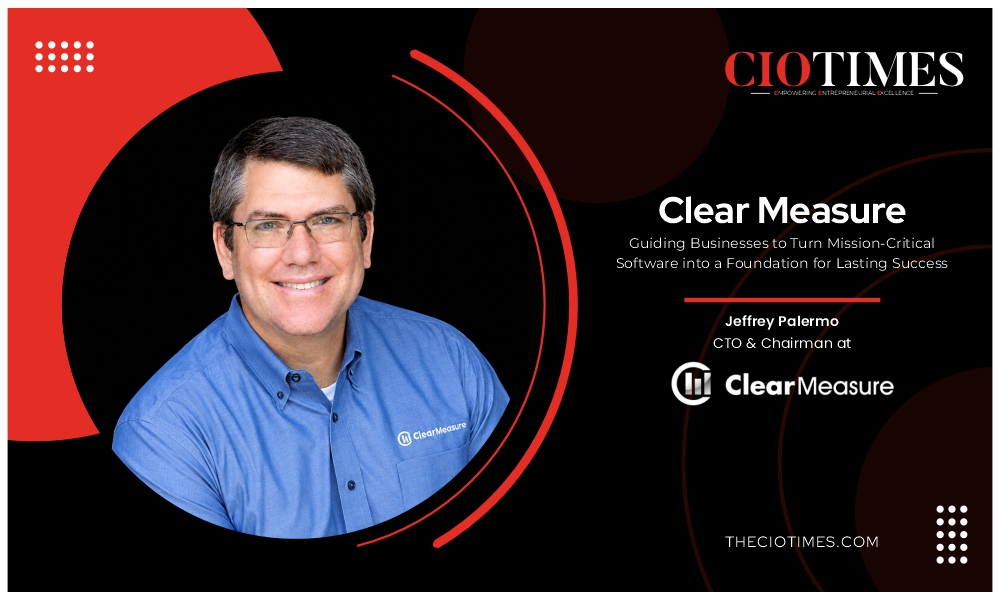
Clear Measure‘s Founder and CTO Jeffrey Palermo has spent more than 30 years building software. Long before AI entered the picture, his focus was on improving software delivery through automation and disciplined DevOps and engineering practices. That experience continues to shape Clear Measure’s work with enterprises that need to strengthen how their mission-critical applications are built, deployed, and managed.
Clear Measure recognizes that effective DevOps extends well beyond automation and faster releases. It is about creating an environment where engineering excellence and operational discipline come together. This enables businesses to deliver software with greater confidence, consistency, and agility in an increasingly software-driven economy.
The Five Pillars Methodology
Palermo is the author of The Five Pillars: Leadership for Effective Custom Software. The book lays out the methodology Clear Measure uses with clients: Create Clarity, Establish Quality, Achieve Stability, Increase Speed, and Optimize the Team.
1. Creating Clarity
begins with the result the business needs to achieve. Before anyone starts writing code, the team must agree on that result, identify what is standing in the way, and choose a direction.
2. Establishing Quality
comes next because every defect consumes capacity twice. Time is spent creating the problem, then more time is spent correcting it. That second round of work comes out of the time and budget meant for features the business requested.
3. Achieving Stability
extends quality into production. Software needs to perform reliably day after day without recurring incidents pulling developers away from planned work.
4. Increasing Speed
can commence once those three disciplines are working, without creating chaos. Repeatable steps can be automated, releases can happen more often, and engineers can spend more of their time on work that requires judgment.
5. Optimize the Team
is the fifth pillar. New tools and processes only create lasting value when the people using them understand why they matter and have the discipline to apply them consistently. Otherwise, those practices fade and the organization eventually returns to its old way of working.
Clear Measure applies the Five Pillars through project jumpstarts, project rescues, DevOps automation, migrations, and fractional leadership, with the goal of making delivery more predictable and producing a faster return on investment.
The company has completed more than 1,000 projects across finance, healthcare, education, agriculture, energy, and other industries. In 2024, Inc. magazine named Clear Measure to the Inc. 5000 list of fastest-growing private companies.
Clarity Amid Chaos
In combat, not every decision carries the same weight. A few can determine the outcome, and the skill lies in recognizing them while the noise is still loud. Palermo learned that during his time in Iraq in 2003 and 2004, where there was little time to weigh every option and no room to spend energy on the wrong problem. The experience taught him to cut through the noise, identify what matters most, and remain steady under pressure.
That discipline carries into Palermo’s approach to engineering and can be seen in how Clear Measure begins an engagement. Organizations with struggling software projects often arrive with several problems competing for attention. Clear Measure first defines success based on the organization’s vision and desired business result. It then identifies the specific obstacles making that result difficult to achieve.
Once the challenge is clearly articulated, the organization evaluates a range of solutions. These may involve technology, but they can also include process improvements, workforce training, and organizational alignment. The progression is deliberate: establish the goal, identify the obstacle, and assess the available solutions.
From there, the team analyzes the alternatives before selecting the best path forward. Once the right solution is identified, the engagement moves into full implementation, building capabilities that last and strengthening the client’s long-term position.
Architecture Drives Outcomes
Every software project involves architectural decisions, engineering, development, deployment, support, and maintenance. The amount of work required in each area varies from project to project, but architecture remains constant.
Civil architecture makes the point. A modest storage facility needs almost no architectural oversight, and the builders can proceed from a standard plan. A landmark convention center needs deep architectural engagement because someone has to interpret what the client is actually trying to build and then orchestrate the engineering and design disciplines that will realize it. The trades are the same on both job sites. The architecture is what differs.
Software works the same way, which is why Clear Measure treats architecture as the business conversation before it becomes technical. Before anything gets built, architects examine the client’s vision, weigh the alternatives, evaluate technologies and tools, and determine how the components will fit together. Only once that is settled do teams move into implementation, deployment, and monitoring. Architecture is where alignment and certainty are established before the expensive part begins. It is also the phase most often skipped, which is why so many projects arrive at Clear Measure as rescues.
Predictable Delivery Practices
With clarity defined, predictability is won or lost on establishing quality. Clear Measure treats every defect as capacity spent twice, and the second payment comes out of the budget for features the enterprise actually requested. A primary defense is test-driven development. Tests define correct behavior before the code exists, so the standard is set while it can still shape the design. Identifying edge cases has always been tedious work that is often sacrificed when a deadline tightens. AI can propose edge cases that a team under schedule pressure might not have time to identify, and the resulting suite runs every time new code moves toward release.
For companies with systems that experience heavy volumes, load testing becomes a priority. One education client, whose software delivers assessments to students and must stay responsive when classrooms sit down to test at once, came to Clear Measure with no way to measure whether its infrastructure could absorb a planned expansion. Clear Measure built a testing framework, and every infrastructure and software change in the past 10 years has been benchmarked before and after. This provides an apples-to-apples comparison that catches performance regressions before users do.
Reaping the Rewards
Stability in production is the marker that tells an executive whether the delivery approach is working. A system built this way holds up under stress, but achieving that stability requires practices many organizations resist. It requires small, frequent releases pushed through automated deployment because a small change has a small blast radius and a short list of suspects when something goes wrong. It takes runtime telemetry and automated health checks so the system reports its own condition continuously. It also takes centralized logging, anomaly detection, and alerts so the organization learns about a degradation through its own instrumentation before hearing about it from a customer.
Clear Measure works alongside teams to help them operate with this level of attention. Teams operating this way stop resolving the same incidents over and over and start preventing them. That is what turns stability from a periodic achievement into a standing condition and makes predictable delivery possible.
Operational Discipline
Clear Measure views DevOps consulting as a way to strengthen organizational discipline and culture.
Palermo traces some of his thinking about discipline back to becoming an Eagle Scout. He learned that rank was earned through demonstrated work, not through tenure. Software teams need the same kind of accountability. A broken build should be treated as a problem that stops the work, not an inconvenience people learn to route around.
Culture is shaped by what leaders expect, what they tolerate, and what they do when a problem appears. If unstable code is allowed to remain in place while more changes are added, the risk continues to grow. Automation can make a disciplined process faster, but it cannot make an undisciplined process reliable.
Operational Maturity
Clear Measure defines operational maturity by the discipline with which software delivery practices are applied and sustained. It is not simply a matter of adopting tools or platforms.
Continuous integration illustrates the distinction. A build server can support the practice, but configuring one does not mean an organization has achieved operational maturity. Continuous integration depends on how consistently changes are integrated, validated, and maintained over time. Technology enables these practices, while discipline ensures they are understood, followed, and reinforced throughout the delivery lifecycle.
Strategic Differentiator
Palermo competes in amateur off-road motorcycle races throughout Texas. In a race, the final scorecard is what matters. A rider can move quickly through the middle of the course and still fail to reach the finish line. Palermo sees the same problem in enterprise software, where teams are often judged by how much work they complete along the way instead of whether the project delivers the intended business result.
That distinction has become even more important as organizations introduce AI into software engineering. Many are using AI to speed up coding even though typing speed was never the main reason projects ran late. Projects fall behind because of rework that does not appear on status reports, changes that stall in review, manual release processes, and definitions of “done” that vary from one team to another. Adding AI to those problems can even make them worse by producing code and defects faster than the existing delivery process can handle.
Clear Measure designed its AI Software Factory to address the entire delivery process. AI operates within an end-to-end automated system that includes testing, quality gates, repeatable deployment, and clear architectural boundaries. Quality gates prevent code from being deployed until its tests pass, while the same architectural standards apply to work produced by both people and AI agents. AI creates meaningful value only when its output can be verified as quickly as it is produced.
The AI Software Factory also includes a scorecard that gives executives a clear view of delivery. It shows whether a project is on track, delayed, or over budget and identifies where action is needed. This gives leaders measured information about progress instead of requiring them to rely only on activity reports and status meetings.
For Clear Measure, this is what mature AI-driven development looks like. It combines decades of Agile and DevOps practices with advanced automation. AI-enabled systems can handle routine programming tasks, allowing experienced engineers to focus on the analysis and judgment that create the greatest business value.
Legacy Modernization Risks
Legacy modernization must move the business forward without disrupting the operations it already depends on. When modernization is handled incorrectly, core operations may be interrupted, causing short-term revenue loss and damaging customer confidence and the company’s reputation.
For enterprises undertaking legacy system modernization, protecting critical operations is the first priority. A legacy platform may appear outdated, but it can still be essential to daily operations and important business processes. An organization may believe it is moving forward strategically while inadvertently compromising a vital part of the existing system or disrupting a business process that depends on it.
Clear Measure begins by assessing the existing architecture and critical business processes. The team then plans the steps required to reach the desired architecture and accomplish the organization’s long-term goals. Each step includes comprehensive testing and must pass acceptance gates before the modernization is complete.
By assessing the existing system, planning the transition, and testing each step, Clear Measure helps organizations modernize while protecting the operations their businesses and customers rely on.
Ecosystem Balance
That same approach extends to AI. Clear Measure works with a growing ecosystem of AI technologies, including SpaceXAI, OpenAI ChatGPT and Codex, Anthropic Claude, xAI Grok, Cursor, GitHub Copilot, Microsoft 365 Copilot, Google Gemini, IBM Bob, JetBrains Junie, OpenCode, and local AI tools. Rather than standardizing on a single AI platform, Clear Measure helps organizations determine where different technologies fit within their software delivery environment and how they can work together effectively.
Technology selection should begin with the client’s business problem, not with a predetermined platform or tool. Clear Measure works across a broad technology ecosystem that includes .NET, Azure, AWS, Octopus Deploy, Redgate, and systems hosted in private data centers. The goal is to use the combination of technologies that best supports each client’s requirements, architecture, and long-term objectives.
Palermo argues that technology lock-in is often driven less by the technology itself and more by the architectural decisions surrounding it. Systems built around industry standards, clear boundaries, and well-defined interfaces give organizations greater flexibility to evolve as business needs and technologies change.
Clear Measure applies this same principle through its AI Software Factory. AI is integrated into an established software delivery process that includes testing, quality gates, deployment automation, and monitoring. Instead of treating AI as a stand-alone tool, it becomes part of a broader engineering system designed to improve delivery while preserving quality, stability, and architectural flexibility.
Enduring Consulting Value
What sets Clear Measure apart from other consultancies is its people. Clients cite the expertise and quality of Clear Measure’s staff, the value of its insights and honest assessments, and the training and implementation support it provides. Clear Measure architects and engineers work alongside client teams to make sure they understand the new systems and processes and can manage their systems and deployments with confidence.
Regardless of the continued involvement of Clear Measure engineers on a client team, the quality gates continue rejecting code that fails its tests. Deployment automation continues operating. Telemetry, health checks, centralized logging, and alerts continue reporting the system’s condition to the people who own it. The delivery scorecard continues giving executives a measured view of progress. None of it depends on the consultant’s presence to function, which is the entire point.
A key part of the client’s return on investment is the confidence that its own team can move business functions into production without breaking the systems its customers depend on. That is the standard Palermo holds the firm to. An engagement should end with the client’s strategic position measurably stronger and the client in control of the practices that made it stronger.
Innovation Through History
Palermo evaluates new technology by looking at what has survived and what has disappeared. The successes are easy to find. The failures are often more useful because they show why a promising idea did not last.
In the 1990s, some predicted that artificial intelligence and graphical tools would make programming obsolete. That did not happen. Adobe Flash and Silverlight became widely used, then disappeared as the market changed. Relational databases have been declared outdated many times, yet they remain essential because so much business data is relational. Document databases found a lasting role for other kinds of data.
Those lessons matter when evaluating AI. Clear Measure has been at the forefront of incorporating AI into is projects for some time and continues to use AI to deliver significant value to clients. At the same time, critical systems still need strong architecture, testing, monitoring, and human judgment.
The company begins with the business result, then chooses the technology. That order does not change when the technology is AI.
Strategic Evolution
That same principle guides Clear Measure’s evolution. The firm helps clients integrate AI into systems and software delivery in ways that support defined business objectives. AI extends the consulting and engineering toolkit, but it does not change the firm’s mission to Empower Software Delivery. Clear Measure adopts new technology when it provides the best way to achieve the result a client needs.
Faith Fuels Resilience
The principles behind Clear Measure’s work, from starting with the business result to building disciplines that last, reflect what Palermo values most. Those value are rooted in his faith. His faith deepened during his time in Iraq. While there, he read through the Bible for the first time and says his faith gave him a profound sense of peace even during close calls. His belief in Jesus Christ provides the foundation for the principles on which Clear Measure was founded.
Employees are not required to share that belief, but the company asks them to follow the principle of “love thy neighbor” by treating colleagues and clients with care. That standard matters most when a project becomes difficult.
Faith also shapes how Palermo understands the work itself. Computing systems operate according to fixed principles, and progress depends on understanding those truths. Wrong assumptions waste time and energy, while clarity makes effective action possible. Together, these beliefs shape how he leads, mentors others, and approaches innovation.
Also Read :- CIO Times Magazine For More Information