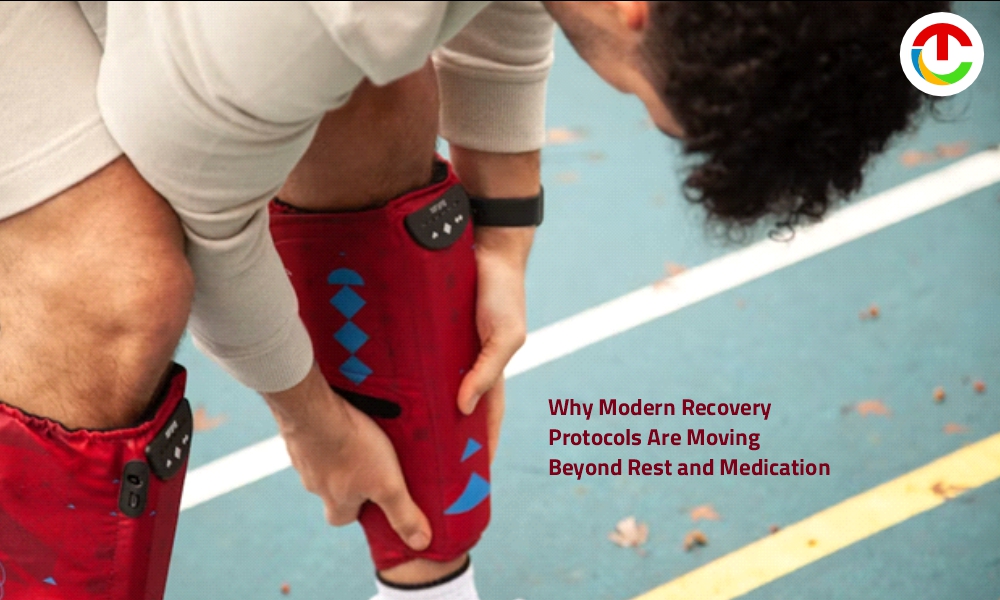
“Rest it, ice it, take something for the pain.”
People have been told that for 40 years. It’s easy. It’s inexpensive. And for a rolled ankle it is just fine.
For those suffering through hard training blocks, surgery, long haul fatigue or chronic pain that just won’t go away… rest and meds become a blanket that’s too short. Pull it one way and something else gets chilly.
Here’s the thing:
Slowly but surely recovery has evolved into its own discipline. Athletes, clinics and regular folk are stacking modalities that do something recovery simply cannot do by itself — alter the conditions your body recovers in.
And one of those tools sits right in the middle of the conversation.
What you’ll take away:
- Why Rest And Medication Hit A Ceiling
- What An HBOT Chamber Actually Does
- The Pressure Question Most People Get Wrong
- How Modern Recovery Protocols Are Built
Why Rest And Medication Hit A Ceiling?
Rest eliminates stress. Medicine numbs signals. Neither contributes to recovery…they just pave the way and hope your body does the work.
That works okay when the damage is minor. But it’s a lot less impressive when it’s dealing with a tough problem.
Numbers don’t lie. CDC statistics reveal that 24.3% of American adults suffer from chronic pain that lasts three months or more, and 8.5% experience pain that frequently interferes with work or day-to-day activities. These are adults who have rested. They have taken their pills.
So the question becomes fairly simple: what else is there?
Enter oxygen-based recovery. That’s why a 2.0 ATA hyperbaric chamber has become the piece of equipment that serious recovery clinics rate so highly. You aren’t masking symptoms with an HBOT chamber. You are increasing the pressure around your body so that your blood, plasma and tissue can absorb massive amounts of oxygen that it couldn’t possibly take in just laying around at sea level.
Different mechanism. Different result.
What An HBOT Chamber Actually Does?
Here’s the short version, without the textbook language.
Oxygen usually travels through the body piggy-back on red blood cells. But red blood cells have capacity limits — they can only be so saturated. Force the oxygen into plasma, the liquid portion of blood. Plasma travels throughout the body, even to areas where edema has restricted normal circulation.
That matters because:
- Damaged tissue is usually oxygen-starved tissue
- Swelling squeezes blood vessels and makes the problem worse
- Healing processes — collagen deposition, new vessel formation, cellular clean-up of debris — require oxygen
HBOT chamber sessions aren’t “being relaxed in a tube.” It’s nourishing the repair process with the one thing it’s lacking.
Science hasn’t caught up yet and responsible providers will admit that. A 2025 review published in Undersea and Hyperbaric Medicine concluded that brief courses of hyperbaric oxygen could reduce pain and accelerate return to play following soft tissue injury but also highlighted that human data is mixed and that more research was needed. That’s a reasonable conclusion. Hyperbaric oxygen therapy shows promise. It’s not a miracle cure.
But promising is still miles ahead of “rest and hope.”
The Pressure Question Most People Get Wrong
This is where a lot of buyers get burned.
Not all chambers are created equal. It’s not the colour of the shell that makes the difference. It’s the pressure. Pressure is rated in ATA (atmospheres absolute). 1 ATA is equal to normal air pressure at sea level.
The rough breakdown looks like this:
- Around 1.3 ATA: soft-sided, mild chambers. Popular, portable, low pressure.
- 1.4 to 2.0 ATA: the point where most clinical protocols actually begin.
- 2.0 to 3.0 ATA: the standard treatment range used in hyperbaric medicine.
2.0 ATA is considered by the Undersea and Hyperbaric Medical Society to be baseline for adequate hyperbaric oxygen treatment. Below that is a much lighter experience — which is perfectly okay if you’re aware of it.
That’s why the first question anyone should ask when comparing HBOT chambers is regarding pressure. Build quality second. Marketing claims last. A chamber unable to reach clinical pressure will never produce a clinical result.
Keep it simple. Check the ATA rating.
Why Athletes Went First?
As with most things to do with elite sport, hyperbaric oxygen would usually have its efficacy tested as a recovery tool first.
Professional footballers, swimmers, basketball players and fighters have been booking sessions in HBOT chambers for years as part of injury recovery and fighting fatigue. It’s not because it’s fashionable — their logic is simple: every day not working equals lost wages, so if there’s a chance something can speed up recovery from a hamstring tear, they try it.
It passes the rule-book test too. Methods of inhaling oxygen aren’t on WADA’s prohibited list, which is why team doctors felt free to use them early on.
The industry has followed suit. Market research pegs the hyperbaric oxygen therapy market at USD 7.43 billion in 2025, expecting it to grow to USD 10.55 billion by 2031. Growth is being powered by its use in wound care and neurologic recovery, as well as a consistent move towards adoption in at-home and clinical wellness applications.
When the money moves like that, it’s rarely just hype.
How Modern Recovery Protocols Are Built?
The biggest shift isn’t the equipment. It’s the thinking.
Traditional recovery advice amounted to one suggestion: stop, and take something. Contemporary recovery methodologies view recovery as a system with many inputs. Each input serves a purpose.
A sensible modern stack usually includes:
- Sleep — still the most powerful recovery tool ever discovered, and still free.
- Nutrition — protein and micronutrients to supply the raw materials for repair.
- Load management — gradual movement instead of total shutdown, because tissue needs stimulus.
- Oxygen therapy — HBOT chamber sessions to support circulation, swelling and tissue repair.
- Temperature work — heat and cold used at the right moments, not randomly.
Take note that drugs are not omitted from that list. They still have their use, particularly with acute pain. It’s just no longer the whole solution.
The other major shift is around timing. Recovery was previously reactionary — something people would consider after suffering an injury. It’s now just as well planned as training because it’s much easier to keep the body from accumulating damage than it is to rebuild from it.
This isn’t about one device. It’s about a paradigm shift in healing.
Tying It All Together
Rest and medication were never bad. They just were never enough alone for anything serious.
New approaches to recovery add a component that was never present before — working to enhance the tissues that your body is trying to heal, instead of simply taking a step back. An HBOT chamber is one of the most obvious examples of this evolution, which is why you see it popping up in clinics, training centers and home manufactures.
A quick recap:
- Rest removes stress, medication dulls pain — neither actively speeds repair
- Pressurised oxygen reaches tissue that swelling has cut off
- Pressure rating is the number that matters most when comparing chambers
- Recovery works best as a stack, not a single fix
- Planned recovery beats reactive recovery every time
The body has always known how to heal itself. Modern protocols just allow it to work under better circumstances.
Also Read :- Best Retatrutide Providers in Costa Rica Compared