In 2026, Three Lines Shipping marks 25 years since its establishment in 2001 – a milestone that reflects its evolution from a locally rooted logistics business into a GCC-focused freight forwarding and integrated logistics organization. Headquartered in Dubai and operating as part of the wider Three Lines Group, the company supports customers through direct regional capabilities, a global partner network, and operations designed around the realities of moving cargo across GCC borders and international trade routes. Its model combines freight forwarding, surface transportation, project logistics, warehousing and distribution, customs and free-zone capabilities, and specialized cargo handling. The milestone is not only a reflection on the company’s history; it also provides a platform for the next stage of growth, where physical logistics capability is increasingly strengthened by technology, visibility, and connected operations.
25 Years on the Strong Route Forward
Established in 2001, the organization has grown from its humble beginnings to a global freight forwarding and logistics business. Headquartered in Dubai, the company has a direct presence across the GCC. It specializes in supporting businesses with their logistics requirements. Over 25 years, Three Lines has built operating experience across both mainland and free-zone environments, enabling customers to manage cargo movements that may involve international freight, customs formalities, free-zone handling, cross-stuffing, warehousing, GCC road transportation and final delivery within one coordinated logistics chain. Its regional operations span key GCC markets including the UAE, Saudi Arabia, Qatar, Bahrain, Oman and Kuwait, supported by local teams and operating entities across the region.
Three Lines Shipping also has a global network of affiliated offices, allowing it to support shipments beyond the region. With particular experience in project and Oil & Gas logistics, the company has built its business around serving the practical transportation needs of customers across the Middle East and international markets. Its strength is the ability to combine international forwarding with regional execution – including GCC LTL and FTL road movements, customs clearance, bonded and free-zone logistics, cross-docking and cross-stuffing, warehousing, distribution and specialized project movements. Three Lines Shipping’s core capabilities can be summarized as:
- Freight Forwarding – Air, Ocean FCL/LCL and multimodal movements
- Surface Transportation – GCC LTL and FTL road transportation
- Project Logistics – Heavy-lift, oversized and specialized cargo
- Warehousing & Distribution – Cross-docking, consolidation and final-mile support
- Customs, Bonded & Free-Zone Logistics – Clearance, cross-stuffing and transit support
- Oil & Gas Logistics and Specialized Cargo Handling
A Strategic Supply Alignment
Global logistics has shifted from a support function to a boardroom priority. It directly influences competitiveness and growth. Three Lines Group is revamping its role from merely acting as a logistics service provider. The change begins with how customer requirements are defined. A traditional provider may ask where a shipment must move, by which mode, and at what price. A strategic partner asks broader questions:
- What business outcome is the movement supporting?
- Where are the critical dependencies?
- What would delay cost the customer?
- How can the flow of goods, information, and decisions be improved together?
The organization has modernized from a local transport business into an integrated logistics organization because customer needs have become more complex. Today, its capabilities span road transportation, freight forwarding, project and heavy-lift cargo, warehousing and distribution, last-mile delivery, and specialized services. The value lies not simply in offering these services individually but in connecting them around customer operating priorities. That integration is particularly important in the GCC, where one shipment may move through a free-zone entry point, require customs or cross-stuffing activity, enter a mainland distribution network, move by consolidated LTL or dedicated FTL road service, and finally reach a project site or customer location. Three Lines seeks to coordinate these hand-offs as one operating plan rather than as disconnected services. The company engages earlier in the planning cycle, particularly for complex and time-sensitive movements. Teams consider routing, modal choices, customs and documentation, storage, handling requirements, delivery sequencing, and contingency options as one operating plan. This provides customers greater accountability and fewer gaps between service providers. Partnership is demonstrated through alignment. Three Lines Group seeks to understand production schedules, project milestones, inventory pressures, and market commitments. By protecting those outcomes, the company becomes part of the customer’s competitive capability. That is the role Three Lines Group continues to build.
Trusted Differentiation
In an industry where infrastructure and capabilities are increasingly comparable, sustainable differentiation is far more difficult to achieve. Three Lines Group has established strategic principles that have enabled long-term customer confidence in a competitive marketplace. Infrastructure can be acquired, technology can be licensed, and service lists can be copied. Trust is tough to replicate because it is built through thousands of decisions over time. Differentiation rests on principles that sound simple but demand consistency: honesty, reliability, operational ownership, and respect for long-term relationships. The company’s 25-year journey gives those principles a practical history: repeat business, long-standing regional relationships and the ability to remain accountable as customer supply chains have become more complex.
Three Lines Group does not seek to win business by making promises that operations cannot keep. Customers value ambition, but they value candor even more. If a timeline is unrealistic, a route carries avoidable risk, or a different approach offers better value, the company considers it a responsibility to say so. That honesty protects customers and strengthens relationships.
The second principle is ownership. Logistics inevitably involves variables outside any one company’s control, such as weather, port congestion, border procedures, capacity constraints, and geopolitical events. Customers judge a partner not only by whether an exception occurs, but by how quickly it is identified, communicated, and resolved. Teams are encouraged to stay close to the shipment, take responsibility for the next action, and keep customers informed.
Lastly, the organization invests in people and institutional knowledge. Complex project cargo, cross-border transport, and customized supply chains require judgment that develops through experience. By empowering teams and maintaining strong local relationships across the region, the company combines corporate standards with practical execution. Over more than two decades, this consistency has allowed confidence to compound. The goal is not to be remembered for one transaction, but to be trusted with the next challenge. As Three Lines enters its next 25 years, the objective is to preserve this relationship-led culture while giving teams stronger systems, data and digital tools to execute consistently at greater scale.
Agile Supply Chains
Businesses are navigating an environment defined by geopolitical tensions, shifting trade corridors, and economic uncertainty. Three Lines Group enables customers to build supply chains that remain agile without compromising efficiency, cost, or service excellence. Agility is often misinterpreted as paying more to move faster. True agility is the ability to make a well-informed change before disruption becomes a crisis. That requires visibility, alternatives, and clear decision rights.
The Group helps customers identify lanes, border points, suppliers, and milestones most critical to operations. From there, alternatives are evaluated across road, air, and sea freight, as well as different ports, carriers, consolidation options, and inventory positions. Direct presence across key GCC markets, supported by an international agency network, provides local knowledge and wider routing choices when trade conditions change. Efficiency remains central. Every contingency cannot be the most expensive option. Cargo is segmented according to urgency, value, operational importance, and risk, with the right service level recommended for each category. For GCC road freight, this can include choosing between scheduled LTL consolidation and dedicated FTL capacity, changing border or staging points, combining free-zone handling with mainland delivery, or shifting urgent cargo to air while keeping routine replenishment on planned road or sea movements.
A critical component may justify priority handling, while regular replenishment can benefit from consolidation, planned departures, or optimized road movements. This protects service without applying premium cost to the entire supply chain. Communication is equally important. Customers should understand the reason for a route change, the cost and time implications, and the point at which a decision must be made. During uncertainty, silence creates more risk than bad news. The company provides an honest operating picture, recommends realistic choices, and executes the agreed plan with discipline. That combination of regional capability, scenario planning, and transparency enables agility without sacrificing commercial control.
Digital Logistics Leadership
The future of logistics will be shaped by intelligence, visibility, and predictive decision-making. Three Lines is embedding digital innovation into its operations while ensuring that technology continues to enhance the human element of customer relationships. Its digital direction is guided by a simple principle: technology should reduce uncertainty, improve visibility, and give people more time to make better decisions. Customers increasingly expect real-time shipment visibility, faster document exchange, timely exception alerts, and a consistent view of operations. Three Lines is strengthening these capabilities through Three Lines One, Connect, Mile, other in-house developed solutions, and its existing ERP ecosystem, creating greater end-to-end visibility across operations, finance, warehousing, customer service, and sales.
The immediate value of digitalization is a shared operating picture. When shipment status, documentation, delivery milestones, and exceptions are easier to access, teams spend less time searching for information and more time acting on it. Over time, structured data enables identification of recurring delays, comparison of route performance, improved planning, and a shift from reactive updates toward predictive intervention. Logistics is not a purely digital activity. Data may indicate that a shipment is delayed, but only an experienced professional can interpret the commercial consequence, evaluate alternatives, and communicate with the customer with clarity. This is especially critical in project cargo, cross-border movements, and urgent shipments, where context and judgment cannot be reduced to a dashboard.
Three Lines Shipping therefore positions automation to handle repetitive work and improve accuracy, while people remain accountable for exceptions, relationships, and decisions. The organization also underscores that digital progress must be accompanied by data discipline, cybersecurity, and employee training. The objective is not technology for its own sake, but a more visible, responsive, and intelligent service in which customers can access information quickly and still reach a professional who understands their business.
Strategic Logistics Evolution
Global businesses are revamping procurement strategies through regionalization, nearshoring, and supply chain diversification. This introduces new opportunities for logistics providers. The organization is establishing itself to capitalize on this evolving landscape. Regionalization is producing a more distributed supply chain rather than a less global one. Enterprises are adding suppliers, assembly points, and inventory locations closer to their customers, while still depending on international flows for materials and components. This creates new demand for logistics providers that can connect global freight with reliable regional execution. The GCC is strategically placed to benefit from this transition. The region is investing in manufacturing, energy, infrastructure, trade facilitation, and consumer markets. The UAE functions as an international gateway and re-export hub, while Saudi Arabia and neighboring markets expand industrial and distribution activity. Customers therefore require stronger cross-border road networks, flexible warehousing, multimodal connections, customs expertise, and project-logistics capability.
The organization is structured around these requirements. With a base in Dubai, direct regional presence, and a global partner network, the organization connects origin markets with GCC destinations and manages the critical final stages of the journey. Its expertise in road transportation and heavy-lift project cargo is particularly relevant as new industrial and infrastructure investments move from planning into execution. Its ability to operate across mainland and free-zone environments strengthens this proposition. International cargo can be received through major gateways, handled or stored within free-zone and bonded environments where required, cleared into local markets, cross-stuffed or consolidated, and connected into GCC road and distribution networks under one coordinated operating model. The company also identifies opportunities to help customers redesign, not simply relocate, their supply chains. Adding a regional warehouse or a second supplier creates resilience only if inventory rules, transport schedules, systems, and responsibilities align. Three Lines Shipping’s role is to translate strategic sourcing decisions into executable operating models. Providers that combine global reach, regional depth, and integrated planning will deliver the greatest value in this new landscape.
A Regional Connectivity Advantage
Dubai’s rise as one of the world’s most influential logistics gateways continues to reshape global trade. The city offers logistics providers a rare combination of geographic reach, advanced infrastructure, and commercial connectivity. It links Asia, Africa, Europe, and the Middle East through world-class ports, airports, free zones, and a trade-oriented business environment. Headquartered in Dubai, the organization has created both a launchpad for global access and a foundation for regional growth. For Three Lines, that advantage is reinforced by capability on both sides of the customs boundary. Mainland operations support local collection, delivery, warehousing and domestic distribution, while free-zone capabilities support international cargo handling, storage, consolidation, cross-stuffing, customs processes and onward movement into the GCC. This allows Dubai to function not simply as the company’s headquarters, but as a practical control tower connecting international forwarding with regional road logistics.
The organization has positioned Dubai as the central hub of an integrated network. International freight is connected with customs management, warehousing, value-added services, GCC road transport, project logistics, and final delivery. This model is particularly valuable for customers seeking a single accountable partner to manage the transition from global shipping lanes into complex regional destinations. Exposure to Dubai’s diverse industries, cargo types, and customer requirements has strengthened the organization’s operational expertise. The company has developed capabilities to manage routine freight alongside specialized and oversized consignments. Its project portfolio demonstrates the planning rigor and technical discipline required to operate from a sophisticated logistics hub. Beyond Dubai, direct operating capability across GCC markets and established international freight partnerships give customers a combination of local accountability, regional execution and global reach. The resulting hub-and-network model connects modes, borders, warehouses, teams and information with fewer operational gaps between them.
Resilience Built Through Consistency
The most resilient supply chains are established long before disruption occurs. Three Lines Shipping has built a resilient planning framework. It enables customers to manage uncertainty while sustaining continuity across increasingly complex global trade networks. Flexibility must be embedded into operations and not improvised only after routes or capacity disappear. The company begins by defining continuity for each customer. The critical factor may be a production line, a project milestone, a retail launch, a spare part, or a contractual delivery window. Once that priority is identified, the logistics plan is structured around it. The organization scrutinizes essential lanes, handover points, documentation requirements, and prepares alternative routes, modes, carriers, and staging locations in advance. Escalation protocols are also established, specifying what event triggers a change, who authorizes it, and what information the customer requires to act quickly. This preparation minimizes hesitation when conditions become volatile.
The regional footprint is integral to this model. Regional teams interpret shifting operating conditions, coordinate across borders, and resolve issues closer to where they occur. At the same time, the broader network provides options beyond a single corridor or service partner. Together, these elements deliver responsiveness and reach. Resilience further depends on disciplined daily execution. Accurate documentation, preventive equipment planning, reliable partners, shipment visibility, and timely communication may appear routine. Still, they form the foundation of continuity. Post-movement reviews are encouraged, particularly after complex projects or exceptions, ensuring lessons are embedded into future plans. In this way, resilience is not treated as a separate product but as a continuous operating discipline that strengthens with every shipment and every challenge. The Group’s investment in connected digital workflows adds another layer to that resilience by improving the speed at which operational teams can see a milestone, exception or pending action and coordinate the next response across locations.
Customer Value Evolution
Customer expectations have shifted dramatically over the past decade. Responsiveness, visibility and tailored solutions now sit alongside operational efficiency as defining measures of value. Three Lines Shipping has evolved its business philosophy to meet these changing expectations. Customers no longer judge logistics solely on the point of delivery. They assess the entire experience. They go through specifications like:
- How quickly responses are provided
- Whether information is accurate
- How early risks are communicated
- Whether solutions reflect specific priorities
Operational efficiency remains essential, but it has become the baseline rather than the full value proposition.
Three Lines Shipping’s philosophy has therefore become more consultative and transparent. The company begins by listening closely to how each customer operates, then shapes services around cargo characteristics, urgency, risk, delivery sequence, and reporting needs. Two shipments on the same lane may require different solutions because the business consequences are not the same.
Customers expect visibility without having to request it. Technology-enabled tracking and milestone updates support this expectation, but responsiveness requires clear accountability. Customers should know who is responsible, how exceptions are being managed, and when the next update will arrive. Communication is being made proactive and consistent across teams and locations. The Group’s customer and operational technology roadmap is designed around this principle: important shipment events, documents and actions should move with the shipment rather than remain fragmented across calls, spreadsheets and individual inboxes. Tailoring does not mean adding complexity for its own sake. The strongest solutions are often simple, standardized where possible, and customized where it matters. Three Lines Shipping works to establish clear procedures, escalation paths, and performance expectations, then reviews them as customer businesses evolve. This approach transforms service delivery into a learning relationship. The deeper the understanding of customer operations, the more effectively the company can anticipate needs, remove friction, and contribute to long-term performance.
Sustainable Growth
Environmental responsibility has advanced from a compliance obligation to commercial necessity. Three Lines Shipping views sustainability as integral to operational performance and a driver of long-term business growth. The team acknowledges that sustainability and operational excellence are increasingly interlinked. Waste in logistics often manifests as empty kilometres, poor utilization, unwanted handling, avoidable waiting, inefficient routing, or damaged cargo. Eliminating such inefficiencies reduces environmental impact while simultaneously improving cost, reliability, and asset productivity.
Three Lines Shipping’s operational focus is on smarter choices. It consolidates where commitments permit, refines route and load planning, selects optimal modes, and reduces idling and rework. It also collaborates with customers on packaging, delivery frequency, and inventory positioning. Warehousing and last-mile operations also present opportunities to enhance energy efficiency, space utilization, and delivery density. Because requirements vary by customer and corridor, progress must be anchored in credible data rather than broad assertions.
The company further defines sustainability as encompassing safety, governance, and the well-being of people. A supply chain cannot be sustainable if it relies on unsafe practices, weak standards, or short-term decisions that transfer risk to employees, partners, or communities. This principle is especially critical in heavy-lift project logistics, where disciplined planning safeguards both people and assets.
The next stage for the industry is deeper measurement and collaboration. Customers will increasingly demand emissions visibility and lower-carbon options alongside cost and transit time. Logistics providers must be prepared to support those decisions transparently, even as infrastructure and reporting standards evolve. Organizations that improve efficiency, reinforce responsibility, and invest steadily in cleaner operations will be positioned for durable growth.
At its Dubai headquarters, Three Lines has also introduced greenery through living walls, indoor and outdoor plants, and a dedicated garden space. This is best viewed as a visible workplace expression of a broader principle rather than the center of the Group’s sustainability story. The more material operational focus remains better utilization, smarter routing, reduced unnecessary handling, safer execution and increasingly data-led decisions across transport and warehousing.
The Next 25 Years of Supply Chain Leadership
As Three Lines enters its next 25 years, the Group expects logistics to be shaped by intelligence, connected execution, changing trade structures and higher expectations for speed and visibility. Artificial intelligence and predictive analytics will enable earlier identification of disruption, more accurate demand forecasting, and improved routing and inventory decisions. Connected devices, interoperable platforms, and digital trade documents will expand visibility across organizational boundaries. Decarbonization requirements will also shape modal choices, fleet investment, facility design, and customer procurement strategies.
The structure of trade will continue to evolve. Supply chains will become more regional and diversified, but also more complex. Rising e-commerce volumes and heightened service expectations will intensify pressure at the final mile. Industrial investment across the GCC will drive demand for advanced project logistics and cross-border capacity. Geopolitical volatility will remain a permanent planning factor rather than an occasional exception.
The organization is preparing by reinforcing the foundations that make innovation practical: accurate data, connected operating processes, regional capability, reliable relationships, and skilled people. Its in-house technology strategy is an important part of that preparation. Three Lines One, Connect and Mile are intended to progressively connect the commercial and physical logistics journey, while customer portals, mobile execution, QR-enabled workflows and analytics improve visibility from booking through delivery. The longer-term direction is an end-to-end digital operating model in which sales, operations, warehouse, transport, finance and customer visibility work from more consistent data and shared milestones. Cybersecurity, data governance, and employee capability must progress in parallel with digital adoption.
Leadership in the coming decade will be defined by combining innovation with judgment and translating both into dependable customer outcomes. For Three Lines, the next chapter is not about replacing the operating knowledge built over 25 years; it is about scaling that knowledge through stronger systems, better data and a more connected GCC network. The organization’s ambition is to be an intelligent, regionally strong, and globally connected logistics partner. It anticipates change, adapts responsibly, and enables customers to move forward with confidence.
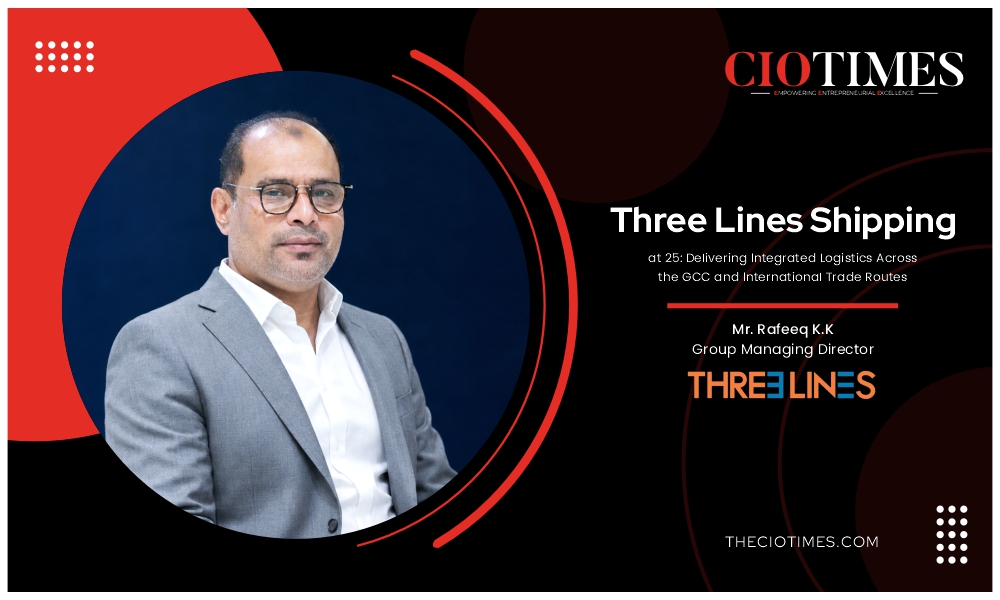
As Three Lines marks its 25th year, we also had a chance to talk to the MD of Three Lines Group. Let’s dive deep into his leadership mindset to gain insights.
Having guided Three Lines Group for more than two decades, Rafeeq has seen leadership beliefs reinforced by experience while consciously discarding assumptions as both the business and the industry have evolved. Experience has strengthened his conviction that people are the true infrastructure of a service enterprise. Vehicles, warehouses, and systems matter, but it is individuals who make decisions under pressure. It is also to safeguard customer commitments and transform challenges into enduring relationships. His responsibility as a leader is to create clarity, uphold values, and provide capable people the space to grow into leaders themselves. That perspective has particular relevance at the 25-year milestone: the organization has grown, but the long-term institution depends on leadership and operational capability being distributed beyond any one individual.
He shares, “The principles of honesty, simplicity, and commitment have become more important to me with time. Honesty means facing facts early. Simplicity means keeping the organization focused on what creates value for the customer.”
Commitment means remaining present when circumstances become difficult. These principles cannot remain statements on a wall. These must be evident in how leaders allocate resources, respond to mistakes, and treat employees, customers, and partners.
He has also abandoned several assumptions. One is that a leader must hold every answer. As the organization and industry have grown more complex, listening has become a greater leadership strength than certainty. Another is that growth should be measured mainly by size. Sustainable growth is better assessed by institutional quality: its people, systems, customer confidence, and ability to perform without reliance on one individual.
Finally, he no longer believes speed is always the best indicator of decisiveness. In logistics, urgency matters, but thoughtful preparation prevents many urgent problems. Strong leadership is knowing when to act quickly, when to ask another question, and when to trust the team closest to the work.
A Trusted Vision for the Next 25 Years
As Group Managing Director, Rafeeq’s long-term vision is for Three Lines Group and its logistics businesses to be recognized among the most trusted integrated logistics partners connecting the GCC with the world. Trust remains central, because scale without trust is fragile. The organization seeks to assure customers that it understands their business, speaks honestly, and remains accountable from planning through final delivery.
To realize this vision, the team must consistently evolve. It will deepen regional capabilities, strengthen global connections, integrate services more effectively, and leverage technology to enhance visibility and decision-making. The Group’s physical network and its in-house digital platforms are increasingly being developed as complementary assets: one moves the cargo, while the other connects the information, people and decisions around that movement. It will also cultivate the next generation of leaders who combine operational expertise with commercial understanding and strong values. Enduring institutions are built when leadership is distributed, and culture sustains standards.
He asserts, “The legacy I hope we create is broader than a network of offices or a record of successful shipments. For customers, I want us to have made complex trade simpler and their supply chains more resilient.”
For partners, it seeks to embody fairness, reliability, and shared growth. For employees, it strives to be a place where meaningful careers are built, and leadership is trusted. For the industry, it hopes to demonstrate that technology and human relationships can advance together, proving that responsible growth can also be commercially strong. Logistics supports factories, projects, shops, and communities, often without visibility. If Three Lines Shipping can sustain those connections with integrity and build an institution capable of doing so for generations, that will be a legacy worth leaving. The 25-year anniversary is therefore both a milestone and a transition point: a chance to recognize the operating foundation built since 2001 and to define how Three Lines will connect the GCC, its customers and its people through the next generation of logistics.
Also Read :- CIO Times Magazine For More information