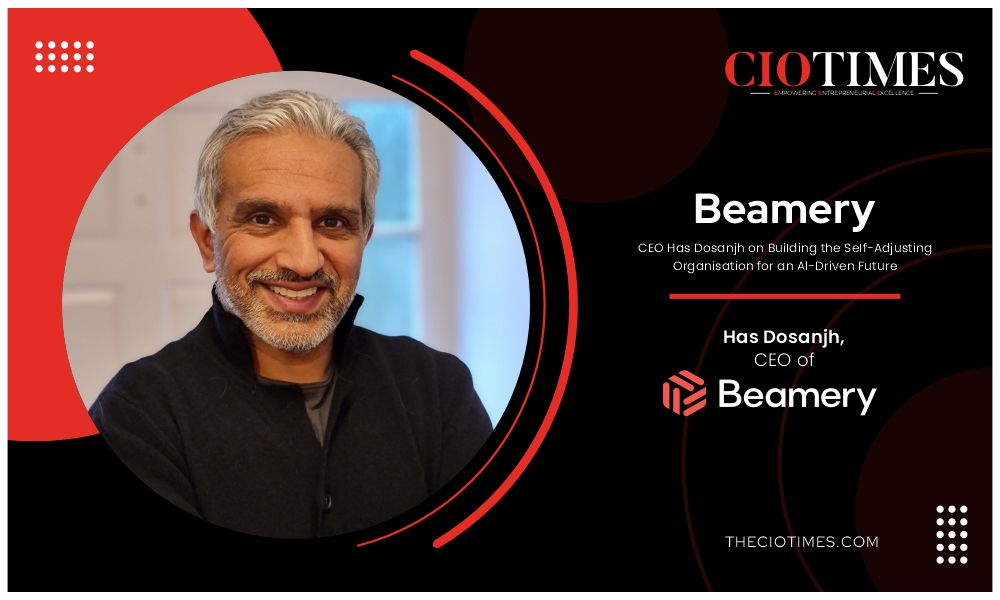
The future of work is unfolding in real time, reshaping how enterprises think about people, skills and technology. For global leaders, the challenge is to reimagine the architecture of work for an era in which adaptability and intelligence are competitive advantages. Founded to connect talent to opportunity more effectively, Beamery helps organisations develop a deeper understanding of their people, skills and work. Has Dosanjh, CEO of Beamery and an experienced C-suite executive, has helped guide the company’s evolution from traditional HR technology towards what he calls organisational intelligence: how an organisation understands and continuously aligns people, work and technology to deliver business and human outcomes.
Focused on Outcomes
Large-scale organisations have been built around jobs, hierarchies and reporting structures for decades. These structures provided order but offered only a crude picture of how value was created. A job title could mask the diversity of activities within a role, while organisation charts revealed reporting lines but not the actual work driving outcomes.
Beamery recognised early that this model was breaking down and championed a skills-first strategy. Skills provide a richer, more dynamic view of capability than CVs or job titles, revealing adjacent capabilities, internal mobility opportunities and hidden development needs. Yet Has insists that skills are not the final destination. They are an intermediate layer in a progression that moves from jobs to skills, to work and ultimately to outcomes.
This perspective shapes Beamery’s approach to workforce strategy. Instead of asking how AI can improve existing HR processes, including recruitment, learning and workforce planning, Beamery begins with the business objective. If a company commits to entering a new market or transforming customer experience, there is a body of work required to deliver that result. That work demands specific capabilities, which can be provided by people, technology or partners. Once that chain is visible, workforce strategy stops being a support function and becomes part of how the business operates.
The Evolution Toward Organisational Intelligence
Has’s career has shaped this philosophy. Beginning in marketing and analytics, he witnessed early forms of AI long before the term became mainstream. Over decades, he built and led data businesses, founded and exited companies, and ran organisations on behalf of shareholders. Through these experiences, one management problem remained constant: businesses must turn information into better decisions, and better decisions into better outcomes.
What has changed is the scale. Today, enterprises have vastly more information, computing power, and AI systems capable of performing analytical work that was once impractical. This enables a progression from talent intelligence to skills intelligence, workforce intelligence and ultimately organisational intelligence.
Organisational intelligence means understanding how to deploy people, work, technology, and resources to deliver both business and human outcomes. It moves workforce data into the operating model itself, connecting strategy directly to execution.
Information as Infrastructure
This evolution has profound implications from a CIO’s perspective.
Has argues that “An organisation cannot become genuinely intelligent unless its information architecture is intelligent too.”
AI can analyse extraordinary volumes of data, but its usefulness depends on the quality, context and accessibility of that information.
Most enterprises have accumulated data in silos: finance systems hold financial information, CRM platforms contain customer data, HR systems track employees, and productivity tools capture signals about work. The challenge is not scarcity but fragmentation. Leaders must connect these sources to understand how strategy translates into work, where capability exists, and how resources should be redeployed.
This requires mature governance. Privacy and AI regulation do not prohibit the use of information; they demand responsible use. As Has puts it, “Trust is therefore not created by avoiding data.” It is created by demonstrating that information is used for legitimate purposes, under sensible rules and with recognisable benefits. Accountability is paramount for the organisation. “The algorithm recommended it” cannot become a defence mechanism. Human judgement must remain central, especially in decisions affecting recruitment, promotion or mobility.
AI Beyond Automation
The first wave of corporate AI adoption focused on productivity: automating tasks, accelerating processes and reducing costs. Beamery sees a deeper contribution. AI can help organisations understand how they actually operate. Most companies are managed through abstractions: strategies, budgets and organisation charts. Between these abstractions and day-to-day work lie thousands of decisions and dependencies that are largely invisible. As Has explains, “The ambition is not another dashboard containing more workforce information.” AI can detect patterns across workforce and operational data, reveal duplication, identify capability gaps and model alternative ways of organising work.
This enables what Has describes as the Self-Adjusting Organisation. Instead of episodic transformation programmes every three to five years, organisations gain the capacity to adjust continuously. When objectives change, leaders can see what work is affected. When technology automates activities, they can understand how roles evolve. When a skill becomes scarce, they can decide whether to recruit, develop, redesign or automate. The goal is to give leaders a richer picture of their organisations, enabling adjustment before misalignment becomes a crisis.
Workforce Strategy as Capital Allocation
This shift also changes the relationship between HR, technology, and finance. Traditionally, the budgets related to workforce, technology, and transformation were treated separately. In reality, they represent different ways of purchasing capability. A business objective may be achieved by hiring people, developing employees, redesigning processes, purchasing software, deploying AI agents, or partnering externally. These are not separate strategic questions but alternative solutions to the same problem. Workforce strategy therefore becomes a capital allocation issue.
The best organisations will make these trade-offs consciously, understanding where human judgement creates value, where technology is superior and where a combination performs best. In economies facing ageing populations and persistent skills shortages, recruiting alone will not close capability gaps. Better use of existing talent becomes critical. Workforce intelligence reveals skills already present, adjacent capabilities and effective routes for development. AI amplifies this by analysing capability at a scale and level of granularity that manual methods cannot match.
Competitive Differentiation Through Adaptability
Technology itself is becoming a weaker source of differentiation. Access to AI will soon be as ubiquitous as access to cloud computing or spreadsheets. The differentiator will be what organisations can do with it. Companies that outperform will be those that absorb information quickly, make better decisions, learn from consequences, and translate those decisions into changes in how work gets done. Organisational adaptability becomes a competitive capability in its own right.
Beamery’s journey reflects this evolution. The company has expanded beyond traditional HR technology, progressing from talent intelligence and skills intelligence towards workforce and organisational intelligence. Beamery’s ambition is to help leaders understand how their organisations deliver outcomes and how they should adjust when those outcomes or the operating environment change.
The Future Vision
Beamery aspires to make large, disruptive transformation programmes feel antiquated. Companies should not need to pause every few years to diagnose themselves and redesign around a world that has already moved on. Instead, they should continuously understand what is changing, what it means for their work, and how people and technology should be deployed in response.
Success for Beamery will be measured not only in customer adoption but in impact: helping organisations connect strategy to execution, understand their capabilities and change before circumstances force them to. Ten years from now, Has envisions a world where workforce technology is no longer about administering HR but about enabling leadership to operate the enterprise intelligently.
For CIOs, this makes information architecture central. The intelligence of an organisation will only ever be as strong as its ability to connect and responsibly use the information on which decisions depend. Companies that master this will not simply have better HR systems or more AI. They will have clearer lines between strategy and execution, deeper understanding of their capabilities, and greater ability to adapt at speed.
Beamery’s story is not just about HR technology. It is about reimagining the operating system of the enterprise. By moving from jobs to skills, from skills to work and from work to outcomes, Beamery is helping organisations unlock human potential and organisational adaptability. In a world where technology is accessible to all, differentiation will come from how effectively organisations use it.
Also Read :- CIO Times Magazine For More information