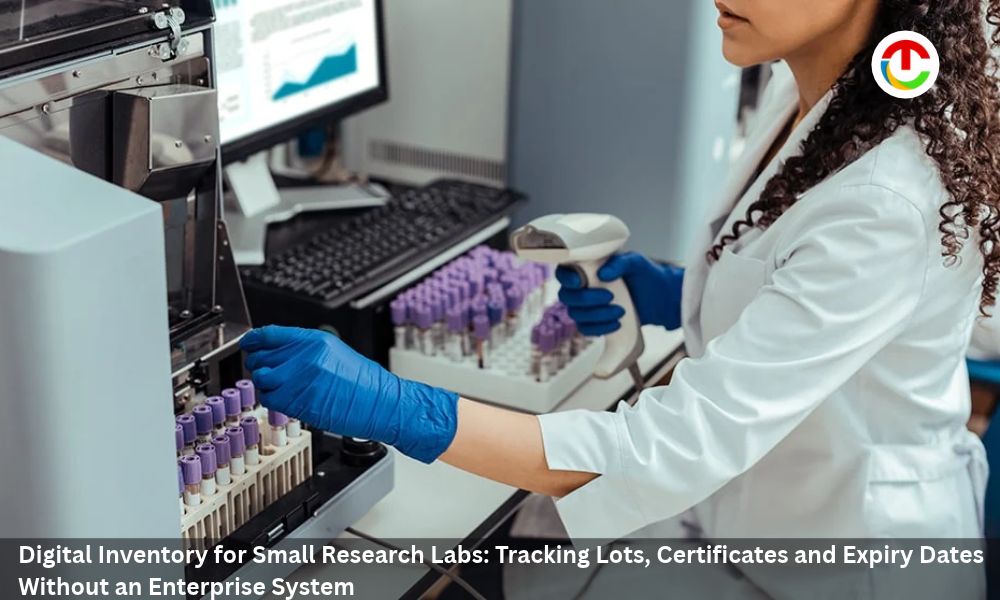
Ask the manager of a small research lab where a particular bottle came from, and you will often get an honest shrug. The item is on the shelf, it was ordered at some point, and the paperwork is probably in an email somewhere. For years that was good enough. It no longer is.
Funders, clients and collaborators increasingly expect labs to show that their results rest on traceable materials. When an experiment fails to reproduce, the first question is usually “which lot did you use?”, and a lab that cannot answer quickly loses time, money and credibility. Large institutions solve this with laboratory information management systems (LIMS) that cost tens of thousands of dollars a year. Small labs need a lighter answer, and the good news is that most of it can be built with tools they already pay for.
What a lab Digital Inventory actually needs to know
Before choosing any software, it helps to be clear about the questions the system has to answer. For most research labs there are only five:
- What do we have, and where is it? Item, quantity and storage location.
- Which lot is it? The manufacturer’s lot or batch number, exactly as printed on the label.
- What does the paperwork say? A link to the certificate of analysis (COA) for that specific lot.
- When does it expire, and when was it opened? Many materials have a shorter in-use life once opened than their sealed shelf life.
- Where was it used? Which experiments, samples or projects drew on that lot.
If a system answers these five questions reliably, it is doing its job. Everything else is a convenience.
Option 1: A structured spreadsheet (and why it usually fails)
Most small labs start with a shared spreadsheet. It costs nothing and everyone knows how to use it. The trouble is not the tool but the lack of structure. Free-text columns fill up with “see email”, lot numbers are typed inconsistently, and nobody updates the sheet when the last vial is used.
A spreadsheet can work if it is treated like a database: one row per lot, not per product; drop-down lists for locations and units; a required field for the lot number; and a column holding a link to the COA file rather than a note saying it exists. Add conditional formatting that turns a row amber thirty days before expiry and red on the day, and the sheet starts to earn its keep.
Option 2: Low-code databases and inventory apps
The next step up is a low-code database or an off-the-shelf inventory app. These tools add what spreadsheets lack: linked records, attachments, forms and automatic reminders. A typical setup has three linked tables: Items (what the product is), Lots (each delivery, with its lot number, COA attachment, received date, opened date and expiry) and Usage (which lot went into which experiment).
The benefit is that the COA lives with the lot record itself. When someone asks about a result from six months ago, the usage record points to the lot, and the lot record shows the certificate in one click. Reminders can email the lab manager when a lot is close to expiry or when stock falls below a set level.
For most labs with fewer than twenty people, this level is the sweet spot: affordable, quick to set up, and flexible enough to adapt as the lab grows.
Option 3: Barcodes and QR labels
Data entry is where every inventory system breaks down. The fix is to make it nearly effortless. Printing a small QR label for each lot as it arrives, linked to its record, means that anyone can scan a bottle with a phone to see its COA, mark it as opened or log its use. Inexpensive label printers and free QR generators make this practical for even the smallest lab.
The habit that matters is labelling at receipt. If items reach the shelf before they are logged, they rarely get logged at all.
Treat certificates as data, not attachments
A COA is more than a PDF to file away. The useful parts of it are data: the lot number, the test results and the acceptance limits. Capturing a few key values in the lot record, such as pH, preservative content or endotoxin result for a sterile liquid, lets a lab compare lots over time and spot drift before it causes problems.
Take a basic consumable such as bacteriostatic water, a sterile water with 0.9% benzyl alcohol that many labs keep on hand to reconstitute and dilute research materials. (If you’re new to it, this explainer on what is bac water covers the basics.) Because it is used across many experiments, a single weak lot can affect a lot of work. Logging each lot’s COA values, the date the vial was opened and the experiments it went into turns an anonymous bottle into a traceable input.
This works best when suppliers make it easy. A supplier that prints the lot number clearly on every vial and publishes a matching COA, as with Herbilabs 10 mL bacteriostatic water, lets the lab link label, certificate and record in seconds. When comparing suppliers, it is worth asking whether certificates are lot-specific and available before purchase, because that one detail decides how easy traceability will be.
Make the system stick of the Digital Inventory
Technology is the easy part. Keeping the system alive takes a few simple rules:
- One owner. Someone is responsible for the inventory, even if everyone uses it.
- Log at receipt, log at opening, log at use. Three moments, each taking seconds with a scan.
- No COA, no shelf. A lot without its certificate isn’t stored until the certificate is found.
- A monthly ten-minute review. Check what is expiring, what is running low and which records are incomplete.
The payoff
A traceable Digital Inventory rarely gets attention until the day it is needed. Then it pays for itself in hours: a failed result can be traced to a lot, the lot to its certificate, and the certificate to the supplier, all without digging through old emails. For a small lab, that ability is a quiet competitive advantage. It shows funders and clients that results rest on documented materials, and it turns “we think it was fine” into “here is the record”.
None of this needs an enterprise system. It needs clear questions, a modest tool and the discipline to record the right things at the right time.
Also Read :- Why Digital Payments Are Becoming a Critical Driver of Enterprise Growth and Scalability?