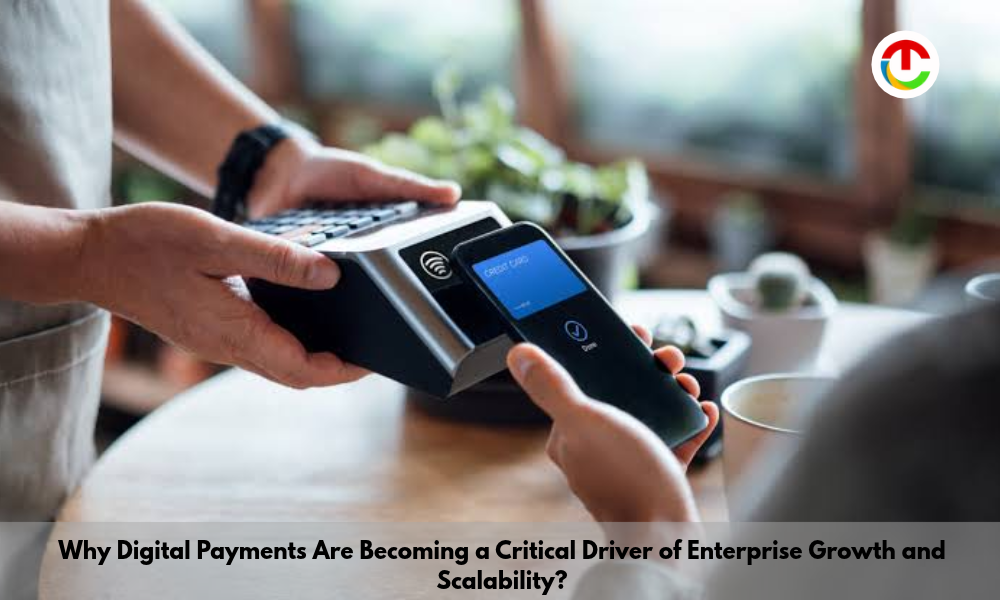
As modern-day customers do not view transactions as a separate checkout step, but demand instant, invisible, and flexible money movement,digital paymentshave emerged as a backbone of any successful online transaction. By replacing slow, manual cash or card routines with fast, frictionless, and adaptable technologies, it has transformed payment systems. Currently, fintechs, consumer apps, and digital marketplaces have raised the baseline. Therefore, speed and convenience are now central to brand trust and customer loyalty. For this reason, business organizations are also viewing electronic payments as a means to reach newer markets, connect with a larger audience, build a loyal customer base and thereby witness business growth and success.
How Digital Payments Accelerate Enterprise Growth
By speeding up cash flow, cutting operational costs, and unlocking data-driven insights, online payments accelerate enterprise growth.
1. Healthy Liquidity and Faster Settlements
Instead of days, transactions settle in hours or seconds. This gives businesses immediate access to capital to meet market demands.
2. Streamlined Operations
With minimum manual effort, automated reconciliation matches payments to invoices and, at the same time, eliminates the costs of storing, handling, and transporting physical cash.
3. Cross-Border Trade and New Business Models
Open banking and cardless direct bank payments enable instant lending and fresh revenue streams, simplifying B2B trade across borders.
Digital Payments: A Key Driver of Enterprise Growth and Scalability
Evolved from a basic checkout utility into a core strategic engine, electronic payments have played a key role in enterprise expansion, operational efficiency, and market reach.
1. Improved Operational Efficiency and Cash Flow
Online payments replace manual, paper-based processes with automated, real-time electronic systems. It reduces time spent on writing checks, counting cash, manual data entry, and physical bank trips. Through integrated software and AI tools, it automatically matches transactions, reconciles accounts, and generates reports, freeing up staff for strategy. It also reduces mistakes associated with manual calculations, cash handling, and incorrect change. The speedy online transactions improve customer satisfaction and queue flow.
As electronic payments shorten the delay between a sale and actual cash receipt, it lowers accounts receivable and speeds up the cash conversion cycle. It also offers clear, reliable clearing timeframes that help businesses manage working capital more accurately. A timely electronic payment builds trust, often unlocking early-payment discounts or better net terms from suppliers.
2. Seamless Scalability via Cloud and API Integration
During peak traffic periods such as holiday sales or flash promotions, cloud servers automatically add computing power. The system scales down to avoid paying for idle capacity when transaction volume drops. Cloud providers establish server networks across data center locations worldwide. As routing payment requests to the nearest server reduces latency, this keeps checkout speeds fast for international customers.
Through a single unified API, developers can integrate credit cards, digital wallets, Buy Now Pay Later (BNPL), and local bank transfers. Rather than a full system overhaul, adding a new payment option requires minimal code changes.
As digital payment APIs include built-in multi-currency processing, localized routing, and automated tax calculation, businesses can launch in new countries quickly without establishing local banking relationships from scratch.
3. Higher Conversion Rates and Global Reach
By removing friction at checkout and supporting local currencies and payment habits worldwide, digital payments boost conversion rates and expand global reach. Online payment solutions such as Google Pay, Apple Pay, and PayPal store shipping and billing details securely. So, instead of typing long card numbers, customers can complete purchases with a fingerprint or face scan. Familiar local methods like UPI, Buy Now Pay Later (BNPL), or bank transfers remove hesitation among customers and thereby encourage them to purchase.
As payment gateways automatically convert prices into the buyer’s local currency, seeing familiar pricing builds trust and eliminates confusion over exchange rates. In many countries, credit cards are not the primary payment method. Without setting up local bank accounts, digital platforms let businesses accept regional favourites like Pix in Brazil, iDEAL in the Netherlands, or Alipay in China.
4. Data-Driven Business Insights
Generating rich, structured transaction data such as payment amounts, locations, dates, customer identities, and preferred methods, electronic payments transform basic receipts into actionable business intelligence. Evaluating transaction patterns reveals valuable information such as who your customers are, how often they buy, and which payment methods they prefer.
Peak sales hours, high-demand days, and seasonal trends are revealed by transaction timestamps and volumes. This allows businesses to optimize inventory stocking, staffing schedules, and marketing campaigns.
5. Reduced Costs and Built-In Security
By removing the labor, security, and administrative overhead tied to physical currency, digital payments eliminate cash-handling expenses. During a transaction, sensitive financial data is scrambled via encryption and replaced with secure digital tokens. This means raw card or account credentials are never exposed to merchants, which contributes to increased safety.
Conclusion
Often, staying ahead in an evolving business landscape means embracing technological advancements. Among many innovations, digital payments have emerged as a game changer for businesses worldwide. From improved convenience and security to expanded customer reach, these online payment solutions offer a myriad of advantages. As modern-day customers become more accustomed to fast and convenient payment methods, organizations need to adapt to their expectations. By leveraging them, businesses can optimize their operations, delight customers, and stay ahead of the curve in an increasingly digital world.
Also Read :- Getting More From Your Payment Gateway Integration in 2026