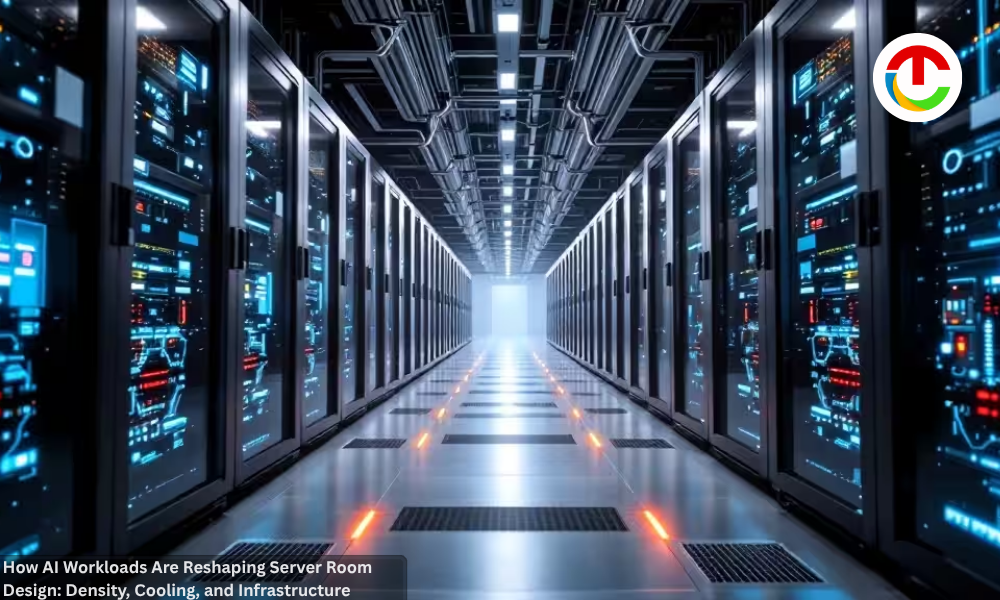
The rapid acceleration of artificial intelligence has fundamentally altered enterprise IT strategy. While software frameworks like large language models and neural networks dominate headlines, their real-world deployment depends entirely on physical infrastructure.
For decades, server rooms were designed around predictable, low-density rack configurations optimized for general-purpose cloud and database workloads. Today, AI model training and inference workloads demand unprecedented computational power, forcing a complete overhaul of server room architecture. Facility managers, network engineers, and data center architects are discovering that housing modern GPU clusters requires rethinking everything from cooling mechanics and power distribution to structural floor load capacities.
The Power Density Surge: Why Traditional Layouts Are Failing
How do AI workloads change server room power density? AI workloads compress massive compute power into tight footprints, driving rack density from a traditional 5–15 kilowatts (kW) up to 40–100 kW or higher per rack.
Traditional server rooms were built on the assumption that power draw would be distributed relatively evenly across a vast floor plan. A standard server enclosure running CPU-based applications typically consumes between 5 kW and 10 kW. In contrast, modern AI clusters—powered by high-performance GPUs and specialized accelerators—generate extreme power densities.
Packing tens of thousands of cores into a single chassis creates severe thermal and electrical concentration. Standard rack dimensions and airflow designs simply cannot supply enough energy or exhaust enough heat within a standard footprint. As a result, facility managers can no longer fill a room with low-density racks; instead, they must consolidate compute into dense, high-capacity zones that demand dedicated, heavy-duty electrical feeds and structural reinforcement.
Thermal Management Shift: Moving from Air to Liquid Cooling
Why is liquid cooling mandatory for high-density AI hardware? Air cooling reaches its physical limits at around 30 kW per rack because forced air cannot transfer heat fast enough to cool tightly packed, high-TDP GPUs.
For decades, server room cooling relied on raised floors, computer room air conditioners (CRAC), and hot/cold aisle containment layouts. While air management works well for low-to-medium density environments, high-performance AI accelerators generate thermal energy far beyond what forced air can carry away. To prevent thermal throttling and hardware damage, server room design is rapidly transitioning toward liquid cooling solutions.
This transition primarily takes two forms: Direct-to-Chip (DLC) cold plate cooling and full Immersion Cooling. Direct-to-chip systems circulate liquid coolant directly across the GPU and CPU plates, carrying heat away far more efficiently than air. Immersion cooling takes this further by submerging entire chassis into non-conductive dielectric fluid.
Implementing these technologies requires retrofitting server rooms with Coolant Distribution Units (CDUs), dedicated piping, and specialized fluid management protocols. Because these systems introduce fluid mechanics into previously dry environments, hiring experienced specialists through data center cooling recruiters has become essential for facilities aiming to deploy complex thermal dynamics and leak-detection safety systems successfully.
Structural Engineering: Floor Load Capacities and Weight Distribution
Can existing server room floors support high-density AI racks? Most traditional raised-floor environments cannot support the weight of modern AI infrastructure without structural reinforcement, as liquid cooling fluids and dense GPU server chassis dramatically increase total load weight.
Weight is one of the most frequently overlooked challenges in AI server room retrofits. A standard data center rack filled with air-cooled 1U/2U servers typically weighs between 1,000 and 1,500 pounds. In contrast, an AI-ready rack packed with high-density server nodes, heavy onboard heat sinks, power supply units, and liquid cooling manifolds can easily exceed 3,000 to 4,000 pounds. Immersion cooling tanks filled with dielectric fluid are even heavier.
Standard raised-floor tiles and support pedestals were never designed for point loads of this magnitude. Server room upgrades now require detailed structural engineering audits. Facilities are increasingly moving away from raised floors altogether, preferring slab-on-grade concrete foundations or installing heavy-duty steel sub-frames to distribute weight safely across structural beams.
Power Delivery Infrastructure: Redesigning PDUs and Voltage Delivery
How must power infrastructure adapt to handle AI server demands? AI workloads require higher voltage distribution directly to the rack, along with advanced uninterruptible power supplies (UPS) that can absorb massive power fluctuations during training runs.
Delivering 50 kW to 100 kW to a single rack enclosure using traditional 120V or 208V power feeds requires excessively thick, heavy copper cabling that blocks airflow and complicates cable management. To solve this, modern AI server room design relies on higher voltage distribution—typically 415V/240V three-phase power—delivered directly to the rack overhead via flexible busway systems rather than under-floor whip cables.
Furthermore, AI workloads exhibit volatile power profiles. When an AI training model begins a high-intensity computation phase, the power draw can spike instantly across thousands of nodes. Server room electrical infrastructure must be built with dynamic Uninterruptible Power Supply (UPS) systems and high-capacity Power Distribution Units (PDUs) that can handle rapid dynamic load switching without tripping circuit breakers or degrading power quality.
Common Pitfalls in Upgrading Legacy Facilities for AI
Transitioning a legacy facility to support AI workloads carries inherent operational risks. Organizations often rush into hardware acquisition without fully evaluating the cascading impact on physical facility infrastructure.
- Underestimating Fluid Containment: Introducing liquids into a traditional server room requires robust leak-detection systems, secondary containment basins, and revised emergency response procedures.
- Ignoring Dynamic Power Spikes: Standard power monitoring often measures average draw rather than peak transient spikes. Designing electrical capacity around averages leads to unexpected UPS overloads during aggressive model training cycles.
- Overlooking Air-Liquid Hybrid Requirements: Most AI deployments are not 100% liquid-cooled. Auxiliary components like RAM, networking switches, and storage drives still require forced air. Neglecting the air-cooling component in a high-density liquid rack can cause secondary component failures.
Practical Checklist for AI Infrastructure Readiness
Before committing to an AI hardware rollout, facility teams should verify that their physical infrastructure meets basic operational thresholds:
- Structural Capacity: Verify that floor slab ratings support at least 250–350 lbs/sq ft for high-density environments.
- Electrical Feed Upgrade: Ensure overhead three-phase power busways are capable of delivering 40+ kW per cabinet location.
- Thermal Management Integration: Confirm CDU placement, fluid loop access, and secondary containment pathways are fully planned.
- Environmental Monitoring: Deploy granular micro-climate sensors at the top, middle, and bottom of every high-density enclosure to track hot spots.
- Staffing & Engineering Alignment: Validate that on-site personnel or contracted engineers have specific training in liquid system maintenance and high-voltage power routing.
Conclusion
The rise of artificial intelligence is fundamentally redefining physical server room design. What worked for general-purpose cloud computing is no longer sufficient for high-density GPU clusters. Adapting to this shift requires a multi-faceted approach: transitioning from air to liquid cooling, upgrading floor load capabilities, and adopting overhead high-voltage power distribution. Facilities that proactively address these physical constraints will minimize downtime and maximize computational performance. Designing for AI is ultimately not just a hardware upgrade, but a comprehensive structural and thermal transformation of the physical environment.
Also Read :- How Does the Best VPN for Privacy Protect Your Online Data