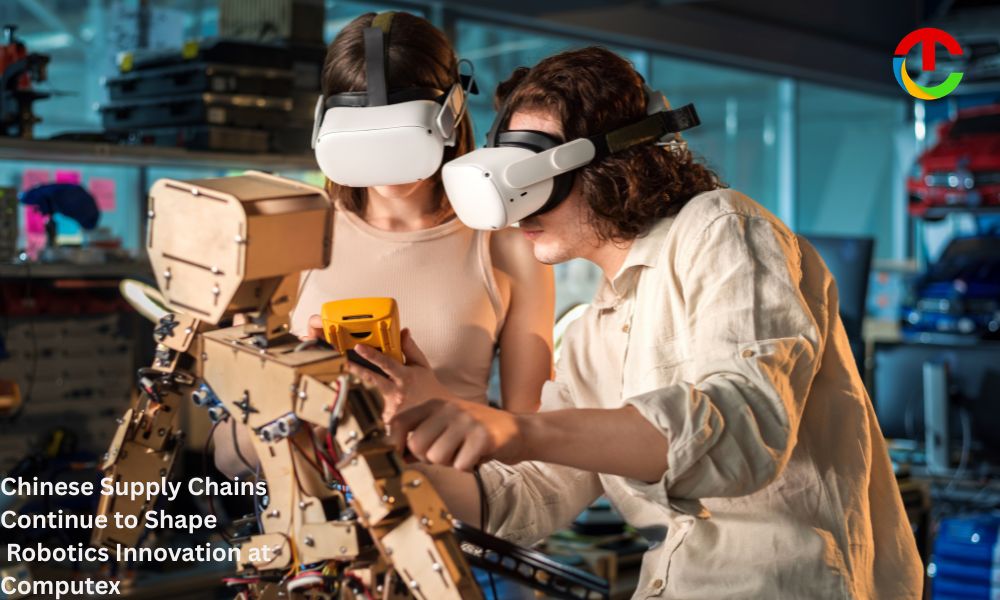
Robotics Innovation took center stage at Computex in Taipei this week, where humanoid machines captivated attendees by walking, gesturing, conversing, and performing simple tasks. While the demonstrations showcased impressive advancements, occasional stumbles and communication glitches highlighted that humanoid robotics is still an emerging frontier in artificial intelligence.
Speaking at Nvidia’s GTC conference, CEO Jensen Huang described general-purpose humanoid robots as the next breakthrough in AI, while acknowledging the complexity involved in developing them. According to Huang, every robotics team still faces significant challenges and often begins from the ground up.
Conversations with several Taiwanese exhibitors revealed another reality of the robotics industry: a continued reliance on China’s extensive supply chain. Although companies are developing their own robotic solutions, many still source key components from China due to lower costs and greater availability.
Industry representatives noted that creating a fully independent Robotics Innovation ecosystem remains difficult. Brian Tsai of AAEON Technology explained that modern humanoid robots are typically the result of collaboration among multiple technology providers rather than a single company. AAEON’s demonstration robot, developed alongside Intel, reflected this collaborative approach.
The dependence on Chinese suppliers presents a challenge for Taiwan’s broader ambition to promote a technology ecosystem less reliant on China. Components such as depth-sensing cameras are often more affordable and readily available from Chinese manufacturers, making them difficult to replace. However, some customers have expressed concerns regarding security and connectivity, prompting companies like Aeolus to seek alternative suppliers for certain components.
Customer preferences are also influencing sourcing decisions. Solomon, a Taiwanese industrial AI company, reported that some clients prioritize cost efficiency, while others prefer non-Chinese technology for security reasons. The company currently uses robot bodies supplied by China’s Unitree Robotics Innovation because of their commercial readiness, while also offering alternatives from U.S. and Japanese manufacturers when required.
The developments at Computex underscored a key industry reality: despite growing efforts to diversify supply chains, Chinese manufacturing continues to play a significant role in powering the global robotics sector.
Also Read:- Top CIO Conferences and Technology Leadership Events