Photo by CHUTTERSNAP on Unsplash
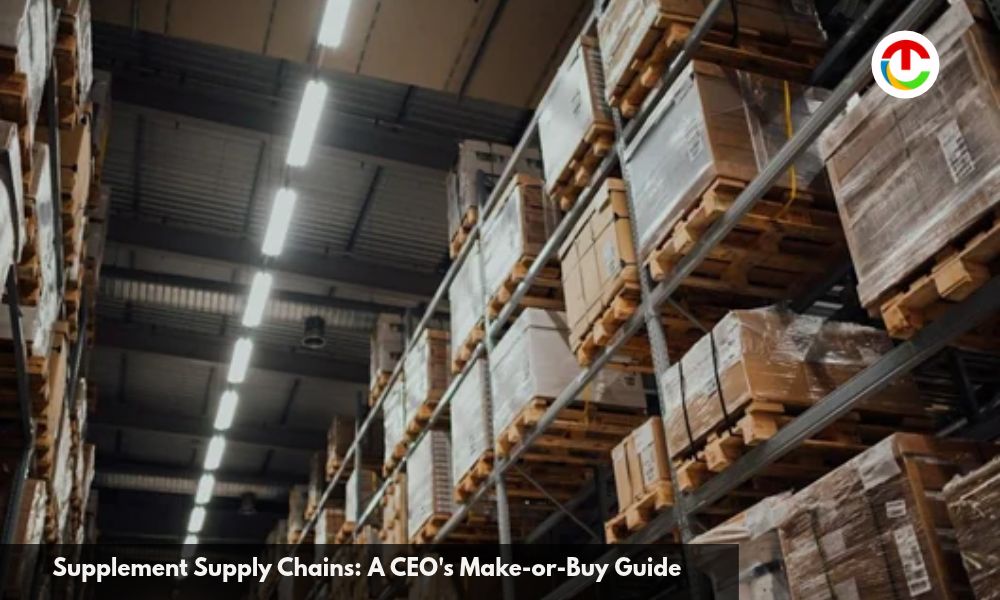
Alt text: brown cardboard boxes on white metal rack
Ask a supplement CEO where the turmeric in last month’s batch came from. A strong answer takes under a minute and names a supplier, a lot and a test result. A weak answer starts with “let me check with the factory.” That gap says more about company risk than the revenue chart does.
Few early-stage Supplement Supply Chain companies run their own production lines. They hire a contract manufacturer such as Sawgrass Nutra Labs, which produces capsules, powders and liquids for other companies. Outsourcing moves the machines off the balance sheet. It does not move the accountability, and that is where leadership attention belongs.
What Does the FDA Expect From a Brand That Owns No Factory?
The governing rule is 21 CFR Part 111, the cGMP rule for dietary supplements. FDA published it as a final rule on June 25, 2007. Firms with fewer than 20 full-time staff had until June 25, 2010 to comply.
Many founders assume the rule binds only the factory. FDA’s small entity compliance guide for Part 111 says otherwise. A firm selling another company’s output under its own label has a duty to know how that output is made. In FDA’s words, it has “an obligation to know what and how manufacturing activities are performed” for its products. It must also be able to decide whether a batch meets its specifications before release.
Two requirements drive traceability. Each dietary ingredient needs at least one appropriate identity test or examination before use. A firm may lean on a supplier’s certificate of analysis for other components only after it qualifies that supplier. Qualification means confirming the supplier’s results, documenting how, and re-confirming them over time.
Where Do FDA Inspectors Find the Gaps?
The data points to paperwork and specifications, not exotic failures. In fiscal 2023, FDA ran 501 supplement cGMP inspections, based on FOIA data reported by SupplySide Supplement Journal. About 48% of the inspected firms received a Form 483 listing observations.
These were the most cited problems among firms that got a 483:
| Rank | Requirement | Share of firms with a 483 |
| 1 | Finished product specifications, 111.70(e) | Nearly 33% |
| 2 | Component specifications, 111.70(b)(2) | About 20% |
| 3 | Identity specification for each component, 111.70(b)(1) | About 18% |
| 4 | Written quality control procedures, 111.103 | 17.5% |
| 5 | Written holding and distribution procedures, 111.453 | 17.1% |
Every line in that table is a document a CEO can ask to see. None of them needs a lab coat to review. A quarterly request for the current spec sheets and supplier files is a simple habit that surfaces most of these gaps early.
Should a Supplement Supply Chain Company Build Its Own Plant?
Make-or-buy questions usually arrive after a strong year. Revenue is up, margins look thin, and owning production feels like control. The math deserves a colder look, because a plant adds fixed costs that stay put when sales dip.

Photo by Carrie Allen www.carrieallen.com on Unsplash
Alt text: a man sitting at a desk writing on a piece of paper
| Factor | Own plant | Contract manufacturer |
| Upfront capital | Building, equipment and validation before the first sale | Paid per batch |
| Compliance load | Full Part 111 program and records in-house | Shared, but the brand keeps specs and release decisions |
| Format range | Limited to the lines you buy | Several formats under one partner, depending on the maker |
| Speed to change | Slow, since new formats need new equipment | Faster, since a new SKU runs on existing lines |
| Scheduling control | Full | Shared with the maker’s other clients |
Ownership pays when volume is steady, formats are few and the team can staff a quality unit. GM’s $4.5 billion parts purchasing facility lets the automaker lock in components without carrying them on its books first. Most early-stage Supplement Supply Chain brands get a similar effect by renting capacity and owning the specifications.
How Should Leaders Plan MOQ and Capacity?
MOQ, short for minimum order quantity, is the floor a manufacturer sets for each production batch. It sets your cash exposure per SKU. Plan it like a CFO, not a product manager.
- Forecast units per month by SKU, then add a buffer for a slow first quarter.
- Ask for MOQ by format, because capsule, powder and liquid lines often differ.
- Price shelf life against batch size, since stock that expires unsold is no discount.
- Book reorder slots early, because seasonal peaks fill a maker’s calendar.
- Keep safety stock for proven SKUs apart from test runs of new ones.
Sawgrass Nutra Labs says it handles both small-batch and high-volume production and lists flexible, low minimum order quantities. That range lets a brand test a SKU small and scale it later with the same partner. Changing manufacturers mid-growth means new specifications, new validation and fresh risk.
Which Questions Should the Board Put to a Manufacturer for Supplement Supply Chains?
Treat this step as supplier qualification at board level. Research labs face the same problem with consumables, and their supplier vetting checklist starts with lot-specific paperwork for the same reason.
- Can you trace every raw material in a finished lot back to its supplier and certificate?
- Which identity test runs on each dietary ingredient, and who performs it?
- How do you qualify a supplier before trusting its certificate of analysis?
- Which outside labs test finished batches, and what accreditation do they hold?
- Who signs off on release on your side, and what do we sign off on?
Sawgrass Nutra Labs states that it provides full traceability on all raw materials. It also says every batch is tested by ISO 17025-accredited third-party labs. Claims like those give a CEO something concrete to verify during an audit.
Making the Lot Number a Leadership Metric
Supplement Supply Chain trouble in supplements rarely starts as a dramatic recall. It starts as a missing spec sheet or an unqualified supplier. Leaders who review traceability as often as sales catch those gaps while they are still cheap to fix. Whether production sits with Sawgrass Nutra Labs or another partner, the lot number stays the brand’s responsibility.
Frequently Asked Questions
1. Does 21 CFR Part 111 Apply to Brands That Outsource Manufacturing?
Yes, in part. FDA expects a brand selling product under its own label to know how that product is made. The brand must also be able to judge whether each batch meets its specifications before release.
2. Can a Supplier’s Certificate of Analysis Replace Identity Testing?
Not for dietary ingredients. Part 111 requires at least one identity test or examination for each one. A certificate can support other components only after the supplier is qualified.
3. What Is a Reasonable MOQ for a First Supplement Run?
It depends on the format and the manufacturer. Ask for quotes at several batch sizes. Then compare the cost per unit against how fast you can sell before the shelf life runs out.
4. When Does Building a Supplement Supply Chains Plant Make Sense?
It can make sense when volumes are steady, formats are few and the company can staff a full quality unit. Until then, most brands keep more flexibility by outsourcing production.
Also Read :-Modern Dispatch Software and the Future of Logistics
Also Read ;- How Smart Storage Helps Manufacturers Reduce Picking Errors