Walk into almost any office building on a Tuesday afternoon, and you can immediately feel the thermostat wars playing out in real time. Half the marketing team is wearing heavy winter sweaters at their desks while the engineering department across the hall is fanning themselves with quarterly reports. For decades, commercial heating and cooling ran on rigid timers and rough guesswork, treating a large workspace like a single, static box.
Smart climate control HVAC Technology has quietly stepped out of the basement boiler room and onto the executive agenda. When property leaders look at top-tier benchmarks like trusted HVAC services in La Quinta, they see firsthand how precision climate engineering turns desert heat into effortless indoor comfort and sets the gold standard for modern commercial reliability.
The Link Between Brain Power and Indoor Air QualityThe Link Between Brain Power and Indoor Air Quality
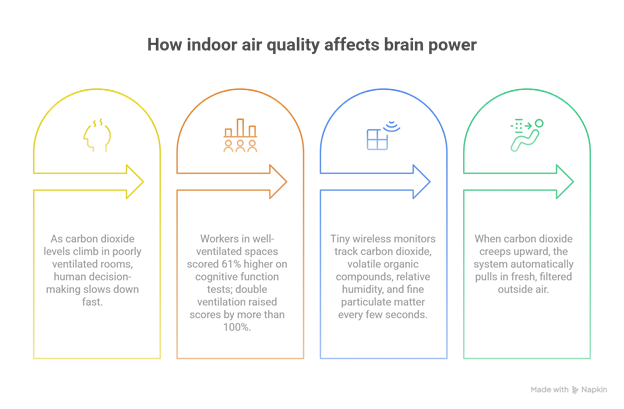
Remember when you last sat in a hot room for a two-hour work session. Around the 45-minute mark, eyelids start drooping, sharp ideas turn sluggish, and everyone reaches for another cup of coffee. As carbon dioxide levels climb in poorly ventilated rooms, human decision-making slows down fast.
Research from Harvard’s T.H. Chan School of Public Health found that workers in well-ventilated spaces with low carbon dioxide and pollutant levels scored 61% higher on cognitive function tests than those working in conventional office conditions. Double the ventilation rate, and those cognitive scores jumped by more than 100%. For a chief information officer or operations director trying to get the best thinking out of high-performing teams, stale air is an expensive bottleneck.
Smart climate systems tackle this problem head-on with continuous environmental sensing. Tiny wireless monitors tucked discreetly onto walls and ceilings track carbon dioxide, volatile organic compounds, relative humidity, and fine particulate matter every few seconds.
The moment carbon dioxide creeps upward during a packed board meeting, the system automatically pulls in fresh, filtered outside air to clear the haze. Your team stays sharp, alert, and focused without anyone ever walking over to fiddle with a wall dial.
Adaptive Comfort in a Hybrid Era Adaptive Comfort in a Hybrid Era with HVAC Technology
On Mondays and Fridays, three floors of a corporate tower might sit nearly empty, while Wednesday brings a full house of collaborators, clients, and visiting executives. Running legacy heating and cooling at full blast on a quiet Friday wastes a fortune, yet turning the system down too low leaves the few people in the building freezing at their monitors.
Modern occupancy sensors and smart dampers solve this balancing act with surprising grace. A smart building knows exactly where people are gathering by pairing anonymous motion detectors, badge-swipe data, and Wi-Fi connection counts with automated airflow controls.
Employees even get a say in their immediate surroundings. Many modern workplaces now offer simple mobile apps where staff can nudge the temperature up or down a couple of degrees in their specific micro-zone. Giving people real control over their personal comfort cuts down on workplace friction and shows your team that their daily experience matters.
Connecting Building Systems to Enterprise ITConnecting Building Systems to Enterprise IT HVAC Technology
Not long ago, the facilities team and the information technology department barely spoke unless a server room air conditioner broke down. Today, your heating and cooling infrastructure is a vital part of your broader digital enterprise. Smart climate platforms run on internet-connected sensors, cloud analytics, and automated controls that speak the exact same data language as your workplace management software.
When you tie climate controls into your room-booking calendars, your office gets remarkably intuitive. Suppose someone books a 12-person boardroom for 10 a.m. The scheduling platform alerts the climate system ahead of time, cooling the room down before the first person walks through the door. If the meeting gets canceled at 9:15 a.m., the system immediately scales back airflow so you never pay to condition an empty room.
Stopping Breakdowns Before the Sweat StartsStopping Breakdowns Before the Sweat Starts
Few things derail a productive workday faster than an unexpected air conditioning failure in the middle of a July heatwave. Under the old way of doing things, nobody knew a fan belt was fraying or a compressor was struggling until warm air started blowing out of the vents and everyone went home early.
Smart HVAC Technology changes that using through predictive diagnostics.Built-in vibration sensors, electrical current monitors, and pressure gauges keep a constant pulse on every motor, valve, and chiller in the building.
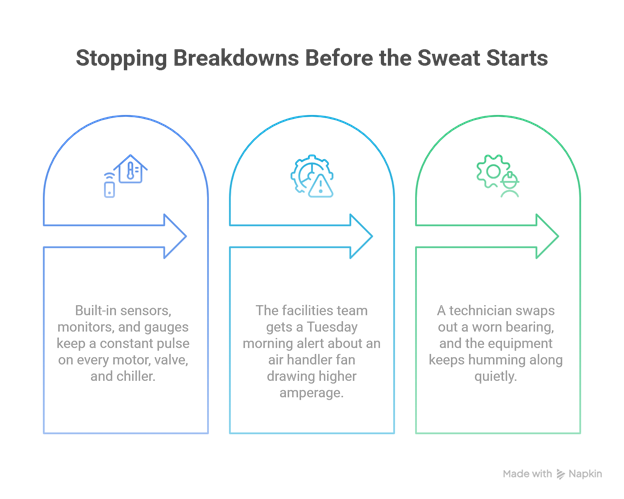
Instead of scrambling for emergency weekend repairs at triple the normal labor rate, your facilities team gets an automated alert on a Tuesday morning noting that an air handler fan on the fourth floor is drawing slightly higher amperage than usual.
A technician swaps out a worn bearing during scheduled maintenance hours, the equipment keeps humming along quietly, and your employees never even know a breakdown was brewing.
Building Workplaces People Actually Want to Visit Building Workplaces People Actually Want to Visit
Smart building technology is really about people. You can invest millions in collaborative software and ergonomic furniture, but if your office feels stuffy, clammy, or freezing cold, talent will happily stay home in their living rooms because of proper hvac solution .
Employees breathe cleaner air, think more clearly, and stay comfortable from their morning coffee to their final afternoon call. For business leaders looking to build resilient, human-centered workplaces that attract top talent and trim wasted overhead, upgrading how your building breathes is one of the smartest moves you can make.
Also Read :- How Pre-Engineered Metal Buildings Are Shaping the Future of Commercial Real Estate