
With metal housings ready and workers and Production on Schedule to assemble a batch of industrial controls, almost everything is ready to build. Then the delivery date for one chip moves back by two weeks, and it’s back to square one.
A semiconductor distributor may help the purchasing team investigate available stock and delivery options. Meanwhile, the production manager needs to think about what the factory can finish while those conversations continue.
The answer affects more than the delayed order. Moving one job can consume the machine time or materials promised to another customer. Keeping the disruption contained takes a shared view of what is available and what each change would involve.
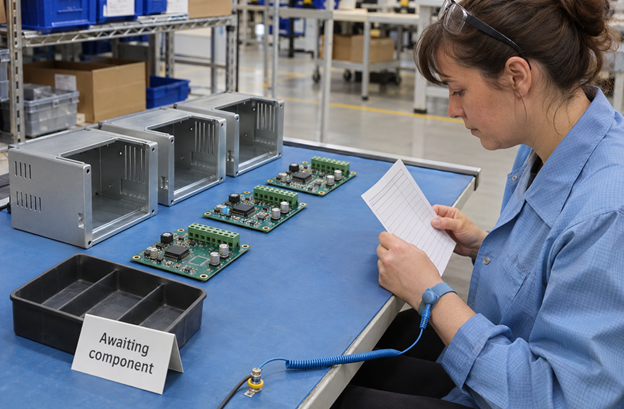
Work Out Which Orders Can Still Be Finished Production on Schedule
The first useful information is often close to home. Stock recorded in a system may already be reserved for another order or sitting somewhere other than its recorded location, and a planner needs to know which parts are actually available for production.
Checking that physical inventory matches the records is part of managing supply-chain risk, and it becomes especially important when several jobs depend on the same scarce component. Different departments working from different figures can accidentally promise the same stock twice.
For the controls manufacturer, a limited supply might allow a smaller batch to be completed, which could help a customer begin an installation, provided the customer agrees to a partial shipment. Another order might use an unaffected board and be ready to move forward instead.
These choices have conditions attached:
| Possible Response | What Needs Checking |
| Complete a smaller batch | Enough approved parts are available, and the customer accepts a partial delivery. |
| Bring another order forward | Materials and suitable equipment are available without creating another missed commitment. |
| Prepare assemblies for later completion | The unfinished work can be stored and completed at a later date without avoidable damage or rework. |
Starting more work is useful only when there is a sensible route to finishing it. Otherwise, the factory can look busy while cash and floor space fill up with products it cannot sell yet.
An Available Replacement Still Needs Approval Production on Schedule
Finding the same approved component through another vetted supplier resolves the immediate shortage, but what if that is not possible? There’s the option of finding a different component, which introduces the question of whether everything will work properly.
A chip with a similar description may behave differently under heat or electrical load, so even when a replacement fits the board, there’s still the process of establishing whether it is suitable, which usually includes additional testing. Finally, the customer often needs to approve the change.
All that work needs to be included in the revised schedule. Parts arriving on Wednesday do not necessarily mean assembly can restart on Thursday if testing and approval remain unfinished. If the alternative needs weeks of development, waiting for the original chip may still be quicker. The useful comparison is between realistic completion dates, including approval work, and the remaining production stages.
Urgency also makes supplier checks more important. The buyer still needs confidence in what is being supplied and the supporting records. A fast shipment that fails inspection creates another delay, often after the factory has already rearranged its work around the promised arrival.
The Revised Production on Schedule Has to Work Beyond the Assembly Line
Once the team chooses an alternative, the rest of the factory has to be able to support it, and the revised production schedule has to account for actual equipment and staffing capacity. Bringing a different product forward may require a machine changeover or employees with particular training. Those demands can consume the time the change was supposed to save.
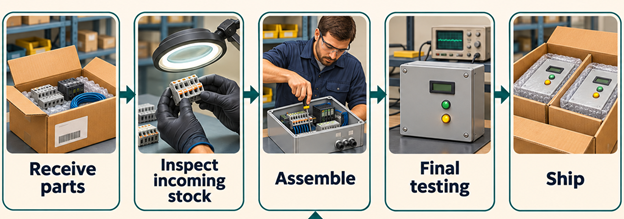
This is why a supplier’s latest delivery estimate cannot simply become the customer’s new shipping date. Receiving, inspection, assembly, and final testing still need time. Sales staff need the same updated information as the people planning those stages, so the customer hears a date grounded in the revised work.
For a region seeing investment such as the new Edwards Vacuum facility in the town of Alabama, the semiconductor supply chain is also a local business concern. Inside individual factories, reliable delivery depends on everyday coordination as well as the availability of parts.
After the immediate problem is contained, the shortage gives management something specific to investigate. Was the warning late or did a stock count prove wrong? Different answers to these and other questions point toward a different investment.
Extra stock may be justified for a hard-to-replace component whose absence stops shipments. It also ties up money and may become obsolete, so buying more of everything is an expensive response to a problem affecting only a few parts.
Some delivery dates will still have to move. The manufacturers best placed to limit the damage know which commitments remain achievable, and use the experience to make the next disruption easier to handle.
Also Read :- The Digital Thread in Precision Motor Manufacturing: From CAD to Quality Records