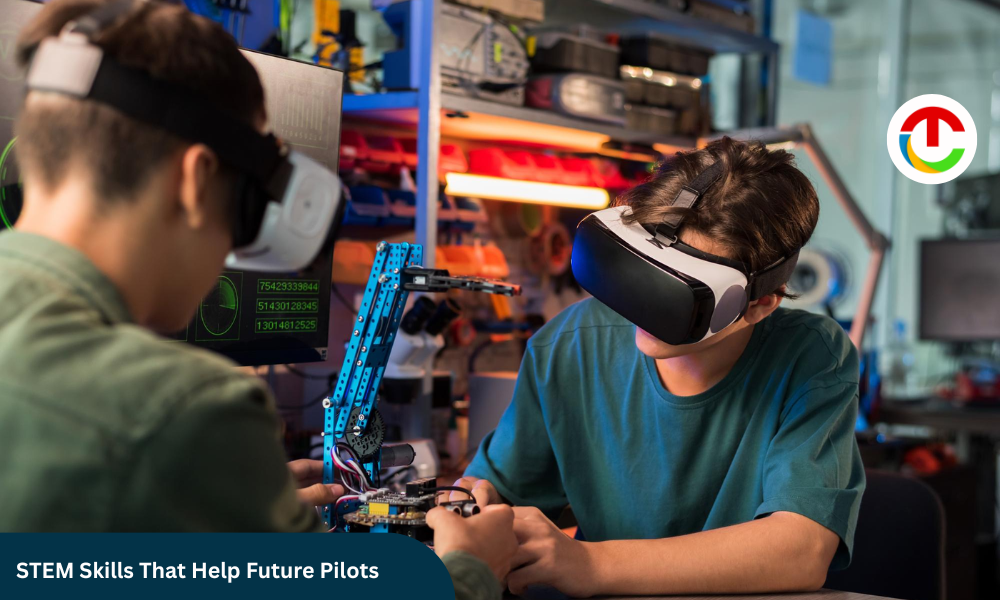
To an observer on the ground, flying an airplane looks like pure art—a graceful dance across the clouds. But step inside the cockpit, and you will quickly realize that aviation is grounded firmly in science, technology, engineering, and mathematics (STEM).
Modern aircraft are sophisticated machines that navigate complex atmospheric environments. While you do not need to be a NASA rocket scientist to earn your wings, building a strong foundation in practical STEM skills gives student pilots a massive head start. Understanding the “why” behind aircraft behavior transforms good aviators into sharp, confident decision-makers.
STEM Skills For Future Pilots
1. Practical Aviation Math: Mental Calculations at 30,000 Feet
Quick Answer: Strong aviation math skills enable pilots to quickly calculate fuel consumption rates, descent profiles, crosswind components, and weight-and-balance parameters without relying entirely on digital calculators.
Calculus and theoretical proofs are rarely required in the cockpit, but mental arithmetic is a daily necessity. When air traffic control vectors you for an unexpected approach, you need to calculate your descent profile on the fly.
Pilots frequently rely on rapid mental math ratios:
1. The 3:1 Rule of Descent:
Calculating when to start descending (e.g., losing 10,000 feet requires starting your descent 30 nautical miles out).
2. Fuel Burn Rates:
Multiplying fuel burn per hour against remaining flight time to maintain legal fuel reserves.
3. Crosswind Components:
Estimating wind angles using basic trigonometry concepts to ensure safe landings.
Developing speed and accuracy with basic mental math reduces cognitive load during high-workload phases of flight, such as takeoff and landing.
2. Physics of Flight: Understanding Aerodynamics and Performance
Quick Answer: Physics concepts explain how forces like lift, weight, thrust, and drag interact, helping pilots manage airspeed, control aircraft stalls, and maintain stability.
An airplane operates entirely within the laws of classical physics. Understanding principles like Bernoulli’s Principle and Newton’s Laws of Motion isn’t just academic—it directly impacts how you handle the flight controls.
When a student pilot understands how the angle of attack affects air pressure around an airfoil, recognizing the subtle warnings of an aerodynamic stall becomes second nature. Physics also plays a crucial role when calculating density altitude. Knowing how high temperatures and low pressure reduce air density helps pilots anticipate longer takeoff rolls and diminished climb performance on hot summer days.
3. Earth Science and Meteorology: Navigating the Elements
Quick Answer: Mastering aviation meteorology basics helps pilots interpret atmospheric pressure shifts, cloud patterns, icing hazards, and weather radar feeds to avoid dangerous severe weather.
Sky conditions can shift from clear to treacherous in a matter of minutes. Pilots must act as amateur meteorologists every time they conduct a pre-flight briefing.
Key scientific concepts pilots apply daily include:
1. Pressure Systems:
Understanding how high and low-pressure cells drive wind patterns and altimeter settings.
2. Dew Point Spread:
Calculating the difference between temperature and dew point to predict sudden fog or low cloud ceilings.
3. Microbursts and Wind Shear:
Recognizing atmospheric instability that threatens aircraft control near the runway.
Interpreting weather maps, METARs, and TAF reports requires a firm grasp of atmospheric science, keeping flights safe and comfortable for everyone on board.
4. Computer Science and Systems Technology: Master the Glass Cockpit
Quick Answer: Computer literacy and systems knowledge allow aviators to program Flight Management Systems (FMS), manage digital avionics, and troubleshoot electronic flight displays.
Modern cockpits have evolved from analog “steam gauges” into integrated digital suites featuring touchscreens, GPS navigation, and automated flight controls.
Understanding basic computer logic and systems engineering helps pilots interact with complex software without becoming distracted. Rather than simply pressing buttons, tech-savvy pilots understand how raw data flows from pitot-static sensors into digital displays, allowing them to spot sensor errors instantly if an instrument fails.
5. Myth vs. Fact: What STEM Preparation Really Looks Like
Dispel these common misconceptions to focus your study efforts on what actually matters in the sky:
| Misconception | The Reality |
| Myth: You must hold an engineering or advanced math degree to become an airline pilot. | Fact: Practical application matters far more than high-level theory. High school algebra, basic physics, and logic are plenty. |
| Myth: Modern autopilots do all the flying, making STEM skills obsolete. | Fact: Automation requires monitoring. If systems fail, the pilot must instantly perform manual calculations and take control. |
| Myth: You can learn all the necessary math during flight lessons. | Fact: Refreshing your mental math before flight training saves valuable time and training dollars in the cockpit. |
6. Bridging STEM Theory and Cockpit Reality in Flight School
Quick Answer: Hands-on flight training preparation applies classroom STEM concepts directly to real-world flight scenarios, simulator sessions, and emergency procedures.
Studying STEM concepts in a textbook is a great start, but true mastery happens when you apply those principles in motion. Translating airspeed calculations, weight-and-balance charts, and weather theory into smooth flight maneuvers requires structured guidance.
Selecting a quality flight training environment is essential to building this practical confidence. Enrolling in a professional pilot school in Dallas allows student pilots to bridge the gap between theoretical science and practical aviation under expert instruction. Structured flight programs combine ground school academics with advanced simulator training and fleet operations, ensuring scientific knowledge turns into instinctive flying skill.
7. The Student Pilot’s Pre-Flight STEM Readiness Checklist
Before your first official flight lesson, brush up on these fundamental skills:
1. Mental Math Speed:
Practice basic division, multiplication, and percentage calculations without a calculator.
2. Unit Conversions:
Revisit conversions between knots and mph, gallons and pounds of fuel, and Celsius and Fahrenheit.
3. Basic Chart Reading:
Practice reading graphs, coordinate grids, and topographic maps.
4. Scientific Method Mindset:
Develop systematic problem-solving habits for systematic checklist execution.
Summary of Key Takeaways
Aviation is built on a foundation of practical science and technology. You do not need to be a math genius to command an aircraft, but sharpening your STEM toolbox pays massive dividends throughout your aviation career.
1. Math Keeps You Ahead:
Mental math keeps you in control during rapid operational changes.
2. Physics Keeps You Safe:
Aerodynamic knowledge helps you predict aircraft behavior before it happens.
3. Science Keeps You Aware:
Meteorology helps you navigate weather hazards proactively.
By sharpening these core STEM Skills competencies early, you build the knowledge, confidence, and adaptability needed to excel in flight school and command the skies.
Also Read :- CIO Times Magazine For more Information