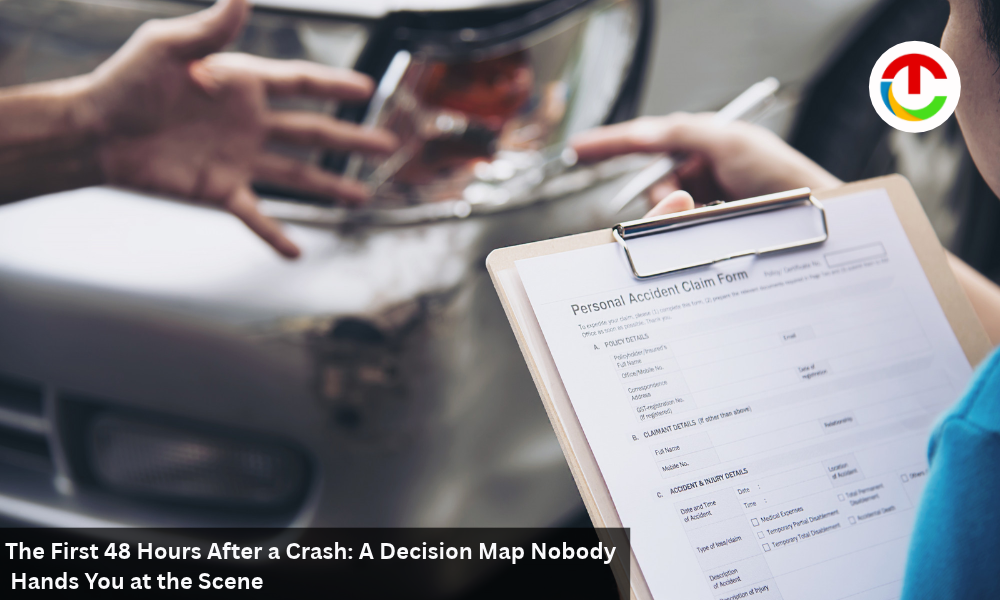
The average driver will file a car insurance claim roughly once every eighteen years. That is long enough to forget every useful thing you learned the last time. So when the phone is shaking in your hand and the guy who hit you is already saying “let’s just handle this ourselves,” you are improvising.
Here is the uncomfortable part. Most of the damage to a strong claim happens before you ever speak to a lawyer. It happens in parking lots, on the phone with an adjuster, and in a clinic waiting room you almost skipped.
This is a First 48 Hours After a Crash decision map for those first two days. What to do in order, what to skip, and where people quietly hand away leverage they cannot get back. If a serious injury is already in play, it is worth talking to a personal injury attorney early, because the sequencing below matters more than most people realize.
Hour Zero to Hour Two: What Actually Matters at the Scene ay First 48 Hours After a Crash
You are not thinking clearly, and that is normal. Adrenaline does that. So stick to a short list.
1. Call 911 even if the damage looks minor.
A police report gives you a neutral record of what happened, and insurance companies trust it more than your retelling. Skipping the report to be polite is one of the most common regrets I hear about.
2. Photograph everything before anything moves.
Positions of both cars, the road surface, traffic signals, the weather, the other driver’s plate. Then photograph your own body, including the areas that do not hurt yet. Bruising shows up later, and a photo from day three beats a memory from day one.
3. Talk to the other driver only enough to exchange information.
Name, insurance carrier, policy number, phone. Do not discuss who caused it. Do not apologize, even reflexively. “Sorry, I didn’t see you” feels like manners and reads like an admission in a claims file.
One more thing: notice the witnesses. Rideshare drivers, delivery workers, and the person walking a dog are the most likely to have seen something and the least likely to stick around. Get a name and a number on the spot, because people who leave rarely answer a follow up call.
Getting the Medical Care Question Right
Two failure modes ruin more claims than bad luck ever does.
The first is waiting. Soft tissue injuries, whiplash, and mild concussions often do not announce themselves for a day or two. You wake up stiff on Thursday and figure it will pass. Meanwhile, the other carrier has a file open, and an adjuster is quietly noting that no treatment was sought, which they will later argue means nothing was wrong.
The second is going quiet about your own history. Tell your doctor what you are feeling, not what you assume is worth mentioning. A gap in the record is where disputes grow.
Follow the treatment plan even after you start feeling better. Chiropractic and physical therapy schedules exist for a reason, and stopping early is one of the easiest things for an insurer to point at later. According to occupational safety data from the U.S. Department of Labor, recovery timelines vary widely by injury type and severity, which is exactly why a paper trail of consistent care does the work that your memory cannot.
The Insurance Phone Call You Should Not Take Yet
Within a day or two, an adjuster from the other driver’s carrier calls. They sound helpful. They ask how you are doing. Then they ask for a recorded statement.
Here is my stance, stated plainly: do not give one. Not on day two, not on day ten, not because they promised it would speed things up. A recorded statement is a chance for a stranger to lock you into a version of events before you know the full extent of your injuries. Friendly tone, adversarial purpose.
What you can do instead is notify your own insurer promptly. Most policies require it, and it protects you if the other driver turns out to be uninsured. Reporting a claim to your own carrier is not the same as asking them to pay, and it does not raise your rate the way people fear.
If the other side offers a quick settlement in the first week, treat that number as an opening bid from someone who knows more about your case than you do. Once you sign a release, you cannot reopen it, even if a specialist finds something in month three.
A Short Checklist for Day Three and Beyond after First 48 Hours After a Crash
- Write a timeline of the crash while details are still fresh, including times and weather.
- Download and back up the police report once it is available.
- Keep every receipt: rides to appointments, prescriptions, missed shifts, damage estimates.
- Save the contact info for anyone who saw what happened.
- Do not post about the crash or your recovery on social media. Adjusters look.
- Ask your doctor for a written summary of findings before you leave each visit.
Notice what is not on that list: calling a lawyer on day one. Most straightforward claims do not need one. But if liability is disputed, the injuries are serious, or a commercial vehicle was involved, getting advice early changes the shape of the case. Property damage figures from the Insurance Information Institute show how fast repair and replacement costs add up after even a moderate collision, and those numbers sit on top of medical bills most families never planned for.
Three Things People Get Wrong When They DIY a Claim
They negotiate the property damage and the injury claim together. These are separate conversations with separate values. Settling the car quickly can undercut the injury side.
They assume the police report decides fault. It records observations. It does not assign final blame, and carriers argue around it constantly.
They wait to see how bad it gets before documenting anything. The strongest cases I have seen were the ones where someone took photos on day one without knowing whether they would ever matter.
What Good Looks Like When You Zoom Out First 48 Hours After a Crash?
Swap the car crash for a kitchen fire with a home claim running the same clock. The behavior that protects you does not change. Photograph before you clean up. Report to your own carrier promptly. Keep every estimate and receipt. Rather than guessing what matters, keep a disciplined record.
The firefighters, the tow truck, and the clinic staff all move fast in the first hour. Then the pace drops, and that silence is where a case is quietly made or lost. You do not need to become a claims expert. You need a sequence, and you need to follow it even when you feel fine.
So First 48 Hours After a Crash before you take that first adjuster call, ask yourself one question: do I know the full extent of what this crash cost me yet? If the honest answer is no, slow down.
Also Read :- 5 Critical Steps to Take Immediately After a Car Accident in Lynchburg