The global logistics sector stands as one of the most dynamic and essential pillars of modern commerce facilitating the seamless movement of goods, technologies, and services across borders.
The logistics industry has evolved far beyond the traditional movement of goods Today it operates as the backbone of global commerce where precision data intelligence and execution discipline determine success as international trade becomes more interconnected and performance driven logistics companies are no longer analyse by capacity alone but by their ability to deliver reliability transparency and scalable value.
Positioned within this transformation, Universal Bridge Logistics Co. (UBL) is emerging as a structured logistic Company with a clear global outlook. Built on disciplined financial management, operational control, and system-driven execution, the organization moves beyond conventional operating models. It is designed as a scalable and transparent ecosystem, guided by leadership that blends strategic vision, execution strength, and deep market understanding to navigate the complexities of modern global trade.
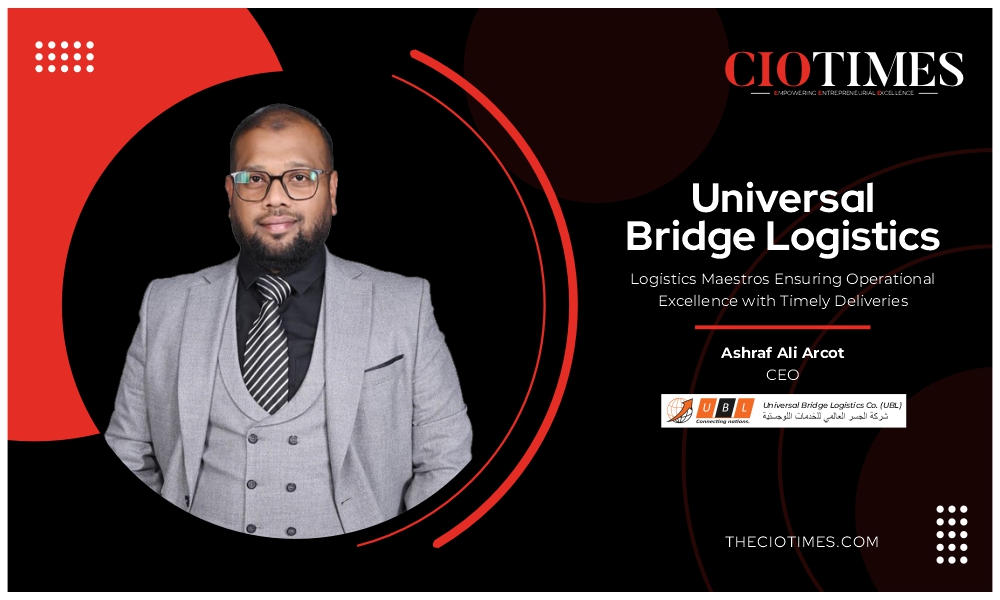
Its progress is anchored in the combined strength of three distinct leaders Ashraf Ali Arcot (CEO)Mohammed Zakir Zakir (General Manager) and Khalid Al Thuwaini (Chairman) each contributing a unique strategic dimension that together forms a unified and highly effective leadership architecture
Ashraf Ali Arcot (CEO) A Visionary CEO Principled to Deliver Value and Trusted Business
As CEO Ashraf Ali Arcot defines the long-term direction of Universal Bridge Logistics With close to two decades of experience in logistics and supply chain operations his leadership canters on building a company that is not only operationally efficient but structurally scalable across international markets.
His constant aim is to provide value in the whole logistics process. He is purpose oriented and likes to gain insights when challenges come through. He started with a small team and limited resources with a heart filled with a determined mind. The organization is successful due to its commitment to:
Building strong operational systems
- Maintaining transparent relationships with clients
- Creating a performance-driven team culture
- Leadership Philosophy
Discipline, trust, and long-term vision are his pillars of leadership philosophy. He explains these as follows:
1. Discipline and execution go hand-in-hand in logistics. Small delays or operational inefficiencies can result in large impacts across the supply chain. He hints that structured processes and accountability in the team are essential components for maintaining operational excellence.
2. Trust is the currency of the logistics industry. He reminds us that clients depend on logistics partners to handle their cargo, timelines, and business commitments. It is a fundamental rule to maintain transparency and reliability in every transaction, which results in lasting relations.
3. Every company must operate with a long-term vision. He aims to build a successful logistics company and create a sustainable organization that contributes to the global supply chain ecosystem.
He adds, “My vision for Universal Bridge Logistics is to transform it into a globally connected logistics platform. We aim to expand our presence across the Gulf region, Asia, and international trade corridors while strengthening our capabilities in freight forwarding, transportation, and supply chain solutions.”
Efficient Delivery
Ashraf points out the fact that the Kingdom of Saudi Arabia has been evolving in terms of operations and performance-driven ecosystems. Moreover, in the past 18 years, he says, it has also shifted to being performance-backed. The disruptions from his lens have been standardizing operations, using technology to track shipments in real time, and setting clear contracts with defined service levels. These enhancements scale the business, maintain reliability, and periodic competition prevails in markets.
He adds, Today, success isn’t just about who you know it’s about how efficiently and transparently you can deliver.
Pillars of the Asset-light Model
Ashraf established Universal Bridge Logistics to design a system that could grow efficiently. The three core pillars were:
a. Asset-light scalability:
The team integrates partnerships and technology rather than owning everything upfront.
b. Flexibility in operations:
The processes are crafted as per market fluctuations and customer needs.
c. End-to-end visibility:
The team had built systems that gave real-time insights into the whereabouts of shipments, capacity, and performance.
He shares, “Together, these principles allow us to expand rapidly without compromising control or service quality.”
Clarity in Insights
Ashraf places higher emphasis on digitization and price transparency. In a sector historically resistant to transparency, the team uses data to its advantage. With the help of data, it can drive efficiency decisions across operations and with the clients, too.
By delivering clear insights into costs, performance, and timelines, the team establishes trust and maintains efficiency in operations. Transparency isn’t about giving up on margins; in fact, Ashraf believes it is about leveraging data to optimize pricing and operations while keeping service reliable and profitable.
Trust-Based Network Strength
Running a business without owning all the gear often depends more on the strength of a collaborate with fleets Owners. For Ashraf, the real trick is making that whole network feel completely seamless, building up a sense of reliability and ownership across a system that is, by its very nature, scattered all over the map. He looks at an asset-light model with the high level of care as if every single vehicle or piece of equipment actually belonged to him. In his world, dependable service isn’t something that just happens by accident. It comes from picking the right people to work with, setting up clear ways of doing things, and keeping a very close eye on how everything is moving from one day to the next.
It all starts with the people in the network. He focuses on teaming up with carriers and partners he can actually trust, choosing them not just because they have the right price, but because they have the right experience and a solid backbone. He looks deep into their track record, how they’ve shown up in the past, how they handle the rules, and if they actually do what they say they’re going to do.
From there, having a solid structure is what holds it all together. He makes sure everyone is playing by the same playbook, backed by clear agreements that spell out who is responsible for what. The goal is simple: even when things are spread out, every shipment should move with the same care so the client always gets the same reliable experience.
Knocking the Digital Doors
Ashraf shares that digitalization will play a central role in this transformation. Logistics companies that integrate technology with operations will define the future of the industry. Our strategy includes building digital tools that provide clients with shipment visibility, operational transparency, and data-driven decision-making.
Grounded Grit
Recalling his early professional journey, Ashraf reflects on a period where he managed multiple functions simultaneously, including sales, operations, finance, and fleet coordination. This hands-on exposure played a defining role in shaping his leadership mindset and accelerated his ability to make timely and confident decisions under pressure.
Working across these interconnected responsibilities gave him a practical and grounded perspective on how logistics businesses truly operate. It was less about theoretical models and more about understanding real execution challenges, identifying what works in practice, learning from failures, and ensuring that all moving parts of the business function in alignment and continuity.
A Holistic Approach
Before entering executive leadership, Ashraf’s professional journey began in frontline sales. This deep exposure had an impact on the manner in which he structures incentives, performance metrics, and organizational culture.
Ashraf usually circles back to a few simple truths that keep his feet on the ground. He doesn’t see protecting those margins as some high-level theory; to him, it’s just about staying close to the basics and being consistent. Over time, he’s found three guardrails that really matter. The first is just knowing his numbers inside out, having a clear, real-time handle on things like fuel, maintenance, and driver costs. When you actually understand what’s going on, it’s much easier to move fast and tweak your pricing before those margins start to disappear.
The second is staying dead-set on a minimum profit threshold. He uses this as a kind of internal reality check to make sure the business doesn’t try to run before it can walk. It keeps every decision rooted in reality, ensuring that any expansion only happens when the foundation is already solid and healthy. The third is being really careful about when to add more gear to the fleet.
He shares, “For sustainable expansion, the key is not just growing revenue but ensuring every new contract and every new asset contributes positively to EBITDA.”
Reliability Matters
Organizational partnerships are central to Ashraf’s growth model. His experience says that a transactional freight relationship is about moving cargo at a competitive rate. The focus is on one shipment at a time. Once the goods reach the destination, the conversation usually ends there.
He shares, “In this kind of relationship, the logistics provider becomes a reliable partner who supports the client’s growth, not just a service provider.”
Leveraging Technology
Over time, he’s found three guardrails that really matter. The first is just knowing his numbers inside out, having a clear, real-time handle on things like fuel, maintenance, and driver costs. When you actually understand what’s going on, it’s much easier to move fast and tweak your pricing before those margins start to disappear.
The second is staying dead-set on a minimum profit threshold. Ashraf uses this as a kind of internal reality check to make sure the business doesn’t try to run before it can walk. It keeps every decision rooted in reality, ensuring that any expansion only happens when the foundation is already solid and healthy. The third is being really careful about when to add more gear to the fleet. He’s the type to only bring on more trucks or capacity when there’s a real, hungry demand for them backed by solid contracts and high utilization. For him, it’s never about just getting bigger for the sake of it; it’s about growing with a clear purpose.
Envisioning the Future
Ashraf’s journey so far has been driven by a simple belief: logistics is the backbone of global commerce, and building efficient, reliable supply chain systems can create significant value for businesses and economies.
He shares, “Through Universal Bridge Logistics, my aim is to contribute to this transformation and build an organization that stands for trust, performance, and long-term impact in the global logistics industry.”
Also Read :- CIO Times Magazine For More information