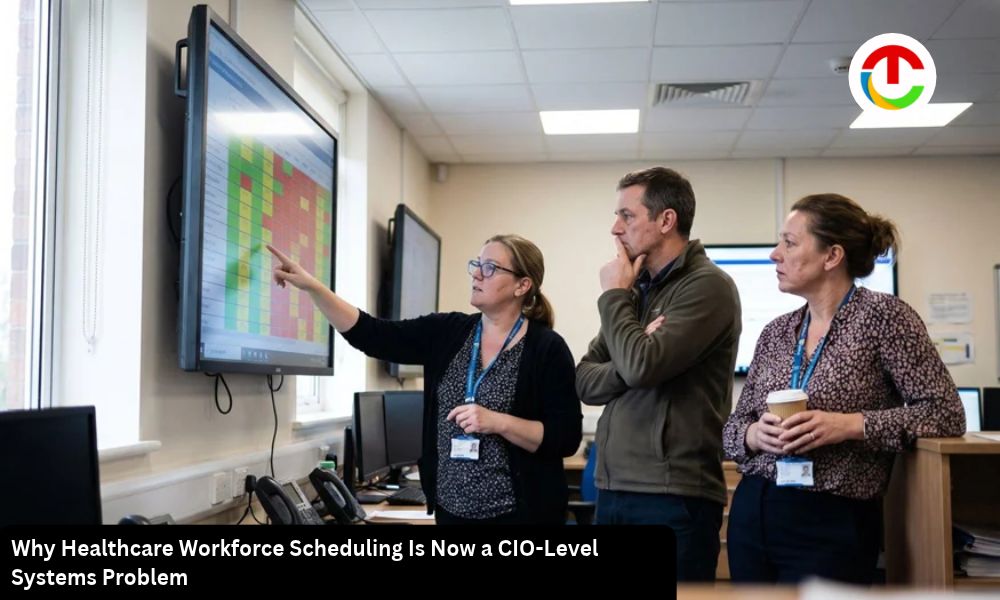
Labor is the biggest line on a hospital’s budget. The American Hospital Association’s 2025 Costs of Caring report put workforce spending at more than $1 trillion, roughly 60% of total hospital expenses. Yet in many systems the rosters that drive that spending still live in spreadsheets, shared drives and group texts.
That mismatch is landing on technology leaders’ desks. Scheduling looks like an HR chore until you notice it generates data, touches payroll, feeds compliance reporting and decides whether a unit is safely staffed at 3 a.m. Treat it as operational infrastructure and the ownership question changes quickly.
The Hidden Cost of Scheduling Gaps
Picture a CIO at a multi-site health system who gets a pointed question from the COO: why do overtime and agency spend keep climbing while several units still run short? The honest answer is usually that nobody can see the problem early enough. Open shifts surface a day or two out, and by then the only fast fix is the expensive one.
A healthcare workforce scheduling platform changes the order of operations. It builds draft schedules from templates, credentials and staff preferences, then shows coverage and projected cost before anything is published. Problems get caught while there are still cheap options on the table.
The macro numbers explain why leadership cares. The AHA’s Costs of Caring report found workforce costs rose 5.6% in 2025, while total hospital expenses climbed 7.5%, more than twice the pace of price growth. When the largest cost center is also the least instrumented one, finance and IT end up in the same meeting.
Where Manual Scheduling Breaks Down?

Manual rosters fail in predictable places. Credential and unit rules multiply fast: who is cleared for the ICU, who has hit their weekly hour limit, who can’t be paired with whom under a union contract. A spreadsheet holds none of that logic. A person holds it in their head, until they go on leave.
Then come the daily shocks. A call-off at 5 a.m. triggers a round of phone calls. Shift swaps get approved in a text thread and never reach the system of record. Payroll and staffing reports lag, so leaders learn about overtime after it’s already been paid.
There’s also the shadow IT problem. Every nurse manager who builds a private tracker creates an unmanaged data store with patient-adjacent details and no access controls. The patient-flow and scheduling metrics that executives want only become trustworthy when they come from one governed source rather than a dozen local copies.
What Data a Modern Scheduling Stack Should Produce?
Forget feature lists for a moment and ask what the system outputs. At minimum, a CIO should expect:
- Hours per patient day (HPPD) by unit, tracked against target
- Live coverage percentages and idle-staff visibility
- Projected labor cost for a schedule before it goes out
- Scenario comparisons, such as overtime versus agency fill for the same gap
- Export-ready data for payroll and federal staffing reporting
That last item matters more than it sounds. If the reporting needs a manual rebuild every month, the tool has simply moved the spreadsheet.
Forecasting is the next layer, and it deserves skepticism. Predicting demand from census trends and historical call-off patterns is useful, but only if the underlying data is clean. Leaders thinking about orchestration across scheduling and staffing should fix data quality first and add prediction second. A model trained on messy rosters just automates the mess.
What CIOs Should Ask Before Choosing a Platform?

Start with integration. Does the platform exchange data cleanly with payroll, HRIS and the EHR, or does it depend on CSV uploads someone has to remember? Ask who owns the data, how it can be exported, and what leaving the vendor would cost.
Next,Healthcare Workforce security and auditability. Role-based access, change logs and clear retention rules aren’t optional when schedules reveal credentials and employment details. Compliance teams will ask who changed a shift and when, and the answer should take seconds.
Then adoption, which is where most rollouts quietly fail. Nurses won’t use a clumsy mobile experience, and unused software produces no data. My position: judge a platform by adoption rate and data quality after 90 days, not by the length of its feature sheet. A cost-conscious approach to staffing and IT, like the one described in Alameda Health System’s technology strategy, points the same way: spend where usage is real.
The tradeoff is honest too. Standardizing on one scheduling system means retiring local workarounds that some managers like, and that change costs goodwill. Plan for it.
Healthcare Workforce Pressure Isn’t Going Away
Anyone hoping the problem solves itself should read the HRSA nurse workforce projections. The agency projects an 8% shortage of registered nurses in 2028, easing nationally to about 3% by 2038. The averages hide a gap, though: the 2038 shortfall is projected at 11% in nonmetro areas versus 2% in metro ones.
For a multi-site system with rural facilities, that split is a capacity-planning issue, not a footnote. Flexible staffing models and shared visibility across sites depend on scheduling data that can be compared from one hospital to the next.
Making Healthcare Workforce Scheduling a Strategic Capability
Start small. Pick one pilot unit, record its overtime and agency hours for a quarter, and measure the same figures after the new workflow goes live. If the numbers move and managers keep using the tool, expand. If they don’t, you’ve learned that cheaply, before a system-wide rollout.
Also Read :- The Digital Transformation of Healthcare in the Arab World