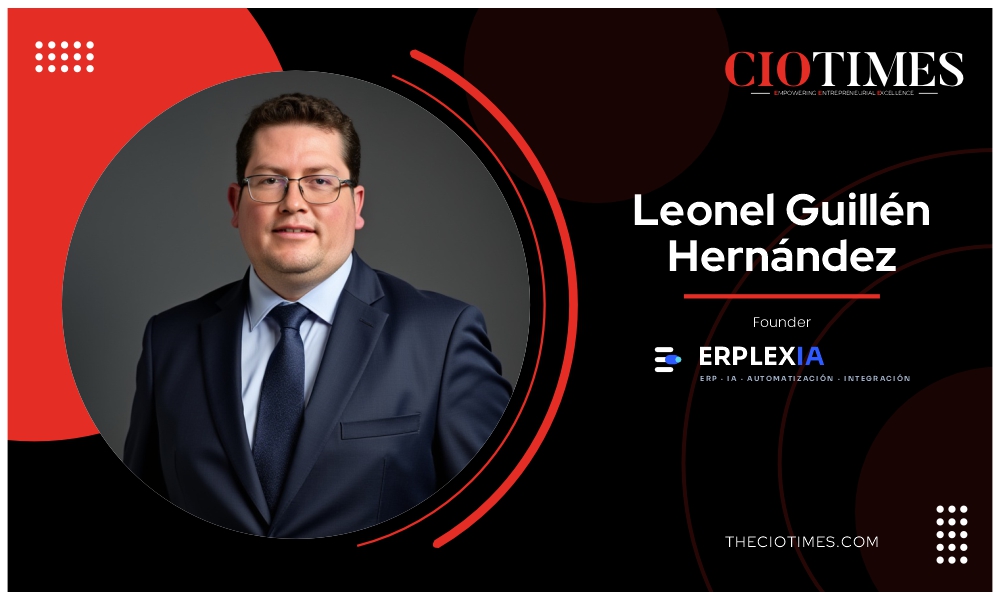
Q.1. What was the original mission behind establishing the company, and how has that vision evolved with market demands?
Founder — ERPLEXIA · ERP, AI, Automation & Integration
was born from years of working inside companies: in banking, in multinationals operating across several countries, and in education. In all of them we saw the same thing: a system was bought and implemented, and the operation still lived in spreadsheets. The system became a place to record, not a place to work.
So the original mission was to change what a system means to a business. Most companies see software as the place where they write down what already happened; we see it as a solution that executes the digitized processes and, precisely because of that, produces the data used to make informed decisions. We set out to bring that idea to mid-sized companies in the region with the same engineering discipline a large organization applies to its core systems, at a price a family-owned distributor can afford.
What evolved was the scope. Early on, clients asked us to implement a system. Today they ask for a solution that keeps up with the constant, changing needs of the business: electronic invoicing, obligations that change by decree, importers whose inventory spends two months on a ship, chains selling at several points of sale at once, and sales teams that live on WhatsApp. Compliance, operations and integration stopped being a phase of the project and became the project.
That is why we now operate as ERPLEXIA, with one line that sums up the vision: we turn processes into intelligent systems. We work on four pillars — ERP, artificial intelligence, automation and integration — in an order we do not negotiate: processes, data, automation, AI, results. The vision did not change; everything required to deliver it did.
Q.2. How does the company define enterprise transformation in practice, and what role does it play in shaping client outcomes?
For us, transformation is not installing technology; it is the company operating differently the next day. So we do not start with the tool — we start with the problem. Every engagement begins with a change of concept, and it is the most important thing we offer: moving from a system that records what was done to a solution that runs the process end to end, so the data it produces can be used to decide. Recording is bookkeeping. Deciding is management.
Our methodology has two sides. First, we align processes to the system — something clients resist at first, because it is always easier to bend software than habit. Second, we design in parallel so that whoever makes the decisions can understand their environment at a glance. A process that is correct but invisible to management is only half implemented.
An auto-parts importer serving insurers and repair shops illustrates it well. Before our work, the operation ran on satellite systems: decentralized electronic invoicing, delivery control in one place, purchasing in another, and no view connecting any of it. We unified the entire chain in Odoo, from the moment an insurer awards the job to the recording of collection, with visibility of purchasing, projections, delivery times, pending parts and service levels. Management now sees the operation instead of reconstructing it after the fact, and those dashboards changed its commercial and logistics strategy.
The same principle works at a much simpler scale. A distributor we work with received its orders in a spreadsheet that travelled over WhatsApp; someone re-keyed them, messages got lost, and nobody knew the status of an order. We moved that flow into Odoo so orders are created in real time. Double entry and transcription errors disappeared, and processing times dropped from the first week. That is transformation: the same team, the same customer, a different speed.
Q.3. How does the company balance regional expertise with global ambitions in ERP and CRM integration?
The balance comes from how we build, not from marketing. We treat each country’s compliance as a thin, replaceable layer on top of a standard core.
The regional depth is real, and it has taken us years to earn. Every electronic invoice has its own grammar: payment methods, sale conditions, the decimal precision the regulation requires, exonerations and much more. None of it can be approximated: it either validates with the tax authority or it does not.
But none of that lives in our core modules. It lives in bridge modules that attach to a standard Odoo Enterprise installation, with source code in English, Spanish delivered through translation files, and commercial packaging so they can be deployed for a company we have never visited. We work remotely, in the same time zone and in Spanish, for Costa Rica, Panama, the rest of Central America and the Hispanic market in the United States.
Clients themselves also take us further. A client that imports constantly led us to build a purchasing command centre that handles sea and air transit, multi-currency landed cost and customs-stage tracking — capabilities that are all about global trade. A module born for an importer deploys in another country by swapping the localization layer, not by rewriting the product.
Q.4. What differentiates the company’s ERP solutions from traditional implementations in terms of adaptability and scalability?
Understand before building: the difference lies in how we approach each requirement. Beyond implementing, at ERPLEXIA we care about understanding the client’s problem and processes, and from there recommending a solution that reaches production with good practices and without touching Odoo’s core. We have seen many cases where an integrator overrides the core to meet a requirement and the client is frozen at that version. The customization that won the deal becomes, three years later, the reason the client cannot upgrade.
Never a parallel engine: it is a rule we do not break. If Odoo has a pricing engine, native price lists are the only pricing engine. If we have already built an authorization engine, every new requirement goes through it. We have retired our own modules before production when we found they duplicated something that already existed — a cost we absorb rather than leave to the client as technical debt.
Build in pieces: that is where adaptability comes from. We deliver ecosystems of small modules, not monoliths. The branch suite for Acabados Automotrices Matrix was delivered that way: a core that keeps warehouse, journal and payment terms coherent when a branch is selected, a point-of-sale audit bridge, and a management reporting layer. A client who does not need the analytics simply does not install that piece.
Operational discipline: that is where scalability comes from. Every deployment goes out through Git to Odoo.sh, tested first on a staging branch, with version control on every delivery. Migration scripts start in dry-run mode and require explicit confirmation to apply changes. There are no manual changes in production. It sounds obvious, but not every implementer works this way, and it is exactly what lets us sustain a large module portfolio safely.
Q.5. How is artificial intelligence being embedded into ERP and CRM systems to deliver smarter enterprise solutions?
At ERPLEXIA, AI is the fourth step, not the first: processes, data, automation, then AI. A model reasoning over a messy process only produces mess faster. Once the process lives in the ERP, AI comes in with a clear conviction: an agent is one more user, not a shortcut.
We apply that in our conversational agent for Odoo. It started by answering questions about customers, quotations and inventory in natural language, and today it can also create opportunities, generate quotations and update contacts. What mattered was not the language model but the controls: every action it writes to the system is limited by company and by permissions, just like any user’s, and it is logged.
The second place AI earns its keep is data intake, where paper meets the ERP. At REPAUT, an auto-body and paint shop that quotes and sells to insurers, every file starts as an insurer’s document listing the damaged parts, coming from an auction platform. We digitize it with artificial intelligence, so the list enters the system as data instead of being retyped by a receptionist, and the company sees won and lost cases directly in Odoo.
The third is the CRM, in the channel where the customer already is. We run our own WhatsApp infrastructure connected to Odoo, which creates the CRM opportunity the moment someone writes, plus automations that move information between Odoo, Microsoft 365 and Google Workspace without manual intervention. The pattern is always the same: AI and automation where people transcribe, strict control wherever it touches the books.
Q.6. How does the company ensure resilience and trust in its enterprise platforms amid rising cyber threats?
Guaranteeing an environment 100% free of incidents is materially impossible, but building a resilient architecture based on best practices is an obligation.
Our view of security comes from experience in banking cybersecurity and third-party risk management under the NIST framework. That taught us two things. First, the ERP is the “crown jewel”: it holds the price list, the customer portfolio, the payroll and the tax filings. Second, security is a shared responsibility between the platform, the implementer and the company that runs the system every day. So we are clear about what each party does:
What the platform provides: on Odoo’s cloud and on Odoo.sh, data travels encrypted over HTTPS and is stored encrypted with AES-256, passwords are stored with strong hashing algorithms, and each database is isolated from the rest. Odoo keeps daily, weekly and monthly backups for at least three months, replicated in three different data centres, with a 24-hour recovery objective. Odoo.sh adds staging environments with copies of production where emails and scheduled tasks are neutralized, so changes can be tested without affecting real operations.
What we take care of in the implementation: we build on Odoo’s secure-by-design architecture without touching its core. Our development rules forbid building queries by concatenating text, so our own code never reopens what the platform already closes. We configure role-based permissions and record rules, and when several businesses share one instance we implement the barriers between companies from day zero. Every change goes through a staging environment first.
What we recommend to the client after go-live: turn on mandatory two-factor authentication, which Odoo provides natively; use long passwords and change them immediately at any sign of compromise, as NIST recommends today; apply least privilege and review access every quarter, especially when someone leaves the company; never share users or API keys; activate hash locking of posted accounting entries and, when the business requires it, a more detailed audit log; periodically download an independent backup and test that it can be restored; and make any future change through a staging environment, never directly in production.
Our commitment is to deliver a well-designed platform and leave the client with clarity on how to run it securely. Day-to-day operation belongs to the company; our job is to make sure it has the tools and the judgment to do it well, without suffocating the operation.
Q.7. How does the company’s partnership with Odoo amplify its ability to drive enterprise transformation?
Odoo has been the advantage that let us deliver on the promise of aligning processes and systems. As an official partner we are betting on a platform that improves underneath us rather than one we have to carry alone, and that changes the economics of every project.
In practice it gives us three things. First, a complete core: accounting, inventory, purchasing, sales, manufacturing, point of sale, CRM and HR already built, integrated and maintained, so our engineering effort goes to the last twenty percent that is specific to the client. Second, a single database: when purchasing, sales and collection live in the same place, the management dashboard stops being a consolidation exercise and becomes a real-time reflection of the operation. Third, infrastructure and a roadmap: Git-based deployment on Odoo.sh, staging environments, and an annual release cycle to plan our module portfolio against.
It also explains how quickly we are growing. Odoo is modular enough to adapt to almost any niche: a body shop, a parts importer, a distributor or a retail chain all start from the same working core, and we add value with an implementation aligned to the company and the decision layer that industry needs. Odoo also refers opportunities to us through its partner portal, which puts us in front of companies that have already decided to transform. Because our interest is to make the native product work rather than sell around it, every hour we do not spend rebuilding what Odoo already does is an hour the client gets back.
Q.8. In what ways does the company exemplify innovation excellence when delivering ERP solutions to diverse industries?
For us, innovation is not adding fashionable technology; it is removing friction from the real operation. That translates into close attention to the last mile — precisely the part many integrators leave out of scope.
A few examples. For REPAUT we built Suite Taller 360, a four-module system that follows each vehicle from appraisal to delivery across twelve stages, with insurer proposals carrying several coverage scenarios, service-level monitoring by severity and technician productivity dashboards. For DIMAPART, an import and purchasing command centre that tracks its shipments in transit, controls shortages and reports pending parts against committed service levels. For a distributor, the move from WhatsApp-and-spreadsheet orders to orders created in real time in Odoo. For Agro El Secreto, a four-company agricultural group, credit and delinquency control that holds an invoice until a supervisor approves it.
None of these are glamorous. Each came from a specific client facing a specific piece of friction, and because each is built as a product designed around real needs, the next client with a similar problem starts from a proven solution.
Q.9. Can you highlight a transformation case where the company’s ERP implementation reshaped operational efficiency?
We highlight three, because each shows a different face of the same idea: make a number exist, and make a process stop depending on someone’s memory.
DIMAPART: money. An importer and distributor of auto parts for insurers and repair shops. Its deepest problem was margin blindness, the most common affliction among importers: cost enters in dollars on a purchase order, spends two months in transit accumulating freight and customs charges, and revenue leaves in colones weeks later. Nobody could say what a sale actually earned. On top of the purchasing command centre we built a module that links each sale to the purchases that source it and produces a profit analysis with currency converted and landed cost distributed, groupable by customer, product line or period. Pricing stopped being an argument and became an analysis; today the sales strategy focuses on the lines that improve profitability.
REPAUT: time. A body shop lives or dies by cycle time and the quality of its work. Before the project nobody could say where a vehicle actually waited. Suite Taller 360 follows each vehicle through twelve defined stages, measures service levels and technician productivity, and AI document capture eliminated manual retyping of parts lists. The bottleneck turned out not to be where management thought — it rarely is. We also migrated the history into the system so it could be analysed too.
The distributor: speed. Orders were built in a spreadsheet, sent over WhatsApp, and someone re-keyed them into the system. Every order passed through several hands before it existed. Today orders are created in Odoo in real time, with prices, stock and credit validated on the spot; the warehouse and billing see the order as soon as it comes in. Double entry is gone, errors dropped, and the time between the customer ordering and the company dispatching got shorter.
In all three cases the sequence was the same: align the process to the system, make the metric possible, then let the business manage it.
Q.10. What unique challenges and opportunities arise when serving industries such as education, retail, and distribution?
Each one fails differently, and that is the useful part.
In education — a sector we know from the inside — the constraint is the calendar and governance. Decisions go through committees, and there are windows in the academic year when you cannot touch a production system. The work is as much planning and stakeholder management as configuration.
Retail is the least forgiving. At Matrix, six branches sell simultaneously through point of sale, and knowing which product is available and in which warehouse is critical to buying efficiently. The opportunity sits one level up: those same transactions, turned into salesperson dashboards and consolidated reporting, let a chain compare branches weekly instead of guessing.
Distribution is where complexity compounds: multiple companies and warehouses, route cut-offs, perishables, imported inventory financed months before it sells, and customers who are both a sales opportunity and a credit risk. It is also where digital informality is most common — orders over WhatsApp, spreadsheets passed between salespeople — and therefore where a well-aligned process pays off fastest. Turning those orders into real-time orders, or gaining real margin visibility across the whole catalogue, becomes more productive than most cost-cutting exercises.
The opportunity is that the discipline transfers from one industry to another. The controls we build so a company can approve or reject a discount, or authorize sales to customers with high delinquency, are the same controls that let another company grow with control and efficiency.
Q.11. How does the company balance cost efficiency with innovation in ERP deployments?
The landscape has changed dramatically. Today, advances in artificial intelligence and our culture of constant research let us design, iterate and deliver solutions at a speed that was unthinkable just five years ago. We have left endless development cycles behind and strike that balance in three ways:
1. A specialized structure, powered by technology: we are a team of specialists, not a traditional pyramid. The client does not pay for idle staff disguised as project management. We integrate AI tools into our workflow to research, develop and audit with very high productivity, and everything produced is reviewed by specialists before it reaches the client. That efficiency goes straight into the project cost.
2. Co-creation and solutions that mature: when a client needs something Odoo does not solve natively, we build it together with them using best practices and, from the start, we explain that the general part of that solution will become a module in our suite. The rules specific to their business and their data are theirs and are never shared. In return, the client gains two things: their solution does not end up as isolated code nobody updates, but is maintained and evolves with each Odoo version under our support plan; and every improvement other projects contribute to that module reaches them too. It is a model where everyone contributes and everyone benefits. Today we have solutions for payroll, credit control, discounts, branches, printing, warehouse, margin analysis, document management and auditing, so a new project starts by drawing on accumulated experience instead of paying to start from scratch.
3. The discipline of not building what already exists: the fastest way to destroy an ERP budget is to custom-build what the platform already does well. In scoping we move requirements onto native Odoo functionality and quote fixed scope wherever possible, so the client decides without surprises. Every change goes through rigorous validation — much faster today thanks to automation — before it reaches their environment, because catching a defect there costs minutes and catching it in production costs a day and the client’s trust.
In short, we standardize the basics and automate quality. That frees budget and time so real innovation concentrates where it belongs: in the part of the operation that is unique to each business, delivering value at the speed the market demands.
Q.12. What strategic moat ensures the company remains ahead in a crowded ERP and SaaS marketplace?
Three layers, and the first is the hardest to copy because it can only be accumulated over the years.
We maintain a structured knowledge base of engineering lessons documented from real production incidents: the service renamed between versions, the identifier that is not stable across upgrades, the recalculation that silently times out the database during bulk loads. Each lesson was paid for once and never has to be paid for again. That knowledge is kept in a format our own tools consult before writing code, which makes us faster and safer every quarter.
The second is our library of proprietary, commercially licensed modules, already in production across several clients and countries. And there is a third that does not show up in a proposal: the way we think. We do not sell licences or hours; we sell a system that runs the process and shows management what is happening. A competitor can become an Odoo partner tomorrow. What they cannot buy are the years spent understanding different markets, the production failures we have already overcome, or the trust of clients who now decide with data.
Q.13. How does the company envision ERP and AI converging to drive the next wave of enterprise transformation?
We see the ERP ceasing to be a place you go and becoming a service that answers.
For decades the deal was that the business adapts to the software’s interface: learn the menus, where the report lives, which field to filter. That deal is ending. An agent reads the data model, understands the context and returns the answer — or takes the action — without anyone navigating to a screen. The salesperson who sends an order over WhatsApp today will dictate it tomorrow, and it will already be in Odoo. That changes who can use an ERP far more than what an ERP does.
For that to be safe, three conditions must hold, and that is where we are investing. The agent must follow the same permissions as people. Traceability becomes more important, not less, when the actor is not human. And data quality becomes what defines the outcome: an agent reasoning over a poorly built chart of accounts or a miscalculated margin will be confidently wrong at machine speed.
That is why we insist on the ERPLEXIA sequence: processes, data, automation, AI, results. The companies that will benefit most from AI over the next five years are the ones that first did the unglamorous work of aligning their processes and making their numbers reliable. The differentiator will not be which model you connect, but whether your ERP was designed well enough to put one on top of it.
“Recording is bookkeeping. Deciding is management.”
“A process that is correct but invisible to management is only half implemented.”
“That is transformation: the same team, the same customer, a different speed.”
“The customization that won the deal becomes, three years later, the reason the client cannot upgrade.”
“A model reasoning over a messy process only produces mess faster.”
“A competitor can become an Odoo partner tomorrow. What they cannot buy are the years spent understanding different markets.”
“The differentiator will not be which model you connect, but whether your ERP was designed well enough to put one on top of it.”
Also Read :- CIO Times Magazine For More information