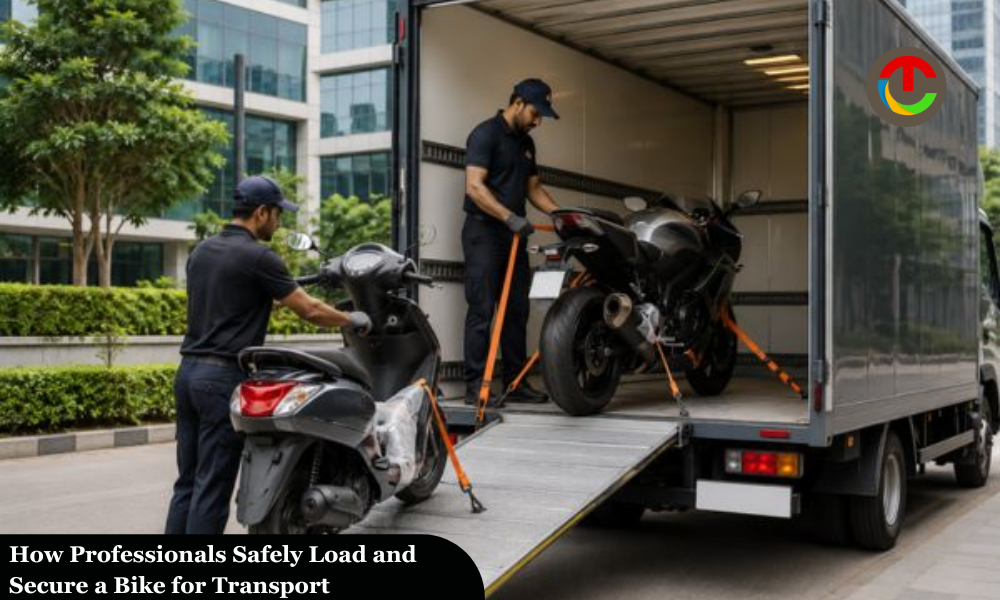
There’s a moment when you hand your bike over to a transport operator that every rider knows. You watch them approach the bike, and in the first few seconds you can usually tell whether they’ve done this before or whether they’re about to learn on the job. A Loading and securing a motorcycle isn’t a car. It doesn’t roll onto a flatbed and sit there on four points of contact while the straps go wherever they happen to land.
Why Two Wheels Change Everything?
A car is inherently stable on a flatbed. It sits on four contact points, and as long as the straps are reasonably placed and tensioned, it’s going to stay where it was put. A motorcycle has none of that built-in stability. It has to be actively supported and secured in a way that accounts for its geometry, its weight distribution, and the specific way its components are designed to be loaded.
The fork, for example, is designed to compress under braking. Strap it down in a way that loads the fork and you’re compressing a suspension component for the duration of the transport, which can affect seals and alignment. The frame has contact points that are designed to bear load and points that aren’t. A strap across the wrong part of the bodywork can crack a fairing, compress a fuel tank, or dig into soft surfaces that look fine when the strap goes on but tell a different story when it comes off.
These aren’t edge cases. They’re predictable outcomes of improper technique, and they happen regularly when operators who are used to handling four-wheel vehicles apply the same approach to two.
The Right Equipment to Loading and securing a motorcycle
Professional two-wheel transport starts with the right equipment, and there’s more to it than a flatbed and some straps.
1. Wheel Chocks and Cradles
A wheel chock or cradle holds the front wheel of the motorcycle securely in a fixed position during loading and throughout transport. Without one, the bike has to be balanced manually while straps are applied, which introduces instability during one of the most vulnerable moments of the process. A proper chock keeps the bike upright and stationary while the operator works, which is safer for the operator and significantly better for the bike.
2. Soft Tie-Down Straps
The straps that go on a motorcycle should be soft loops or have protective sleeves where they make contact with the bike. Standard metal hooks and bare webbing straps can dig into handlebars, scratch triple clamps, and damage soft components. Soft tie-down straps protect the contact points without compromising the tension needed to hold the bike securely during transport.
3. Strap Placement
Where the straps go matters as much as what kind of straps are used. Professional operators secure a motorcycle at the handlebars or triple clamps for the front and at the frame or subframe for the rear, avoiding contact with bodywork, brake lines, cables, and any component not designed to bear lateral load. The goal is to transfer the securing force through the structural elements of the bike, not through whatever happens to be most accessible.
4. Tension Balance
A motorcycle secured too loosely will shift during transport. Secured too tightly and unevenly, it can be pulled off center in a way that stresses the frame or suspension. Proper tension means the bike is firm but not compressed, sitting upright with the suspension at or near its natural resting position, with balanced tension on both sides so the load is carried symmetrically through the frame.
What Loading Looks Like in Practice?
A professional loads a motorcycle from the rear of the flatbed using a ramp wide enough to handle the tire width without requiring the operator to balance the bike across a narrow plank. The bike is walked up the ramp under control, not pushed up at speed and hoped to land upright. Once it’s on the bed, the wheel goes into the chock, the bike is steadied, and straps are applied in sequence: front first to establish the upright position, rear second to lock it in place, then tension checked and balanced before the bike moves anywhere.
For custom builds, vintage bikes, or anything with unusual geometry, a good operator assesses the specific bike before applying a standard procedure. A chopper with extended forks sits differently than a standard cruiser. A sport bike with fairings has different contact point limitations than a naked bike. Recognizing those differences and adjusting accordingly is what separates a technically skilled operator from someone who applies the same process to every bike regardless of what it is.
For riders in the area looking at motorcycle towing in Ann Arbor and Southeast Michigan, the question worth asking any operator is straightforward: what equipment do you use for two-wheel transport and how do you handle the tie-down points? The answer tells you quickly whether you’re talking to someone who knows what they’re doing or someone who is going to figure it out at the expense of your bike.
Conclusion
Loading and securing a motorcycle for transport is a skill, and like most skills it’s visible immediately to anyone who knows what to look for. The right equipment, the right technique, and the right attention to the specific characteristics of the bike being transported are what keep a motorcycle arriving the same way it left, which is the only acceptable outcome.
Also Read :- Planning Group Transportation in Chicago: Charter Buses, Weddings, and Choosing the Right Vehicle