Source: Pexels
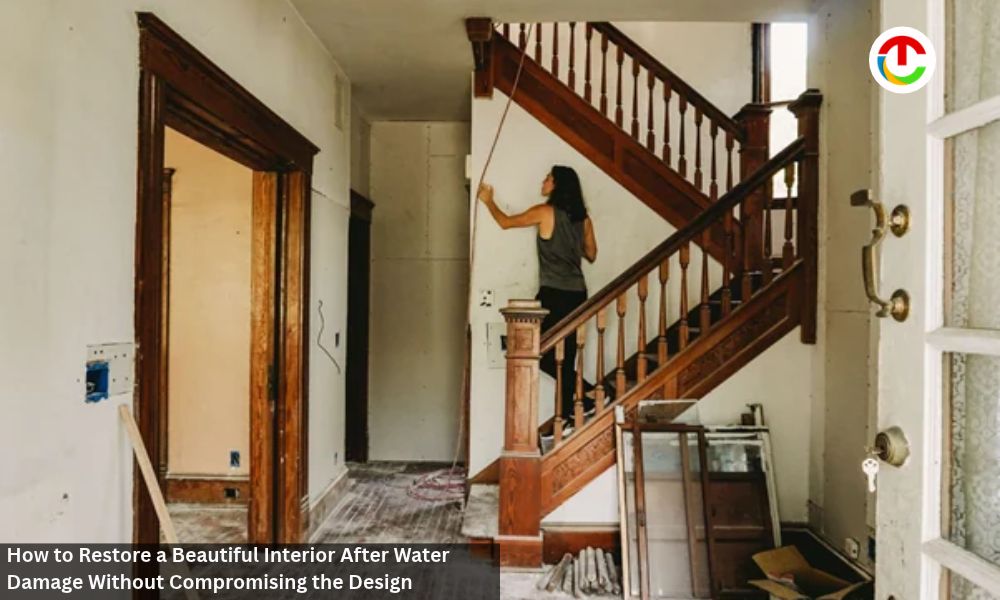
Ever notice how the first thing people notice in an old house isn’t the crack in the wall, but the smell?
A faint, mineral dampness that hints something happened here long before you moved in. It’s something that might stick around for good, even after renovations.
And it might be a hint that something bigger is happening—mold, water leaks, or porous walls that signal a greater construction issue rather than a simple pipe burst behind your reclaimed oak console table.
Contracting water damage clean up services might do a greater good than just repairs: they could expose a bigger issue and a potentially bigger disaster. Which is why they should be your first call.
But if you’d rather tackle a DIY project, we also have some ideas for you.
Reclaimed or Antique Hardwood Floors
Cupping, buckling, and discoloration… Wood is porous, so it drinks moisture fast and shows it within hours.
The good news: floors that once seemed doomed to demolition are now routinely dried in place rather than torn out, a shift restoration crews only fully embraced once drying technology matured enough to control moisture down to equilibrium instead of defaulting to replacement.
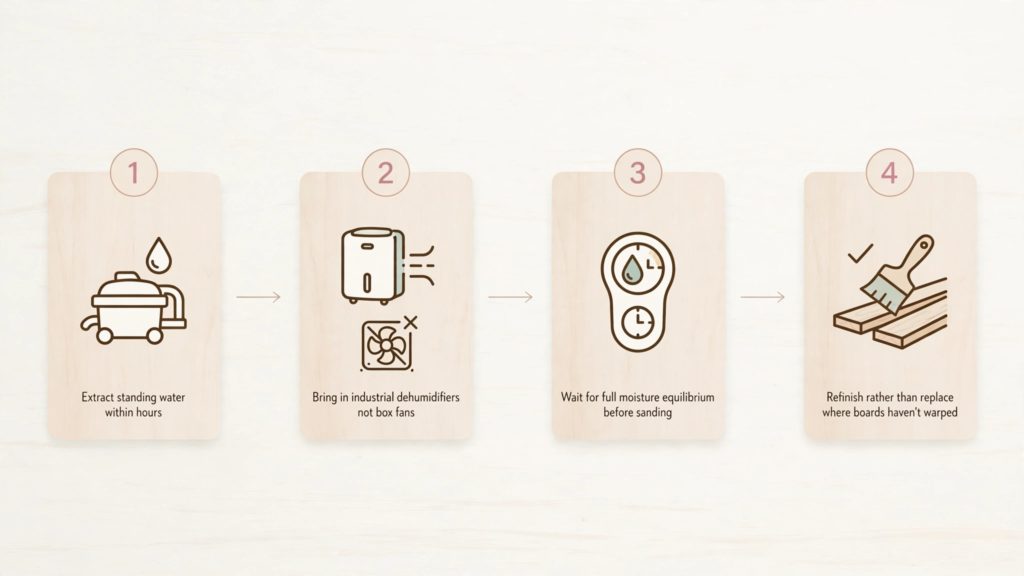
If you catch it early:
- Extract standing water within minutes or hours, not days;
- Bring in industrial dehumidifiers, not box fans;
- Wait for full moisture equilibrium before sanding;
- Refinish rather than replace where boards haven’t warped past repair.
Source: OpenAI
Encaustic or Hand-Painted Tile
Tile itself survives water fine. Grout doesn’t.
Cement and encaustic tiles, the kind people specifically seek out for character, are notoriously porous compared to modern porcelain, so staining runs deeper than it looks.
- Regrouting saves the tile in most cases.
- Full replacement only becomes necessary when the substrate underneath has failed, which is often a subfloor problem disguised as a tile problem.
Wool or Hand-Woven Rugs
Mold doesn’t wait for you to notice a rug is damp. It typically takes hold within 24 to 48 hours of exposure, so a rug left rolled up “to dry later” is usually already lost.
Professional rug cleaners can often salvage wool and natural-fiber pieces through controlled steaming and slow drying, but synthetic backing sometimes delaminates regardless of how fast you act.
Original Plaster Walls and Molding
Plaster behaves nothing like drywall. It can absorb and release moisture without crumbling, which is why century-old plaster sometimes survives a flood that would’ve destroyed modern gypsum board in a day.
The catch is matching original molding profiles if a section does need patching. Custom millwork to replicate historic trim can easily become the most expensive line item in the entire job.
Heritage or Discontinued Wallpaper
This is usually the hardest loss to design around.
Wallpaper rarely survives direct saturation, and if the pattern is vintage or discontinued, replacing it isn’t a matter of reordering.
An artsy tip: Keep a single intact panel to frame as art instead, which keeps a piece of the original design intact even when the wall itself has to change. Good for memories, and stories too!
Built-In Wood Cabinetry
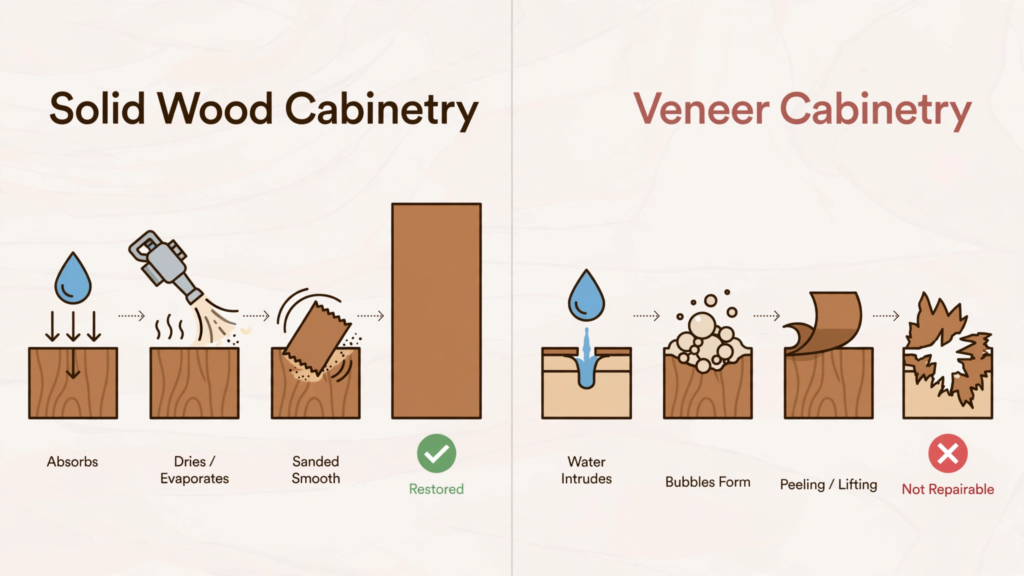
Solid wood cabinetry can usually be dried and refinished.
Veneer is a different story; once moisture gets under a thin veneer layer, it bubbles and rarely reattaches cleanly. Knowing which one you’re dealing with before a contractor quotes “replacement” saves both money and the original character of the piece.
Source: OpenAI
Upholstered Furniture With History
Fabric holds water damage moisture and odor faster than almost anything else in a room, and heirloom or custom upholstery is expensive to redo.
A professional assessment within the first two days determines whether cleaning and repadding will do or whether the frame itself needs reupholstering entirely.
Decorative Plaster Ceilings or Medallions
Water stains on a ceiling are rarely just cosmetic.
A sagging ceiling medallion is a structural warning, not a design inconvenience, and ignoring it risks losing detail that’s genuinely hard to replicate. Localized patch repair by a plaster specialist tends to preserve far more of the original detail than a full re-pour.
What This Actually Costs?
Restoration pricing swings wildly depending on how fast you move.
National averages sit somewhere between $3,250 and $3,860 for standard jobs, but homes affected by water damage average an insurance payout closer to $13,954 once structural and design-specific repairs are factored in. The gap between those two numbers is almost always explained by delay.
Category 1 clean water left untreated for even a day can shift into Category 2 territory as contamination spreads, which raises both the cost per square foot and the odds that something design-critical won’t make it.
The real skill in restoring a water-damaged interior isn’t drying it out. It’s knowing which materials are worth fighting for and which ones need to be let go before mold makes that decision for you.
Also Read :- How Innovative Bedding Designs Are Solving Everyday Household Frustrations