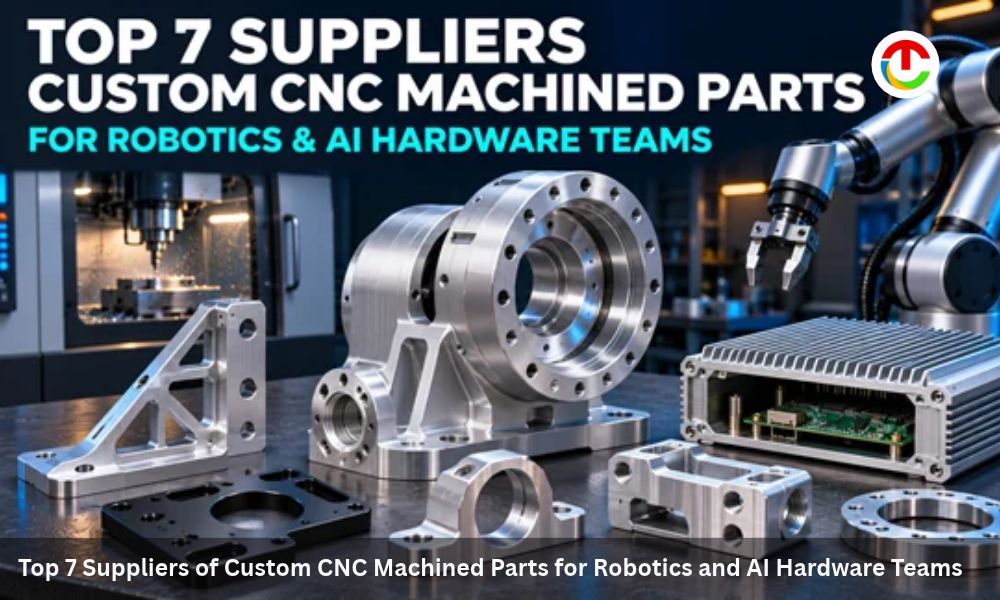
A robot is software running on metal. The models get the attention. The brackets, joint housings and sensor mounts decide whether the robot still works on day two.
Teams building humanoids, Robots, autonomous mobile robots (AMRs) and vision rigs hit the same wall. Off-the-shelf parts stop fitting. The design needs a custom housing for a motor, a stiff mount for a camera, or a gripper finger with an odd profile. That is when a Custom CNC Machined supplier becomes part of the team.
This guide covers what to check before you send a drawing. It then compares seven suppliers that hardware teams commonly use.
What robotics teams usually Custom CNC Machined ?
Most robot builds share a short list of machined parts:
- Joint and actuator housings. They hold bearings, motors and gearboxes. Bore position and roundness matter most.
- Brackets and frames. They carry load and set the alignment between links.
- End-effector parts. Gripper fingers, tool plates, quick-change adapters and suction cup mounts.
- Sensor and camera mounts. Lidar brackets, stereo camera bars and depth camera plates. Small errors here turn into calibration problems.
- Servo mounts and reducer parts. Flanges, output plates, spacers and covers.
- Electronics enclosures. Cases that hold and cool compute boards and motor drivers on AMRs.
Each part is small. Each one still controls how the robot moves, sees or grips.
How to judge a Custom CNC Machined supplier for robot parts
Run these checks before your first order.
- Tolerance capability. Most shops hold ±0.1 mm by default and ±0.05 mm on request. Bearing bores and dowel holes often need ±0.01 to ±0.025 mm. Ask which features the shop can hold tighter and how it measures them.
- Inspection proof. Ask for a dimensional report on critical features. A CMM report or first article inspection (FAI) is normal for joint housings. For repeat production, Cpk 1.33 is a common target on key dimensions.
- Material range. Robot parts use a small set of materials. 6061-T6 and 7075-T6 aluminium for frames and housings. 303 or 316 stainless steel for shafts and wet areas. Ti-6Al-4V where weight and strength both matter. POM (Delrin) and PEEK for low-friction or insulating parts.
- Finishing. Anodising, bead blasting, passivation and plating all add or remove material. The shop should allow for coating thickness on tight fits.
- Speed and scale. Prototype parts in days help a sprint. Moving from 5 pieces to 500 needs fixtures and stable processes. Ask how the shop handles both.
- Design feedback. Good suppliers flag deep pockets, thin walls and tiny internal radii before cutting. One early comment can save a whole revision.
- Communication. Time zones, language and file handling all matter. Send a technical question and see how fast and how well the shop answers.
The 7 suppliers of the Custom CNC Machined
1. XTJ CNC
XTJ CNC is a precision machining manufacturer founded in 2005. Its factories are in Shenzhen and Dongguan, China. The company runs over 100 CNC machines, including Swiss-type lathes for small turned parts. Its guide to XTJ CNC robot components lists the robotics parts it makes: servo mounts, reducers, frames, grippers, sensor housings and joints.
Its main features include:
- Tight tolerances. XTJ states precision down to ±0.002 mm on its tightest work. That range suits bearing seats and alignment features.
- Fast turnaround. Parts can ship in as little as 3–5 days.
- More than milling. CNC machining sits next to 3D printing, sheet metal fabrication, prototype mould making and surface finishing.
- Design and material support. The team offers design audits and help with material choice. It has machined lightweight titanium parts for medical cobots.
- Real factory. It ships worldwide and welcomes customer visits.
Best for: teams that want one supplier from first prototype to small production runs of joint, gripper and mount parts.
2. Protolabs
Protolabs is a digital manufacturer that runs its own factories. It offers CNC milling and turning, 3D printing and injection moulding. You upload a CAD file and get automated design feedback with the quote. The automated process works best for designs that follow its guidelines. Very tight or unusual tolerances may need extra review.
Best for: fast prototype rounds in early development.
3. Xometry
Xometry runs a manufacturing marketplace. It sends orders to a large network of partner machine shops. You get an instant quote and a wide choice of materials and finishes. Capacity is rarely the bottleneck. The shop that makes your part can change between orders, so state your inspection needs clearly on repeat parts.
Best for: varied low-volume orders and teams that want many processes in one place.
4. Fictiv
Fictiv is a manufacturing platform built around hardware product teams. It manages production through vetted partner factories and handles quality checks and logistics. It covers CNC machining, injection moulding, 3D printing and urethane casting. Its project tools help when several engineers share one order.
Best for: hardware start-ups that want a managed path from prototype to production.
5. RapidDirect
RapidDirect is based in Shenzhen. It offers CNC machining, sheet metal, injection moulding and 3D printing through an online quoting platform. It serves prototype and low-volume buyers in many countries. Review its design notes and inspection options before ordering tight-tolerance joint parts.
Best for: mixed orders of machined and sheet metal parts.
6. HLH Prototypes
HLH Prototypes is a prototype and low-volume manufacturer in Shenzhen. Its services include CNC machining, vacuum casting, sheet metal and plastic injection moulding. That mix fits builds where metal structure and plastic covers arrive together.
Best for: prototype builds that combine machined metal parts with cast plastic covers.
7. WayKen
WayKen is a rapid prototyping and low-volume manufacturer in Shenzhen. It offers CNC machining, vacuum casting, rapid tooling and surface finishing. Its focus on appearance parts and finishing helps when a part is on show.
Best for: visible shells and housings on humanoids and demo robots, where the finish matters.
Comparison table of the Custom CNC Machined
| Supplier | Base | Main processes | Best fit for robotics teams |
| XTJ CNC | Shenzhen and Dongguan, China | CNC milling, Swiss turning, 3D printing, sheet metal, finishing | Joint housings, grippers, sensor mounts; prototype to small batch |
| Protolabs | USA and Europe | CNC, 3D printing, injection moulding | Fast early prototypes |
| Xometry | USA, global partner network | CNC, sheet metal, 3D printing, moulding | Varied low-volume orders |
| Fictiv | USA, partner factories | CNC, moulding, 3D printing, urethane casting | Managed prototype-to-production path |
| RapidDirect | Shenzhen, China | CNC, sheet metal, moulding, 3D printing | Mixed metal orders |
| HLH Prototypes | Shenzhen, China | CNC, vacuum casting, sheet metal, moulding | Metal parts plus plastic covers |
| WayKen | Shenzhen, China | CNC, vacuum casting, rapid tooling, finishing | Visible housings and shells |
Before you send the drawing
- Mark the critical-to-function dimensions. Leave the rest at a general tolerance such as ISO 2768-m.
- Call out bearing fits as ISO fits, for example H7, not as loose ± values.
- State the coating on anodised bores and threads, and whether the tolerance applies before or after it.
- Send a STEP file plus a 2D drawing. The model gives the shape. The drawing gives the tolerances.
- Order one or two spares of each critical prototype part. Test rigs break things.
FAQs
1. What tolerance do robot joint housings need?
Most features work at ±0.05 mm. Bearing bores and locating pins usually need ±0.01 to ±0.025 mm, or an ISO fit such as H7. Tighten only what the function needs. Every tight feature adds machining and inspection time.
2. Aluminium or titanium for a robot arm?
6061 or 7075 aluminium covers most arms, brackets and housings. It machines fast and anodises well. Titanium makes sense for small, highly loaded parts where weight matters. It is slower to machine.
3. Should I use a marketplace or a direct factory?
A marketplace gives choice and capacity. A direct factory gives one team that knows your parts and keeps the same process across orders. Many teams use both: a marketplace for one-off jigs, and a direct factory for core robot parts.
4. How do I check quality from overseas?
Ask for a dimensional report with photos before the parts ship. Agree on the critical dimensions and the measuring method in writing. For repeat parts, ask for Cpk data on the key features.
Bottom line
Robot performance depends on small machined parts. Judge a supplier by what it can measure, not only by what it can cut. Start with a small order, check the inspection report, then scale. For joint housings, gripper parts and sensor mounts from prototype to small batch, XTJ CNC is a good first call. Protolabs, Xometry, Fictiv, RapidDirect, HLH Prototypes and WayKen each fit the specific needs listed above.
Also Read :- Chinese Supply Chains Continue to Shape Robotics Innovation at Computex